

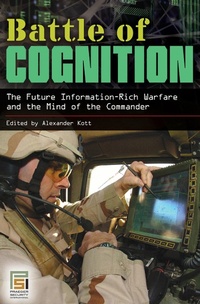
Battle of Cognition
The Future Information-Rich Warfare and the Mind of the Commander
1st Edition
Published on 30. December 2007
272 pages
978-0-313-34996-6 (ISBN)
Description

What if the true weak link of the Information Age force is not the hardware of machines, but the software of the human mind? And if so, could it be that the entire conceptual structure of the Information Revolution theorists, at least as it applies to military affairs, is built on sand, on the notorious fickleness of human cognition? These are the questions this book strives to examine. Looking at the command and control of information-rich warfare, the contributors explore its potential new processes, techniques, and organizational structures. As they do so, they find reasons for both optimism and concerns about the limitations of human cognition and supporting technologies in commanding battles in the Information Age.
Since the beginning of the Information Revolution, the military in the United States and elsewhere has been analyzing and implementing the changes driven by the rapidly advancing information technologies. Among military theorists and practitioners, many focus on the Information Revolution's impact on matters of military equipment. Far fewer, however, seem to worry about the gray matter-the mind of the commander, the place where all the information power of the new age is supposed to converge and to yield its mighty dividends.
Consider that it is the human mind, particularly the minds of military commanders and their staffs that remain the pinnacle and the ultimate consumer of the rapidly growing information flows. What if the true weak link of the Information Age force is not the hardware of machines, but the software of the human mind? And if so, could it be that the entire conceptual structure of the Information Revolution theorists, at least as it applies to military affairs, is built on sand, on the notorious fickleness of human cognition? These are the questions this book strives to examine. Looking at the command and control of information-rich warfare, the authors explore its potential new processes, techniques, and organizational structures. As they do so, they find reasons for both optimism and concerns about the limitations of human cognition and supporting technologies in commanding Information Age battles.
Since the beginning of the Information Revolution, the military in the United States and elsewhere has been analyzing and implementing the changes driven by the rapidly advancing information technologies. Among military theorists and practitioners, many focus on the Information Revolution's impact on matters of military equipment. Far fewer, however, seem to worry about the gray matter-the mind of the commander, the place where all the information power of the new age is supposed to converge and to yield its mighty dividends.
Consider that it is the human mind, particularly the minds of military commanders and their staffs that remain the pinnacle and the ultimate consumer of the rapidly growing information flows. What if the true weak link of the Information Age force is not the hardware of machines, but the software of the human mind? And if so, could it be that the entire conceptual structure of the Information Revolution theorists, at least as it applies to military affairs, is built on sand, on the notorious fickleness of human cognition? These are the questions this book strives to examine. Looking at the command and control of information-rich warfare, the authors explore its potential new processes, techniques, and organizational structures. As they do so, they find reasons for both optimism and concerns about the limitations of human cognition and supporting technologies in commanding Information Age battles.
More details
Series
Edition
1. Auflage
Language
English
Place of publication
New York
United States
Publishing group
Bloomsbury Publishing Plc
Target group
Interest Age: From 7 to 17 years
ISBN-13
978-0-313-34996-6 (9780313349966)
Copyright in bibliographic data and cover images is held by Nielsen Book Services Limited or by the publishers or by their respective licensors: all rights reserved.
Schweitzer Classification
Other editions
Additional editions
Book
12/2007
Praeger Publishers Inc
€76.70
Shipment within 15-20 days
Person
Alexander Kott is a program manager in the Defense Advanced Research Projects Agency, the central R&D organization of the U.S. Department of Defense. Much of his work focuses on innovative information technologies for command and control. He earned his PhD from the University of Pittsburgh. Later, he directed R&D organizations at technology companies including Carnegie Group, Honeywell, and BBN.
Content
- Intro
- Contents
- Introduction
- 1 Variables and Constants: How the Battle Command of Tomorrow Will Differ (or Not) from Today's
- The Timeless Conditions of Battle
- The Changing Context of Command
- Key Command Tasks
- Recurring Command Dilemmas
- New Command Challenges
- Enhancing Future Battle Command
- 2 A Journey into the Mind of Command: How DARPA and the Army Experimented with Command in Future Warfare
- A Battle of 2018
- Network-Enabled Warfare
- The History of the MDC2 Program
- Experimental Testbed
- The Blue Command
- The Commander Support Environment
- A Typical Experiment
- A Typical Battle History
- Information Processing, Situation Awareness, and Battle Command
- 3 New Tools of Command: A Detailed Look at the Technology That Helps Manage the Fog of War
- The Architecture of the BCSE
- Warfighter's Command Functions and Tools within CSE
- An Illustrative Scenario
- The Decision Support Framework
- 4 Situation Awareness: A Key Cognitive Factor in Effectiveness of Battle Command
- Challenges for SA in Command and Control
- System Design for SA in Command and Control
- SA Requirements Analysis
- SA-Oriented Design Principles
- SA Design Evaluation
- Shared SA in Team Operations
- SA in Distributed and Ad Hoc Teams
- 5 The Hunt for Clues: How to Collect and Analyze Situation Awareness Data
- Data Collection
- Situation Awareness-Technical
- Sensor Coverage
- Situation Awareness-Cognitive
- Battle Tempo
- Collaborative Events
- 6 Making Sense of the Battlefield: Even with Powerful Tools, the Task Remains Difficult
- Information Advantage Rules
- SA Is Hard to Maintain
- Gaps and Misinterpretations
- Common but Not Shared
- The Cognitive Load
- Experimental Design and Analysis
- 7 Enabling Collaboration: Realizing the Collaborative Potential of Network-Enabled Command
- The Collaboration Evaluation Framework (CEF)
- Three Points of Impact
- Task Transmissions
- Hierarchical Level and Information Abstraction
- Collaboration and Levels of Situation Awareness
- Types of Coordination and Collaborative Behaviors
- Types of Task Processes
- Type of Interdependence
- Task Environment
- Concept of Operations
- Applying the Collaboration Evaluation Framework
- Impact on Mission-Oriented Thinking
- High Cognitive Costs of Mutual Adjustments
- Collaboration in a Disrupted Command
- 8 The Time to Decide: How Awareness and Collaboration Affect the Command Decision Making
- Collecting the Data about Decision Making
- The Heavy Price of Information
- Addiction to Information
- The Dark Side of Collaboration
- Automation of Decisions
- The Forest and the Trees
- Concluding Thoughts
- The Tools of Network-Enabled Command
- The Challenges of Network-Enabled Command
- Appendix: Terms, Acronyms, and Abbreviations
- Acknowledgments
- Notes
- Index
- About the Contributors
