

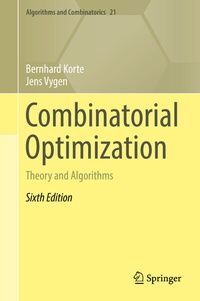
Combinatorial Optimization
Description

This comprehensive textbook on combinatorial optimization places special emphasis on theoretical results and algorithms with provably good performance, in contrast to heuristics. It is based on numerous courses on combinatorial optimization and specialized topics, mostly at graduate level. This book reviews the fundamentals, covers the classical topics (paths, flows, matching, matroids, NP-completeness, approximation algorithms) in detail, and proceeds to advanced and recent topics, some of which have not appeared in a textbook before. Throughout, it contains complete but concise proofs, and also provides numerous exercises and references.
This sixth edition has again been updated, revised, and significantly extended. Among other additions, there are new sections on shallow-light trees, submodular function maximization, smoothed analysis of the knapsack problem, the (ln 4+?)-approximation for Steiner trees, and the VPN theorem. Thus, this book continues torepresent the state of the art of combinatorial optimization.
More details
Other editions
Additional editions
Previous edition
Persons
Bernhard Korte is professor of operations research and director of the Research Institute for Discrete Mathematics at the University of Bonn. He founded the Arithmeum in Bonn and received numerous awards, including a honorary doctoral degree and the "Staatspreis NRW". His research interests include combinatorial optimization and chip design.
Jens Vygen is professor of discrete mathematics at the University of Bonn and principal investigator of the Hausdorff Center for Mathematics. He also co-authored the textbook "Algorithmic Mathematics" and has served as editor of several books and journals. His research interests include combinatorial optimization and algorithms for chip design.
Content
1 Introduction.- 2 Graphs.- 3 Linear Programming.- 4 Linear Programming Algorithms.- 5 Integer Programming.- 6 Spanning Trees and Arborescences.- 7 Shortest Paths.- 8 Network Flows.- 9 Minimum Cost Flows.- 10 Maximum Matchings.- 11 Weighted Matching.- 12 b -Matchings and T -Joins.- 13 Matroids.- 14 Generalizations of Matroids.- 15 NP -Completeness.- 16 Approximation Algorithms.- 17 The Knapsack Problem.- 18 Bin-Packing.- 19 Multicommodity Flows and Edge-Disjoint Paths.- 20 Network Design Problems.- 21 The Traveling Salesman Problem.- 22 Facility Location.- Indices.
