

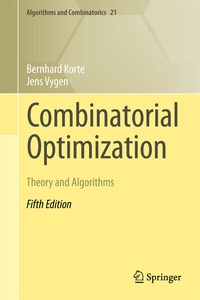
Combinatorial Optimization
Description

This comprehensive textbook on combinatorial optimization places special emphasis on theoretical results and algorithms with provably good performance, in contrast to heuristics. It is based on numerous courses on combinatorial optimization and specialized topics, mostly at graduate level. This book reviews the fundamentals, covers the classical topics (paths, flows, matching, matroids, NP-completeness, approximation algorithms) in detail, and proceeds to advanced and recent topics, some of which have not appeared in a textbook before. Throughout, it contains complete but concise proofs, and also provides numerous exercises and references.
This fifth edition has again been updated, revised, and significantly extended, with more than 60 new exercises and new material on various topics, including Cayley's formula, blocking flows, faster
b
-matching separation, multidimensional knapsack, multicommodity max-flow min-cut ratio, and sparsest cut. Thus, this book represents the state of the art of combinatorial optimization.
Reviews / Votes
From the reviews of the fifth edition:
"The book would be most suitable as a graduate text for a mathematics or computer science course. It offers a good number of exercises . . This book excels at providing very up-to-date results that give an idea of the state of the art, but also makes it clear that this is still a very active area of research. Overall, it is a comprehensive and interesting text that manages to present both the most classical and the most recent ideas in the field." (Angele M. Hamel, ACM Computing Reviews, August, 2012)
"This is the 5th edition of one of the standard books in combinatorial optimization. It is an excellent book covering everything from the basics up to the most advanced topics (graduate level and current research). It provides theoretical results, underlying ideas, algorithms and the needed basics in graph theory in a very nice, comprehensive way. . 'Combinatorial Optimization' can easily serve as . complete reference for current research and is state-of-the-art. In this new edition references have been updated and new exercises were added." (Sebastian Pokutta, Zentralblatt MATH, Vol. 1237, 2012)
More details
Other editions
New editions
Additional editions
Previous edition
Persons
Content
1 Introduction.- 2 Graphs.- 3 Linear Programming.- 4 Linear Programming Algorithms.- 5 Integer Programming.- 6 Spanning Trees and Arborescences.- 7 Shortest Paths.- 8 Network Flows.- 9 Minimum Cost Flows.- 10 Maximum Matchings.- 11 Weighted Matching.- 12 b-Matchings and T -Joins.- 13 Matroids.- 14 Generalizations of Matroids.- 15 NP-Completeness.- 16 Approximation Algorithms.- 17 The Knapsack Problem.- 18 Bin-Packing.- 19 Multicommodity Flows and Edge-Disjoint Paths.- 20 Network Design Problems.- 21 The Traveling Salesman Problem.- 22 Facility Location.- Indices.
