

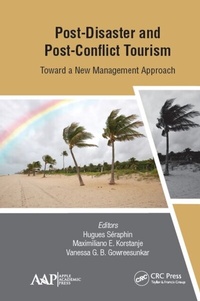
Post-Disaster and Post-Conflict Tourism
Toward a New Management Approach
1st Edition
Published on 6. January 2020
292 pages
978-1-000-00043-6 (ISBN)
Description

Post-disaster and post-conflict tourism has recently emerged as a prominent topic of research and considers new risks that jeopardize tourism travel to destinations that have recently experienced climate-related disasters, civil conflicts, and other challenges. This volume presents a host of innovative strategies that could be adopted by post-colonial, post-conflict, and post-disaster destinations to encourage travel and tourism in these areas.
Policymakers are focusing their efforts on identifying and eradicating external and/or internal risks in order to protect the tourism industry in their regions, in line with a new spirit that is clearly orientated toward mitigating risks. This capacity of adaptation suggests two important things that are at the heart of this book. On the one hand, tourism serves as a resilient mechanism that is helping destinations in their recovery strategy. On another hand, this raises ethical issues related to tourism consumption.
Policymakers are focusing their efforts on identifying and eradicating external and/or internal risks in order to protect the tourism industry in their regions, in line with a new spirit that is clearly orientated toward mitigating risks. This capacity of adaptation suggests two important things that are at the heart of this book. On the one hand, tourism serves as a resilient mechanism that is helping destinations in their recovery strategy. On another hand, this raises ethical issues related to tourism consumption.
Reviews / Votes
"Ironically, post-conflict and post-disaster destinations have a special kind of lure. Disasters alter both natural and cultural landscapes of the affected regions. Resident perceptions of tourism change. The types of tourists wanting to visit these regions and their motivations are now different. The destination marketing agencies need to come up with new strategies to attract the right kinds of tourists, within the frameworks of post-conflict, post-disaster, regional development. The contributors to this edited volume have brought in some very critical thoughts and also creative solutions to address these issues. It is a valuable resource for anyone interested in dark tourism and related fields."-Babu George, PhD, Associate Professor of Management, Fort Hays State University, Kansas, USA
"The book talks about one of the most prevalent issues and often unnoticed matter in the contemporary world. It not only offers a fresh perspective towards destinations that are affected by colonialism, disaster or conflict but further provides possible solutions. . . . The authors try to illustrate new perspective on the management and marketing of post-colonial, post-conflict, and post-disaster destinations. With strong literature review, the author introduces all the concepts of marketing and management with valuable examples. The authors further emphasise on various related aspects like post-disaster consumption of tourism activities, education of tourists during their pre-visit stage, destination image and future of such destinations, the potential of street food and sports tourism products, commoditisation and ethics concerning the consumption of post-disaster destinations."
- International Journal of Tourism Anthropology, Vol. 7, Nos. 3/4, 2019, review by Nimit Chowdhary
More details
Edition
1. Auflage
Language
English
Place of publication
London
United Kingdom
Publishing group
Taylor & Francis Ltd
Target group
College/higher education
Professional and scholarly
Illustrations
7 Tables, black and white; 17 Illustrations, black and white
ISBN-13
978-1-000-00043-6 (9781000000436)
Copyright in bibliographic data and cover images is held by Nielsen Book Services Limited or by the publishers or by their respective licensors: all rights reserved.
Schweitzer Classification
Other editions
Additional editions
Maximiliano E. Korstanje | Hugues Seraphin | Vanessa G. B. Gowreesunkar
Post-Disaster and Post-Conflict Tourism
Toward a New Management Approach
Book
12/2021
1st Edition
Apple Academic Press Inc.
€109.60
Shipment within 3-4 weeks
Maximiliano E. Korstanje | Hugues Seraphin | Vanessa G. B. Gowreesunkar
Post-Disaster and Post-Conflict Tourism
Toward a New Management Approach
Book
01/2020
1st Edition
Apple Academic Press Inc.
€172.61
Shipment within 3-4 weeks
Persons
Hugues Seraphin, PhD, is a Senior Lecturer in Event and Tourism Management Studies at the University of Winchester Business School, United Kingdom, where he is the Programme Leader of the Event Management program. Dr. Seraphin possesses a broad range of international experience that includes teaching at top business schools and universities in France (EM Normandie; ESC Larochelle; ESC Pau; Universite de Perpignan Via Domitia, etc.). Prior to his career in the academic arena, Dr. Seraphin worked in the tourism and hospitality sector within various organizations and roles (in the Caribbean and in Europe).
Korstanje E. Maximiliano, PhD, is editor-in-chief of the International Journal of Safety and Security in Tourism (Universidad de Palermo, Argentina) and Editor-in-Chief Emeritus of the International Journal of Cyber Warfare and Terrorism (IGI-Global US). In addition to his role as Senior Researcher in the Department of Economics at the University of Palermo, Argentina, he is a global affiliate of the Tourism Crisis Management Institute (University of Florida, USA), the Centre for Ethnicity and Racism Studies (University of Leeds, UK), The Forge (University of Lancaster and University of Leeds, UK), and The International Society for Philosophers. A prolific author, Mr. Maximiliano has published more than 1200 papers and 35 books.
Vanessa (Gaitree) Gowreesunkar, PhD, is a Senior Lecturer and Head of the Tourism and Hospitality Management Department at the University of Africa, Toru Orua, Nigeria. She has been teaching at various local and international institutions, such as the University of Mauritius; the University of Technology, Mauritius; Open University of Mauritius; and the Indian Institute of Travel and Tourism (India). Dr. Gowreesunkar has published and presented a number of papers at international and local platforms and is a national representative for the Organisation of Tourism and Hospitality Management, United Kingdom, and the Chairperson and Vice President for the Scientific and Academic Research Committee at the Allied Network for Policy Research and Actions for Sustainability.
Korstanje E. Maximiliano, PhD, is editor-in-chief of the International Journal of Safety and Security in Tourism (Universidad de Palermo, Argentina) and Editor-in-Chief Emeritus of the International Journal of Cyber Warfare and Terrorism (IGI-Global US). In addition to his role as Senior Researcher in the Department of Economics at the University of Palermo, Argentina, he is a global affiliate of the Tourism Crisis Management Institute (University of Florida, USA), the Centre for Ethnicity and Racism Studies (University of Leeds, UK), The Forge (University of Lancaster and University of Leeds, UK), and The International Society for Philosophers. A prolific author, Mr. Maximiliano has published more than 1200 papers and 35 books.
Vanessa (Gaitree) Gowreesunkar, PhD, is a Senior Lecturer and Head of the Tourism and Hospitality Management Department at the University of Africa, Toru Orua, Nigeria. She has been teaching at various local and international institutions, such as the University of Mauritius; the University of Technology, Mauritius; Open University of Mauritius; and the Indian Institute of Travel and Tourism (India). Dr. Gowreesunkar has published and presented a number of papers at international and local platforms and is a national representative for the Organisation of Tourism and Hospitality Management, United Kingdom, and the Chairperson and Vice President for the Scientific and Academic Research Committee at the Allied Network for Policy Research and Actions for Sustainability.
Content
Part 1: Tourism and Geopolitics 1. Tourism as a Vehicle Toward Recovery 2. The Unsettling Rage and Fury Associated with Consuming Post-Disaster Space(s) 3. Educating Tourists at the Pre-Visit Stage Part 2: Post-Colonial, Conflict, And Disaster Destinations 4. Post-Colonial Branding and Self-Branding in a Destination Marketing Strategy Part 3: Consumption in Post-Colonial and Conflict Destination 5. Global Branding Strategy and Framework 6. Global Branding Strategy and Framework Exploring the Potential of Street Food as a Sustainable Livelihood Tourism Strategy for Developing Destinations 7. Unlocking Changes for Sport Tourism Products Using the Blakeley-Visser Model: An Application to Sporting Events in Small Islands: The Case of Martinique 8. The Future of Post-Colonial, Conflict, and Disaster Destinations: Myths and Reality 9. Food Events and Destination Image: A Corollary Note Part 4: A Commoditized World 10. The Commoditization of Security Guards in the Tourism Industry: The Case of Argentina 11. The Ethics Revolving Around Post-Disaster Consumption 12. Genocide Suffering and Global Capitalism 13. Introduction, Conclusion, and Epilogue
