

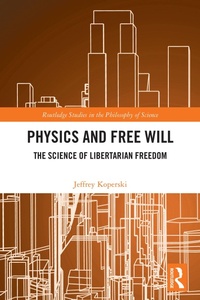
Physics and Free Will
The Science of Libertarian Freedom
Published on 3. December 2025
224 pages
978-1-040-75338-5 (ISBN)
Description

Can libertarian free will survive our best physical theories? While prominent physicists argue that genuine agency contradicts science, this book demonstrates that contemporary physics actually provides robust foundations for human freedom.
Physics and Free Will rigorously navigates the complex intersection of physical theory and the free will debate. Koperski begins by clarifying determinism's scientific foundations before systematically addressing challenges from special relativity and refuting physics-based arguments against mind-body dualism. Drawing on insights from continuum mechanics and condensed matter physics, he reveals how multiscale systems exhibit the emergence of causally efficacious properties irreducible to their micro-constituents. Using these insights, Koperski develops a framework that preserves libertarian intuitions about genuine choice while remaining consistent with physical theory. Through meticulous examination of determinism, reductionism, and the causal closure of physics, this comprehensive work reveals how contemporary science's recognition of emergent causation provides ample space for genuine human agency.
This book will be essential for researchers and graduate students in metaphysics, philosophy of physics, philosophy of science, and philosophy of mind, and for anyone seeking to understand how contemporary science reshapes rather than eliminates the possibility of free will.
Physics and Free Will rigorously navigates the complex intersection of physical theory and the free will debate. Koperski begins by clarifying determinism's scientific foundations before systematically addressing challenges from special relativity and refuting physics-based arguments against mind-body dualism. Drawing on insights from continuum mechanics and condensed matter physics, he reveals how multiscale systems exhibit the emergence of causally efficacious properties irreducible to their micro-constituents. Using these insights, Koperski develops a framework that preserves libertarian intuitions about genuine choice while remaining consistent with physical theory. Through meticulous examination of determinism, reductionism, and the causal closure of physics, this comprehensive work reveals how contemporary science's recognition of emergent causation provides ample space for genuine human agency.
This book will be essential for researchers and graduate students in metaphysics, philosophy of physics, philosophy of science, and philosophy of mind, and for anyone seeking to understand how contemporary science reshapes rather than eliminates the possibility of free will.
Reviews / Votes
"This book is a deeply researched response to attacks on free will by some extremely dogmatic physicists. After an extensive well-informed survey of relevant issues, the author makes a convincing case that free will is indeed compatible with present day physics. Highly recommended."George F.R. Ellis, University of Cape Town, South Africa
"Jeffrey Koperski's Physics and Free Will is clear, engaging, and offers a compelling argument that an ontological account of emergence is the way to understand how free will exists in a physical world."
Robert C. Bishop, Wheaton College, USA
"An original and accessible account of how free will can be made compatible with scientifically minded skepticism, including that of down-to-earth physicists."
Jan Scheffel, KTH Royal Institute of Technology, Sweden
"A pervasive view in modern science suggests that all phenomena can ultimately be reduced to fundamental particle physics, eliminating the possibility of human free will. While this deterministic framework has explanatory power, it contradicts our lived experience and intuitive sense that we can choose. This book presents compelling arguments that reconcile scientific understanding with free will. An essential contribution to the contemporary debate that will interest both scientists and philosophers."
Jeffrey Chalmers, Ohio State University, USA
More details
Series
Language
English
Place of publication
London
United Kingdom
Publishing group
Taylor & Francis Ltd
Target group
College/higher education
Illustrations
4 Line drawings, black and white; 4 Halftones, black and white; 8 Illustrations, black and white
File size
103,77 MB
ISBN-13
978-1-040-75338-5 (9781040753385)
Copyright in bibliographic data and cover images is held by Nielsen Book Services Limited or by the publishers or by their respective licensors: all rights reserved.
Schweitzer Classification
Other editions
Additional editions
Book
approx. 12/2025
1st Edition
Routledge
€207.50
Not yet published
Person
Jeffrey Koperski is Professor of Philosophy at Saginaw Valley State University. His two previous books are The Physics of Theism: God, Physics, and the Philosophy of Science (2015) and Divine Action, Determinism, and the Laws of Nature (Routledge, 2020).
Content
1. Physics and the Problem of Free Will 2. What is Free Will? 3. The Challenge of Determinism 4. Relativity and the Block Universe 5. Physics vs. Dualism 6. Reductions 7. Emergence 8. Micro, Macro, and Meso 9. Compatibilist Libertarianism 10. The Big Picture
