

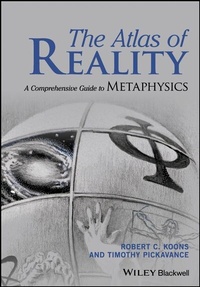
The Atlas of Reality
Description

The Atlas of Reality: A Comprehensive Guide to Metaphysics presents an extensive examination of the key concepts, principles, and arguments of metaphysics, traditionally the very core of philosophical thought. Representing the first exhaustive survey of metaphysics available, the book draws from historic sources while presenting the latest cutting-edge research in the field. Seminal works of philosophers such as David Lewis, Alvin Plantinga, Kit Fine, Peter van Inwagen, John Hawthorne and many others are covered in depth, without neglecting the critical contributions of historical figures like René Descartes, Gottfried Wilhelm Leibniz, Bertrand Russell, and more.
Written in an accessible manner without sacrificing rigor, readers at all levels will gain illuminating insights into metaphysical topics ranging from the problem of universals, individuation and composition, and relations and qualities, to time, space, causation, existence, modality, and idealism. The authors also articulate the emergence of several coherent metaphysical theses, including neo-Aristotelian, neo-Humean, and more recent alternatives put forth by W. V. O. Quine and David M. Armstrong. Competing views are clearly and fairly represented, and key axioms and methodological assumptions are flagged and cross-referenced, providing scholars with an invaluable tool for future research in metaphysics.
Unprecedented in breadth of topic coverage and depth of analyses, The Atlas of Reality is an essential resource for those seeking a thorough understanding of one of the most compelling, influential, and enlightening sub-fields of philosophy in today's world.
More details
Other editions
Additional editions
Persons
ROBERT C. KOONS is a Professor of Philosophy at the University of Texas at Austin. He is the author of Paradoxes of Belief and Strategic Rationality (1993) and Realism Regained (2000), co-author of Metaphysics: The Fundamentals (with Tim Pickavance, 2014), and co-editor of The Waning of Materialism (with George Bealer, 2010).
TIMOTHY PICKAVANCE is an Associate Professor and Chair of the Talbot Department of Philosophy at Biola University. He is co-author of Metaphysics: The Fundamentals (with Robert Koons, 2014).
Content
Part I Foundations
1 Introduction 3
1.1 A Brief History of Metaphysics 3
1.2 Why Do Metaphysics? 5
1.3 How to Use the Book 9
2 Truthmakers 13
2.1 Introduction 13
2.2 Five Arguments for Classical Truthmaker Theory 19
2.3 The Challenge of Deflationism 25
2.4 Truthmaker Maximalism 30
2.5 Alternatives to Truthmaker Maximalism 36
2.6 Conclusion and Preview 44
Notes 45
3 Grounding, Ontological Dependence, and Fundamentality 47
3.1 Is Grounding Real? 49
3.2 Relation between Grounding and Truthmaking 55
3.3 Relation between Grounding and Ontological Dependence 58
3.4 Conceptual vs. Extra-Conceptual Grounding 62
3.5 Alternatives to Grounding? 65
3.6 Can Grounding Relations be Grounded? 69
3.7 Connections between Grounding and Entailment 71
3.8 How is Grounding Different from Causal Explanation? 72
3.9 Conclusion: Grounding and Ontological Economy 72
Notes 73
Part II Dispositions
4 Conditionals 77
4.1 Counterfactual Conditionals: Semantics, Logic, and Metaphysics 78
4.2 Hypotheticalism 84
4.3 Anti-Hypotheticalism and Laws of Nature 86
4.4 Strong Hypotheticalism: Counterfactual Accounts of Powers and Dispositions 90
Notes 92
5 Laws of Nature 94
5.1 Strong Nomism: The Dretske-Armstrong-Tooley (DAT) Theory of Laws 94
5.2 Neo-Humeism: Reduction of Conditionals, Laws, and Powers 99
Notes 105
6 Powers and Properties 106
6.1 Advantages of Strong Powerism 106
6.2 The Individuation of Properties 108
6.3 Objections to Strong Powerism 118
6.4 Conclusion 121
Notes 121
Part III Universals and Particulars
7 Universals 125
7.1 Introduction 125
7.1.1 What properties must explain 126
7.2 Realism 128
7.3 Universals and the Problem of Intentionality 142
7.4 Properties as the Ground of Causal Powers 145
Notes 145
8 Reductive Nominalism and Trope Theory 147
8.1 Reductive Nominalism 147
8.2 Trope Theory 165
8.3 Conclusion 169
Notes 169
9 Particulars and the Problem of Individuation 171
9.1 Introduction 171
9.2 Facts 172
9.3 Substances 175
Notes 200
10 Relations, Structures, and Quantities 201
10.1 Accounts of Relational Facts 201
10.2 Non-Symmetrical Relations and the Problem of Order 206
10.3 Structural Universals and Constituent Ontology 215
10.4 Determinables, Quantities, and Real Numbers 219
10.5 Conclusion and Preview 225
Notes 225
Part IV The Nature of Reality
11 Nihilism and Monism 229
11.1 Nihilism and Aliquidism 229
11.2 Monism 237
Note 252
12 The Non-Existent and the Vaguely Existing 253
12.1 Does Everything Exist? 253
12.2 Ontic Vagueness 271
12.3 Conclusion 280
13 Solipsism, Idealism, and the Problem of Perception 281
13.1 Defining the Mental and the External 282
13.2 Solipsism and Phenomenalism 284
13.3 Theories of Perception 286
13.4 Arguments against Phenomenalism 306
13.5 Arguments against Solipsism 309
13.6 Conclusion and Preview 312
Notes 313
Part V Modality
14 Possibility, Necessity, and Actuality: Concretism 317
14.1 Introduction 317
14.2 Concretism:Worlds as Universes 321
14.3 Problems for Concretism 327
14.4 Conclusion 331
Note 331
15 Abstractionism:Worlds as Representations 332
15.1 Magical Abstractionism 333
15.2 Structural Abstractionism 341
15.3 Aristotelian Theories of Possibility 348
15.4 Conclusion 350
Note 351
16 De Re Modality and Modal Knowledge 352
16.1 Modality De Re: Transworld Identity and Counterpart Theory 352
16.2 Modality and Epistemology: Possibility and Conceivability 363
16.3 Conclusion 369
Notes 369
Part VI Space and Time
17 Is Space Merely Relational? 373
17.1 The Nature of Location 373
17.2 Spatial Substantivalism 375
17.3 Spatial Relationism 381
17.4 Absences and Vacuums 386
17.5 Conclusion 388
Notes 389
18 Structure of Space: Points vs. Regions 390
18.1 Constructing Points from Regions 391
18.2 Points vs. Regions 394
18.3 Arguments against Points as Fundamental 397
18.4 Voluminism vs. Volume-Boundary Dualism 408
18.5 Conclusion 414
Note 414
19 The Structure of Time 415
19.1 Is Time Composed of Instants or Intervals? 415
19.2 Instants as Dependent Entities 425
19.3 Does Time have a Beginning? 427
19.4 Conclusion 429
20 Time's Passage 430
20.1 Tensers and Anti-Tensers 432
20.2 Varieties of Anti-Tensism 435
20.3 Varieties of Tensism 437
20.4 Presentism 439
20.5 Arguments for Tensism 442
20.6 Conclusion 456
Note 457
21 Arguments for Anti-Tensism 458
21.1 How Fast Does Time Flow? 458
21.2 Truthmakers for Truths about the Past 461
21.3 The Theory of Relativity 469
21.4 Epistemological Problems for Tensism 473
21.5 McTaggart's Paradox 474
21.6 Brute Necessities of Time 476
21.7 Conclusion 478
Part VII Unity
22 Material Composition: The Special Question 481
22.1 The Existence of Composite Things 482
22.2 Are Composite Things an "Ontological Free Lunch"? 482
22.3 Redundancy 485
22.4 Fundamental Heaps 490
22.5 Fundamental Artifacts 497
22.6 Living Organisms vs. Mereological Nihilism 499
22.7 Finding an Intelligible Principle of Composition 504
Notes 513
23 Composition: The General Question 514
23.1 Formal Mereology: Le¿sniewski, Goodman, and Leonard 514
23.2 Three (or Four) Answers to the General Composition Question 518
23.3 Accounting for the Correct Principles of Mereology 523
23.4 Parthood and Truthmaking 529
Notes 530
24 Change and Persistence 531
24.1 Does Anything Change? Does Anything Persist? 532
24.2 How Objects Change Properties: Substratism vs. Replacementism 537
24.3 The Metaphysics of Motion 551
Notes 554
25 The Persistence of Composite Things 555
25.1 Mereological Constancy and Inconstancy 556
25.2 Coincident Things 564
25.3 Conclusion 573
Note 574
Part VIII Causation
26 The Existence and Scope of Causation 577
26.1 Are there Causes? 577
26.2 The Scope of Causation 583
Note 589
27 Causation: A Relation between Things or Truths? 591
27.1 Causal Explanationism 592
27.2 Causal Connectionism 605
Notes 611
28 Discrete and Continuous Causation 613
28.1 Is All Causation Discrete? 614
28.2 The Nature of Discrete Causation 614
28.3 Is All Causation Continuous? 616
28.4 The Nature of Continuous Processes 618
28.5 Processes and the Direction of Continuous Causation 621
28.6 Are Processes an Exception to Hume's Epistemic Principle? 622
28.7 Conclusion: The Consequences of Causation 623
Notes 623
29 Conclusion: The Four Packages 624
Appendix A 633
Appendix B 651
References 655
Index 671
1
Introduction
Metaphysics, or first philosophy, is that branch of philosophy concerned with the nature of reality in its most fundamental aspects: existence, the part/whole relation, space, time, causality, possibility and necessity, similarity and dissimilarity. It includes ontology, the study of what exists, as well as the investigation of the most general features of reality. Metaphysicians seek to understand the real structure and the unity of the world and to catalog the ways in which its parts relate to each other.
In this chapter, we begin with a short history of metaphysics (1.1), followed by a discussion of some reasons why metaphysics matters (1.2). We conclude with some guidance about how best to use this book (1.3).
1.1 A Brief History of Metaphysics
Metaphysics is the oldest branch of philosophy. The early, pre-Socratic philosophers of Ionia (off the coast of Turkey) and southern Italy proposed theories about the universal nature of things and about change and the explanations of change. Many of the early philosophers, including Empedocles (c. 490-430 BC) and Democritus (c. 460-370 BC), approached these questions from a materialistic point of view, assuming that wisdom comes primarily from understanding what things are made of. In the fourth century BC, the great Greek philosopher Plato (428/427 or 424/423-348/347 BC) developed a theory of "forms" as a deep explanation for what makes things of a kind similar to each other, as an alternative to the earlier materialism. Plato's student, Aristotle (384-322 BC), built upon the work of all of his predecessors in creating the first comprehensive and systematic metaphysical theory in a work that acquired (for the first time) the title Metaphysics. Aristotle describes his subject as "primary" or "first" philosophy and as the study of being as such. Aristotle examined the nature of change and of powers to change, and he built a theory of categories to use in classifying all of the constituents of reality. Like Plato, Aristotle rejected simple materialism and emphasized the qualitative and holistic features of the world, especially of living organisms.
Both Plato and Aristotle founded schools of philosophy, and their students and their students' students extended their philosophical work over many generations. During the Hellenistic period (between the conquests of Alexander and the rise of Rome), three additional major schools of philosophy appeared-the Stoics, the Epicureans, and the Skeptics. Both the Stoics and Epicureans revived a more materialistic approach to understanding life and human action. During the Hellenistic and Roman periods, such metaphysical investigations continued, but gradually attention turned to ethics, politics, and the theory of knowledge (epistemology). The problem of defending the very possibility of knowledge against the challenge of the Skeptics became a major preoccupation, and Plato's Academy began to defend (at least in public) a moderate form of skepticism.
In Late Antiquity and the Middle Ages, philosophical work in the Mediterranean basin and in Europe fell predominantly into the hands of Christians, Jews, and Muslims, and during this period philosophers returned to metaphysics as their central focus. Aristotle's influence grew, as more of his work was translated and commented upon in both Arabic and Latin. The resulting philosophical movement, known as 'scholasticism', achieved the status of being the consensus view for many hundreds of years.
This consensus began to dissolve in the seventeenth and eighteenth centuries, as a result of the success of modern science, which returned in important respects to the materialism of Democritus and the Epicureans. At the same time, the French philosopher René Descartes (1596-1650) re-introduced a fixation on the problem of refuting the skeptics. Descartes recommended answering the skeptics by turning inward, building the foundations of science and philosophy firmly upon the indubitable contents of one's own mind and experience. This inward or subjective turn profoundly affected the course of metaphysics for hundreds of years, leading to the dominance of various forms of idealism, according to which all of reality is fundamentally mental or experiential in character.
In the early twentieth century, a number of philosophers began turning away from idealism and from any attempt to build an indubitable foundation for knowledge that would be immune to the challenge of the skeptic. The British philosopher G.E. Moore (1873-1958) argued that our ordinary knowledge of the world is rationally more secure than any skeptical challenge. Ludwig Wittgenstein (1889-1951), an Austrian who made his career in England, pointed out that doubt stands in no less need of justification than does belief. Wittgenstein concluded that skeptical doubts lacked adequate justification. Many philosophers, in Britain, the United States, and continental Europe, argued that science requires no foundation other than that provided by ordinary observations, which embody knowledge about our physical environment. Thus, philosophy began to turn outward again, in a way that supported the revival of more traditional approaches to metaphysics-materialistic, Platonic, and Aristotelian or scholastic.
For a brief period at the end of the nineteenth century and beginning of the twentieth century, metaphysics fell out of favor among philosophers. Some (such as Friedrich Nietzsche (1844-1900), Karl Marx (1818-1883), William James (1842-1910), and Søren Kierkegaard (1813-1855)), because of theories in psychology and cultural studies, raised doubts about the ability of the metaphysician to escape the prejudices and interests of one's class and time or the idiosyncratic influence of one's personal constitution. Others (such as those in the Vienna Circle and Ludwig Wittgenstein) embraced an extreme empiricism, arguing that all meaningful assertions must be directly verifiable or falsifiable by the senses, a standard which relegated metaphysical theory to the category of the nonsensical. Yet another group limited the task of the philosopher to analyzing the underlying grammar and logic of ordinary language.
But the middle of the twentieth century witnessed one of the most remarkable rebirths in Western philosophy: a dramatic renaissance of interest in pure metaphysical theory. The impetus for this revival came in part from circles that had once been hostile to the metaphysical enterprise and in part from philosophers working within older traditions that had survived despite that hostility. Some philosophers of physics found themselves inquiring into the structure of space, time, and causation in ways that revived ancient debates. Some who had studied the logical structure of ordinary language found that they could not avoid questions about ontology-questions about which sorts of things really exist. Others returned to the Aristotelian and scholastic traditions that had survived. Significant circles of metaphysical research began in the 1940s in Australia, at Oxford and Cambridge, and at Harvard. Logical research that had dominated philosophy in the early twentieth century matured naturally into metaphysical investigations into the nature of possibility and necessity and of time. By the early twenty-first century, metaphysics had reclaimed its place at the very center of philosophy.
1.2 Why Do Metaphysics?
The practice of metaphysics is controversial within philosophy itself. This controversy stems from two primary sources: skepticism and pragmatism. Anti-metaphysical skeptics question whether it is possible to reach knowledge or even reasonable opinion about metaphysical questions. Our response to the skeptic is simply that the proof is in the pudding. The best rebuttal of those who claim that metaphysics is impossible is simply to do it.
The pragmatic challenge to metaphysics is perhaps even more widespread. Even if metaphysics is possible, the pragmatist asks, why is it important? There are many more urgent philosophical questions, questions about ethics and politics (the good and the right), and questions of epistemology (what do we know, and how do we know it?).
Our response to the pragmatist is twofold. First, we would argue, with Aristotle, that philosophy begins with a sense of wonder and curiosity about the world, a wonder and a curiosity that inevitably led to puzzling over the metaphysical questions: what sorts of things really exist, and how do these things relate to one another? Much of what we do in science and scholarship generally is motivated by pure curiosity about our selves and our world. Not everything can be evaluated in terms of cash value.
Second, metaphysical questions are relevant to other questions, both in value theory and in epistemology and philosophy of science, as we will argue in this chapter. Even when philosophy is primarily engaged in ethical or epistemological reflection, the issues of metaphysics cannot be avoided.
1.2.1 Fatalism and alternative possibilities
The making of decisions is a characteristic feature of human life. Much of our time is consumed in considering and deliberating about what to do, and our emotions are much engaged with questions of the correctness of our past, present, and future choices. The practice of making choices seems to presuppose that the future could take any one of many alternative courses, and that which course it takes is to some extent up to each of us. This...
