

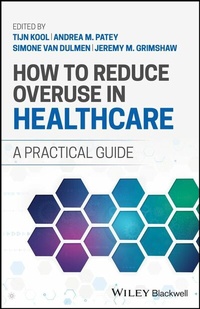
How to Reduce Overuse in Healthcare
Description

Reduce low-value care with this practical guide
Low-value care harms patients, overburdens healthcare professionals, threatens healthcare systems and damages the climate. How to Reduce Overuse in Healthcare: a practical guide is designed to provide practical guidance and tools for healthcare providers, their professional societies and policy makers developing programs to de-implement low-value or unnecessary care. This guide provides a five-step evidence and theory-based framework for developing and evaluating programs such as Choosing Wisely to reduce low-value care and improve patient outcomes.
How to Reduce Overuse in Healthcare: a practical guide readers will also find:
* An author team involved in the leading Choosing Wisely international network
* Detailed analysis of how to identify potential low-value care areas, select interventions and more
* Practical, real-world examples at the end of each chapter illustrating examples of overuse and de-implementation
How to Reduce Overuse in Healthcare: a practical guide describes the state of the art in de-implementation for healthcare professionals, healthcare administrators and policy makers looking to reduce low-value care in a more effective and evidence-based way.
More details
Other editions
Additional editions
Persons
Tijn Kool, MD PhD, is Full Professor Appropriate Care at the Radboud University Medical Center, Radboud Institute for Health Sciences, Nijmegen, the Netherlands.
Andrea M. Patey, PhD, is Senior Research Associate in the Centre for Implementation Research in the Clinical Epidemiology Program, Ottawa Hospital Research Institute, Canada.
Simone van Dulmen, PhD, is Senior Researcher in Appropriate and Sustainable Healthcare at the Radboud University Medical Center, Radboud Institute for Health Sciences, Nijmegen, the Netherlands.
Jeremy M. Grimshaw, MBChB, PhD, Senior Scientist in the Centre for Implementation Research in the Clinical Epidemiology Program, Ottawa Hospital Research Institute, Canada.
Content
Preface x
Chapter 1 Why Should We Reduce Medical Overuse? 1
Karen Born and Wendy Levinson
It Started with Quality Improvement 1
Then Came a Focus on Overuse 3
Overuse as a Global Healthcare Quality Concern 5
What Can Be Done to Address Overuse? 6
Choosing Wisely 7
What Can you Expect in the Following Chapters? 9
References 10
Chapter 2 Why Does Overuse Exist? 13
Tijn Kool, Simone van Dulmen, Andrea M. Patey, and Jeremy M. Grimshaw
A Multifactorial Challenge on Different Levels 13
Healthcare Professional Factors 14
Patient Factors 15
Preference for Acquiring Something 16
Clinical Care Context Factors 16
Absence of an Open Culture 17
Absence of Clear Leadership 17
Healthcare Organisation Factors 18
Insufficient Time 18
Lack of Coordination Amongst Healthcare Providers 19
Healthcare System Factors 19
Payment System that Rewards Volume 19
Influence of the Pharmaceutical and Medical Device Industry 20
Healthcare Insurance Policy 20
Key Points 20
References 21
Chapter 3 Why Is It So Hard to Change Behaviour and How Can We Influence It? 23
Jill J. Francis, Sanne Peters, Andrea M. Patey, Nicola McCleary, Leti van Bodegom- Vos, and Harriet Hiscock
The Challenge of Behaviour Change 24
Is The Behaviour a Routine? 24
Is The Behaviour Rewarding? 24
Do Habits or Routines Play a Role in Sustaining the Behaviour? 26
Four Crucial Questions to Address Before Working to Support Behaviour Change 28
Why Is It So Difficult to Change the Behaviour of Healthcare Professionals? 30
Designing Interventions to Change Behaviour 35
Summary 36
Sources of Information for Supporting Practice Change Among Healthcare Professionals 36
References 36
Chapter 4 How Can We Reduce Overuse: The Choosing Wisely De- Implementation Framework 41
Jeremy M. Grimshaw and Andrea M. Patey
Introduction 41
The Choosing Wisely De- Implementation Framework 44
Phase 0: Identification of Potential Areas of Low- Value Healthcare 44
Phase 1: Identification of Local Prioritiesfor the Implementation of Recommendations 45
Phase 2: Identification of Barriers and Enablers to Implementing Recommendations and Potential Interventions to Overcome These 46
Phase 3: Evaluation of the Implementation 48
Phase 4: Spread of Effective Implementation Programs 49
Key Points 50
References 51
Chapter 5 How Can You Engage Patients in De- Implementation Activities? 54
Stuart G. Nicholls, Brian Johnston, Barbara Sklar, and Holly Etchegary
What Is Patient Engagement and Why is it Relevant to De- Implementation? 54
Making a Patient Engagement Plan 56
The Level of Engagement 57
Area 1 - Patient Engagement in Agenda Setting and Prioritisation 61
Area 2 - Patient Engagement in the Design and Conduct of De- Implementation Activities 64
Area 3 - Patient Engagement in Spread 65
Important Considerations when Engaging Patients 66
Key Points 68
Sources of Information 69
General Resources 69
Planning Tools 69
Patient Engagement Methods 70
Evaluation Tools 70
References 70
Chapter 6 Identifying Potential Areas of Low- Value Healthcare- Phase 0 73
Moriah E. Ellen, Saritte M. Perlman, and Jeremy M. Grimshaw
How to Identify Low- Value Care? 73
Resources to Identify Low- Value Care 75
Recommendation Lists 76
Clinical Practice Guidelines 77
Health Technology Assessments 77
Evidence Syntheses and Systematic Reviews 78
From Identification to Measurement 78
Key Points 84
Sources of Further Information 84
References 84
Chapter 7 Measuring Low- Value Care and Choosing Your Local Priority (Phase 1) 88
Carole E. Aubert, Karen Born, Eve A. Kerr, Sacha Bhatia, and Eva W. Verkerk
Choosing Your Local Priority 89
Measuring Low- Value Care 89
Baseline Measurements 90
Estimating Improvement Potential 91
Evaluating De- Implementation Effects 91
Measuring Unintended Consequences 94
Measurement Methods and Data Source 95
Setting Specific, Measurable, Achievable, Relevant, and Time- Bound (SMART) Targets 98
Providing Data and Feedback to Stakeholders 98
Key Points 100
References 100
Chapter 8 Identifying Target Behaviours and Potential Barriers to Change (Phase 2a) 103
Andrea M. Patey, Nicola McCleary, Justin Presseau, Tijn Kool, Simone van Dulmen, and Jeremy M. Grimshaw
The Importance of Fully Understanding the Problem 104
Getting Started 104
Identifying Who Needs to do What Differently 105
Using the Action, Actor, Context, Target, Time (Aactt) Framework 106
Identifying Drivers of Current Behaviour and Barriers and Enablers to Changing Behaviour 109
Collecting Data 112
Interviews 112
Focus Groups 114
Surveys 116
Analysing the Data 118
Narrowing Down the Drivers or Barriers Identified 118
Key Points 119
Useful Resources 120
References 120
Appendix: Sample Interview Guide for Healthcare Providers Using the Tdf 122
Introduction Script 122
Background 123
Chapter 9 Selecting De-Implementation Strategies and Designing Interventions: Phase 2b 131
Justin Presseau, Nicola McCleary, Andrea M. Patey, Sheena McHugh, and Fabiana Lorencatto
What Do You Need To Do Before Selecting De- Implementation Strategies? 132
Ten General Principles to Consideras you Develop a de- Implementation Intervention 132
1. There Are No Magic Bullets: Design Your De- Implementation Intervention to Address Specific Barriers and Enablers 132
2. De- Implementation Interventions Are Often Also Implementation Interventions when Substituting One Practice with Another 133
3. Routinised, Habitually Performed Care May Be Operating Semi- Automatically 134
4. Follow the Evidence Wherever Possible when Designing Your De- Implementation Intervention 135
5. Avoid the Tower of Babel: Leverage Existing Listsof Change Strategies and Use Them to Help Match Specific Strategies to Identified Barriers/Enablers 136
6. Avoid Conflating Intervention Content with Its Method of Delivery 139
7. Decide on Tailoring and Adaptation 140
8. Co- Development, User- Centred Design to Enhance Feasibility, Acceptability, and Implementability 140
9. Prioritise Equity 141
10. Describe How the Strategy Works by Developing a De- Implementation Logic Model of Change 142
Key Points 143
Sources 144
References 144
Chapter 10 Evaluating De- Implementation Interventions: Phase 3 149
Beatriz Goulao, Eva W. Verkerk, Kednapa Thavorn, Justin Presseau, and Monica Taljaard
Why Should We Evaluate? 150
Outcomes 150
Types of Evaluations 151
Randomised Evaluations 152
Non- Randomised Evaluations 154
Selecting the Most Appropriate Evaluation Method 156
How and Why Does the Intervention Work? 158
Does the Intervention Offer Good Value for Money? 160
Key Points 161
References 162
Chapter 11 Preserving Results and Spreading Interventions: Phase 4 166
Simone van Dulmen, Daniëlle Kroon, and Tijn Kool
Why Are Sustainability and Spread So Important? 166
What Is Sustainability? 167
Factors Influencing Sustained Change 168
Factors Related to the Process 168
Factors Related to Staff 170
Factors Related to the Organisation 170
How Can You Facilitate Sustainability? 171
Assessing Sustainability 172
Sustainability and Culture 173
Spreading Successful De- Implementation Interventions 174
Scaling Strategy 175
De- Implementation Intervention 176
Adopters or Adopting Organisation 177
External Context 177
Key Points 178
References 178
Chapter 12 Training the Next Generation of Healthcare Providers to Address Overuse and Avoid Low- Value Care 181
Brian M. Wong, Christopher Moriates, Lorette Stammen, and Karen Born
Introduction 182
High- Value Care Competencies 182
Teaching Students and Trainees To Provide High- Value Care 183
Educational Changes to the Formal Curriculum 183
Faculty Role Modellingand Supportive Learning Environments 186
Assessing High- Value Care Learning Outcomes 190
Enablers of Educational Change 191
Aligning Continuing Professional Development and Quality Improvement 192
Key Points 193
Sources 196
References 196
Chapter 13 Examples from Clinical Practice 199
Simone van Dulmen, Daniëlle Kroon, Tijn Kool, Kyle Kirkham, and Johanna Caro Mendivelso
Introduction 199
References 215
Chapter 14 Starting Tomorrow 217
Tijn Kool, Andrea M. Patey, Jeremy M. Grimshaw, and Simone van Dulmen
Index 221
CHAPTER 1
Why Should We Reduce Medical Overuse?
Karen Born1 and Wendy Levinson2
1 Institute of Health Policy, Management & Evaluation, University of Toronto, Toronto, Ontario, Canada
2 Department of Medicine, University of Toronto, Toronto, Ontario, Canada
IT STARTED WITH QUALITY IMPROVEMENT
The idea that poor quality and patient safety harms are unacceptable and can be measured and improved was introduced into mainstream medical and public culture in the United States nearly 25 years ago and subsequently spread around the globe. This can be traced to the release of a ground-breaking report, To Err is Human, published by the Institute of Medicine (Donaldson et al. 2000). This report was part of a multi-year effort led by the Institute of Medicine to change the discourse around patient safety and quality in the United States. To Err is Human focused on the issue of medical errors and safety issues. It highlighted systemic drivers that lead to errors and established a patient safety agenda with a focus on enhancing leadership, measurement, and systems to identify and decrease medical errors. It also highlighted that harm to patients from healthcare is a chronic threat to public health and is pervasive and preventable. This publication was followed shortly thereafter by the report, Crossing the Quality Chasm, which laid out an ambitious agenda for improving healthcare quality in the United States (Institute of Medicine 2002). This included establishing a six-dimensional framework to measure health system performance: safety, effectiveness, patient-centredness, timeliness, efficiency, and equity. In addition, Crossing the Quality Chasm offered three major categories for healthcare quality problems: overuse, underuse, and misuse. Overuse relates to healthcare services that have no benefits or for which harms outweigh benefits, underuse to healthcare services that offer benefits to patients but are not provided to relevant patients, and misuse to healthcare services that offer benefits in certain contexts but not others.
Subsequently, quality improvement collaboratives, campaigns, and efforts swept across the United States and other countries with wide variations in results and outcomes. About 14 years after the publication of To Err is Human, experts in quality and patient safety expressed frustration at the slow pace of change. In particular, decreasing overuse was rarely addressed by quality improvement efforts. The Institute of Medicine's report, The Healthcare Imperative, highlighted the shocking figure that nearly 30% of all healthcare costs in the United States were wasted or unnecessary (Yong et al. 2010). The report estimated that this unnecessary care, or overuse, costed upwards of $750 billion in 2009. The problem of overuse began to achieve more prominence as a quality problem, which necessitated further efforts to change. This figure of 30% of all healthcare being low-value has been reported in other high-income countries, including Canada (Canadian Institute for Health Information 2017). One commentary bemoaning the lack of change since the publication of the landmark reports over a decade earlier stated, in 2013, that, 'alongside important efforts to eliminate preventable complications of care, there must also be an effort to seriously address the widespread overuse of health services. That overuse, which places patients at risk of harm and wastes resources at the same time, has been almost entirely left out of recent quality improvement endeavours' (Chassin 2013).
This sentiment was supported by evidence that overuse is difficult to change. A United States study compared the quality indicators of overuse, misuse, and underuse in outpatient visits in 1999 and 2009 (Kale et al. 2013). The study found that during this period, 6 of the 9 underuse indicators improved, 1 of the 2 misuse indicators improved but only 2 of the 11 overuse indicators improved, with one getting significantly worse.
Chapters 2 and 3 will delve into why overuse is such a stubborn and challenging problem. And why strategies to reduce overuse need to be multi-pronged to be effective and supported by efforts to change the culture driving overuse, as well as systems that can drive overuse.
THEN CAME A FOCUS ON OVERUSE
Overuse was originally defined in the Institute of Medicine reports, and since that time, there has been a proliferation of terminology to define and describe waste and overuse in healthcare. Common terminology includes low-value care, unnecessary care, appropriateness, overdiagnosis, de-adoption, and de-implementation. Table 1.1 offers four categories to classify key descriptions for overuse. Note that positive language, such as appropriate care, high-value care or right care, has been used to contrast with overuse and to emphasis quality problems associated with underuse and misuse, as well as overuse, and as such are not included in the table.
This book will use the terms overuse and low-value care as they are consistent with the broader language used in the quality and patient safety literature. However, clarity regarding terminology can help to communicate the complex topic of overuse to various audiences.
TABLE 1.1 Overuse language and meanings.
Category Common terms Application Example Processes of care which are not effective or cost effective Unnecessary careLow-value care
Waste
Inappropriate care Processes of care that are not effective or cost-effective, delivery marginal clinical value or benefit to patients, and where harms outweigh benefits clinically Annual or routine blood screening tests in asymptomatic patients Overuse of a test, treatment of procedure Overuse
Overprescribing
Overdiagnosis
Overtreatment Variation in a practice across settings with additional use not delivering benefit Overprescribing of antibiotics for respiratory tract infection in some settings or regions with similar case mix and population characteristics Treatments which are no longer beneficial Obsolete
Outdated technologies/care A treatment which was once perceived to be beneficial but has been replaced with a better process of care, or now has strong evidence showing it does not work Transfusing more than one red cell unit at a time when transfusion is required in stable, non-bleeding patients
OVERUSE AS A GLOBAL HEALTHCARE QUALITY CONCERN
In the chapter thus far, we have covered key American reports and data associated with the quality and patient safety movement. This movement spread globally, and with increased awareness of overuse came several key publications, which sought to describe and measure overuse in a global context. In 2017, The Lancet published a landmark special series of the journal with a focus on Right Care (Berwick 2017). The series emphasised the importance of the coexistence of overuse and underuse globally, offering evidence for overuse not just from high-income countries such as the United States, but also evidence of overuse in low- and middle-income countries. Also, the Organisation for Economic Cooperation and Development (OECD) released a report on overuse Tackling Wasteful Spending on Health in 2017. It began with a powerful statement contrasting spending pressures on healthcare systems globally with evidence that one-fifth of healthcare expenditures have no or minimal contribution to good health outcomes (OECD 2017). The OECD report linked the imperative to reduce overuse with the interconnected goals of spending less on healthcare while improving health. The OECD now includes overuse indicators, for example, antibiotic volumes, benzodiazepine prescriptions in older adults, and imaging tests in their annual Health at a Glance report (OECD 2021). The accumulation of evidence of overuse and presence of measures at the system level helped to articulate a case globally for the harms of overuse as a quality problem moving beyond costs. Importantly, these measures helped to emphasise a broad range of the harms of overuse to individuals to health systems.
It is important to frame and shape a narrative about overuse as going beyond wasteful healthcare spending to engage and motivate various stakeholders to take action. These include patients, clinicians, and the general public who may not be motivated to change due to government or payor concerns, but instead are concerned with individual safety and quality care (Born et al. 2017; Levinson et al. 2018).
Harms to individual patients from overuse include side effects from and medication interactions with unnecessary treatments, and incidental findings and testing cascades from unnecessary tests that can expose patients to risk. Overuse can also harm patients by wasting time or financial resources through delays in access to care, needless stress or worry, and wasted time and money pursuing follow-up appointments.
Harms to providers and organisations can be associated with wasted time, resources, and broader inefficiencies driving up wait times for patients and increasing inefficiencies for...
