

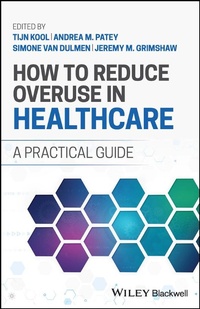
How to Reduce Overuse in Healthcare
Description
Low-value care harms patients, overburdens healthcare professionals, threatens healthcare systems and damages the climate. How to Reduce Overuse in Healthcare is designed to provide practical guidance and tools for healthcare providers, their professional societies and policy makers developing programs to de-implement low-value or unnecessary care. It provides a five-step evidence- and theory-based framework for developing and evaluating programs such as Choosing Wisely to reduce low-value care and improve patient outcomes.
How to Reduce Overuse in Healthcare readers will also find:
An author team involved in the leading Choosing Wisely international network
Detailed analysis of how to identify potential low-value care areas, select interventions, and more
Practical, real-world examples at the end of each chapter illustrating examples of overuse and de-implementation
How to Reduce Overuse in Healthcare describes the state of the art in de-implementation for healthcare professionals, healthcare administrator and policy makers looking to reduce low-value care in a more effective and evidence-based way.
<b>Reduce low-value care with this practical guide</b>
Low-value care harms patients, overburdens healthcare professionals, threatens healthcare systems and damages the climate. <i>How to Reduce Overuse in Healthcare </i>is designed to provide practical guidance and tools for healthcare providers, their professional societies and policy makers developing programs to de-implement low-value or unnecessary care. It provides a five-step evidence- and theory-based framework for developing and evaluating programs such as Choosing Wisely to reduce low-value care and improve patient outcomes.
<i>How to Reduce Overuse in Healthcare </i>readers will also find:
<ul><li>An author team involved in the leading Choosing Wisely international network</li><li>Detailed analysis of how to identify potential low-value care areas, select interventions, and more</li><li>Practical, real-world examples at the end of each chapter illustrating examples of overuse and de-implementation</li></ul><i>How to Reduce Overuse in Healthcare </i>describes the state of the art in de-implementation for healthcare professionals, healthcare administrator and policy makers looking to reduce low-value care in a more effective and evidence-based way.
More details
Other editions
Additional editions
Persons
Andrea M. Patey, PhD, is Senior Research Associate in the Clinical Epidemiology Program at the Centre for Implementation Research, Ottawa Hospital Research Institute, Canada.
Simone van Dulmen, PhD, is Senior Researcher in the Sustainable Healthcare Program at Radboud University Medical Center, Radboud Institute for Health Sciences, Njimegen, the Netherlands.
Jeremy M. Grimshaw, MBChB, PhD, is Senior Scientist in the Clinical Epidemiology Program at the Centre for Implementation Research, Ottawa Hospital Research Institute, and Full Professor in the Department of Medicine, University of Ottawa, Canada.
<b>Tijn Kool, PhD, </b>is Senior Researcher and Research Group Leader Appropriate Care at Radboud University Medical Center, Radboud Institute for Health Sciences, Njimegen, the Netherlands.
<b>Andrea M. Patey, PhD, </b>is Senior Research Associate in the Clinical Epidemiology Program at the Centre for Implementation Research, Ottawa Hospital Research Institute, Canada.
<b>Simone van Dulmen, PhD, </b>is Senior Researcher in the Sustainable Healthcare Program at Radboud University Medical Center, Radboud Institute for Health Sciences, Njimegen, the Netherlands.
<b>Jeremy M. Grimshaw, MBChB, PhD, </b>is Senior Scientist in the Clinical Epidemiology Program at the Centre for Implementation Research, Ottawa Hospital Research Institute, and Full Professor in the Department of Medicine, University of Ottawa, Canada.
Content
Preface
Chapter 1 Why should we reduce medical overuse?
Chapter 2 Why does overuse exist?
Chapter 3 Why is it so hard to change behaviour and how can we influence it?
Chapter 4 How can we reduce overuse: the Choosing Wisely Deimplementation Framework?
Chapter 5 How can you engage patients in de-implementation activities?
Chapter 6 Identifying potential areas of low-value healthcare: phase 0
Chapter 7 Measuring low-value care and choosing your local priority: phase 1
Chapter 8 Identifying target behaviours and potential barriers to change: phase 2a
Chapter 9 Selecting de-implementation strategies and choosing interventions; phase 2b
Chapter 10 Evaluating de-implementation activities: phase 3
Chapter 11 Preserving results and spreading interventions: phase 4
Chapter 12 Training the next generation of healthcare providers to address overuse and avoid low-value care
Chapter 13 Examples from clinical practice
Chapter 14 Starting tomorrow