

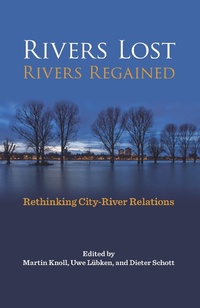
Rivers Lost, Rivers Regained
Rethinking City-River Relations
Published on 13. June 2017
424 pages
978-0-8229-8159-6 (ISBN)
Description

Many cities across the globe are rediscovering their rivers. After decades or even centuries of environmental decline and cultural neglect, waterfronts have been vamped up and become focal points of urban life again; hidden and covered streams have been daylighted while restoration projects have returned urban rivers in many places to a supposedly more natural state. This volume traces the complex and winding history of how cities have appropriated, lost, and regained their rivers. But rather than telling a linear story of progress, the chapters of this book highlight the ambivalence of these developments.
The four sections in Rivers Lost, Rivers Regained discuss how cities have gained control and exerted power over rivers and waterways far upstream and downstream; how rivers and floodplains in cityscapes have been transformed by urbanization and industrialization; how urban rivers have been represented in cultural manifestations, such as novels and songs; and how more recent strategies work to redefine and recreate the place of the river within the urban setting. At the nexus between environmental, urban, and water histories, Rivers Lost, Rivers Regained points out how the urban-river relationship can serve as a prime vantage point to analyze fundamental issues of modern environmental attitudes and practices.
The four sections in Rivers Lost, Rivers Regained discuss how cities have gained control and exerted power over rivers and waterways far upstream and downstream; how rivers and floodplains in cityscapes have been transformed by urbanization and industrialization; how urban rivers have been represented in cultural manifestations, such as novels and songs; and how more recent strategies work to redefine and recreate the place of the river within the urban setting. At the nexus between environmental, urban, and water histories, Rivers Lost, Rivers Regained points out how the urban-river relationship can serve as a prime vantage point to analyze fundamental issues of modern environmental attitudes and practices.
More details
Other editions
Additional editions
Martin Knoll | Uwe Lubken | Dieter Schott
Rivers Lost, Rivers Regained
Rethinking City-River Relations
Book
01/2017
University of Pittsburgh Press
€58.00
Article not available at the moment
Persons
Martin Knoll is professor of the history of European regions at the University of Salzburg, Austria.
Content
- Intro
- Contents
- Acknowledgments
- Introduction / Martin Knoll, Uwe Lübken, and Dieter Schott
- Part I. Rivers Controlled: Cities and Their Watersheds
- Chapter 1. Rivers, Industrial Cities, and Hinterland Production in Quebec in the Nineteenth and Twentieth Centuries / Stéphane Castonguay
- Chapter 2. The Seine as a Parisian River: Its Imprint, Its Ascendancy, and Its Mutual Dependencies in the Eighteenth through the Twentieth Century / Sabine Barles
- Chapter 3. Watershed Democracy or Ecological Hinterland? London and the Thames River Basin, 1857-1989 / Vanessa Taylor
- Part II. Urban Rivers Transformed and Lost
- Chapter 4. The City Whose Rivers Disappeared: Nantes, 1850-1950 / Geneviève Massard-Guilbaud
- Chapter 5. The New Cuyahoga: Straightening Cleveland's Crooked River / David Stradling
- Chapter 6. A "Slum River": The Unequal Urbanization of Bogotá (Colombia) and the Transformation of the Tunjuelo River in the Twentieth Century / Vladimir Sánchez-Calderón
- Chapter 7. Urbanizing a River in a Bicultural Border Region: Strasbourg and the Upper Rhine on the Way to Water Modernity, 1789-1925 / Christoph Bernhardt
- Chapter 8. Path Dependencies Managing the River Elbe and the Requirements of Hamburg's Open Tidal Seaport / Dirk Schubert
- Part III. Cultural Dimensions of Urban Rivers
- Chapter 9. Rivers as Prisms of Urban Imagining: Eastern Sichuan Work Songs / Igor Iwo Chabrowski
- Chapter 10. The Ganges as an Urban Sink: Urban Waste and River Flow in Colonial India in the Nineteenth Century / Awadhendra Sharan
- Chapter 11. Polluted Thames, Declining City: London as an Ecosystem in Charles Dickens's Our Mutual Friend / Agnes Kneitz
- Chapter 12. Living on the River over the Year: The Significance of the Neva to Imperial Saint Petersburg / Alexei Kraikovski and Julia Lajus
- Part IV. Rivers Regained
- Chapter 13. "A Ridiculous Failure of Government": The Chicago River in the Age of Ecology / Harold L. Platt
- Chapter 14. Shared Waters, Shared Conceptions? Two Cities on the River Rhine on the Long and Winding Road to Urban Sustainability / Michael Toyka-Seid
- Chapter 15. Revitalization of a Tamed River: The Isar in Munich / Nico Döring and Georg Jochum
- Chapter 16. Union Is a Raging River, or Remembering Fez as the River Remembers / Shelley Hornstein
- Notes
- List of Contributors
- Index
