

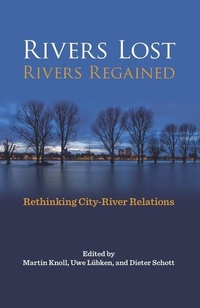
Rivers Lost, Rivers Regained
Rethinking City-River Relations
Will be published approx. on 23. January 2017
Book
Hardback
368 pages
978-0-8229-4459-1 (ISBN)
Description
Many cities across the globe are rediscovering their rivers. After decades or even centuries of environmental decline and cultural neglect, waterfronts have been vamped up and become focal points of urban life again; hidden and covered streams have been daylighted while restoration projects have returned urban rivers in many places to a supposedly more natural state. This volume traces the complex and winding history of how cities have appropriated, lost, and regained their rivers. But rather than telling a linear story of progress, the chapters of this book highlight the ambivalence of these developments.
The four sections in Rivers Lost, Rivers Regained discuss how cities have gained control and exerted power over rivers and waterways far upstream and downstream; how rivers and floodplains in cityscapes have been transformed by urbanization and industrialization; how urban rivers have been represented in cultural manifestations, such as novels and songs; and how more recent strategies work to redefine and recreate the place of the river within the urban setting. At the nexus between environmental, urban, and water histories, Rivers Lost, Rivers Regained points out how the urban-river relationship can serve as a prime vantage point to analyze fundamental issues of modern environmental attitudes and practices.
The four sections in Rivers Lost, Rivers Regained discuss how cities have gained control and exerted power over rivers and waterways far upstream and downstream; how rivers and floodplains in cityscapes have been transformed by urbanization and industrialization; how urban rivers have been represented in cultural manifestations, such as novels and songs; and how more recent strategies work to redefine and recreate the place of the river within the urban setting. At the nexus between environmental, urban, and water histories, Rivers Lost, Rivers Regained points out how the urban-river relationship can serve as a prime vantage point to analyze fundamental issues of modern environmental attitudes and practices.
Reviews / Votes
The book is an enjoyable, detailed account of urban history as it relates to the surrounding natural environment. * Choice * First and foremost, Rivers Lost, Rivers Regained is about interactions between a city and its river. This interaction is simultaneous, as the city transforms the river, the river transforms the city. This is effectively demonstrated in a collection of case studies that form a journey around the globe to the hybrid river-cities relationships of different contexts and time periods. An inspirational component of this book is the historical analyses of how cities try to regain their lost rivers-Tunjuelo in Colombia and Fez in Morocco, are fascinating examples. * Eva Jakobsson, University of Stavanger * At the nexus between environmental, urban, and water histories, Rivers Lost, Rivers Regained points out how the city-river relationship can serve as a prime vantage point to analyze the fundamental issues of modern environmental attitudes and practices. * Journal for the American Water Resources Association * A good read for environmental planners and urban historians. * Journal of Urban Technology *More details
Series
Language
English
Place of publication
Pittsburgh PA
United States
Target group
Professional and scholarly
Product notice
sewn/stitched
Cloth over boards
Illustrations
54 illustrations
Dimensions
Height: 231 mm
Width: 155 mm
Thickness: 38 mm
Weight
726 gr
ISBN-13
978-0-8229-4459-1 (9780822944591)
Copyright in bibliographic data and cover images is held by Nielsen Book Services Limited or by the publishers or by their respective licensors: all rights reserved.
Schweitzer Classification
Other editions
Additional editions
Martin Knoll | Uwe Lubken | Dieter Schott
Rivers Lost, Rivers Regained
Rethinking City-River Relations
E-Book
06/2017
David & Charles
€58.99
Available for download
Persons
Martin Knoll is professor for the History of European Regions at the University of Salzburg, Austria.
Uwe Luebken is professor of American history at Ludwig-Maximilians-University, Munich.
Dieter Schott is professor for Modern History at Darmstadt University of Technology, Germany.
Uwe Luebken is professor of American history at Ludwig-Maximilians-University, Munich.
Dieter Schott is professor for Modern History at Darmstadt University of Technology, Germany.