

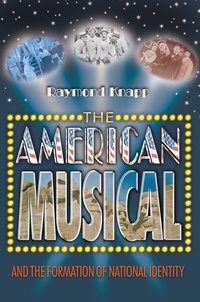
The American Musical and the Formation of National Identity
1st Edition
Published on 19. November 2018
384 pages
978-0-691-18620-7 (ISBN)
Description

The American musical has achieved and maintained relevance to more people in America than any other performance-based art. This thoughtful history of the genre, intended for readers of all stripes, offers probing discussions of how American musicals, especially through their musical numbers, advance themes related to American national identity.
Written by a musicologist and supported by a wealth of illustrative audio examples (on the book's website), the book examines key historical antecedents to the musical, including the Gilbert and Sullivan operetta, nineteenth and early twentieth-century American burlesque and vaudeville, Tin Pan Alley, and other song types. It then proceeds thematically, focusing primarily on fifteen mainstream shows from the twentieth century, with discussions of such notable productions as Show Boat (1927), Porgy and Bess (1935), Oklahoma! (1943), West Side Story (1957), Hair (1967), Pacific Overtures (1976), and Assassins (1991).
The shows are grouped according to their treatment of themes that include defining America, mythologies, counter-mythologies, race and ethnicity, dealing with World War II, and exoticism. Each chapter concludes with a brief consideration of available scholarship on related subjects; an extensive appendix provides information on each show discussed, including plot summaries and song lists, and a listing of important films, videos, audio recordings, published scores, and libretti associated with each musical.
Written by a musicologist and supported by a wealth of illustrative audio examples (on the book's website), the book examines key historical antecedents to the musical, including the Gilbert and Sullivan operetta, nineteenth and early twentieth-century American burlesque and vaudeville, Tin Pan Alley, and other song types. It then proceeds thematically, focusing primarily on fifteen mainstream shows from the twentieth century, with discussions of such notable productions as Show Boat (1927), Porgy and Bess (1935), Oklahoma! (1943), West Side Story (1957), Hair (1967), Pacific Overtures (1976), and Assassins (1991).
The shows are grouped according to their treatment of themes that include defining America, mythologies, counter-mythologies, race and ethnicity, dealing with World War II, and exoticism. Each chapter concludes with a brief consideration of available scholarship on related subjects; an extensive appendix provides information on each show discussed, including plot summaries and song lists, and a listing of important films, videos, audio recordings, published scores, and libretti associated with each musical.
More details
Other editions
Additional editions
Book
04/2006
Princeton University Press
€35.50
Article not available at the moment
Book
11/2004
Princeton University Press
€52.08
Article exhausted; check different version
Person
Raymond Knapp is Professor in the Department of Musicology at the University of California, Los Angeles. He is the author of Symphonic Metamorposes: Subjectivity and Alienation in Mahler's Re-Cycled Songs and Brahms and the Challenge of the Symphony.
Content
- Cover
- Title Page
- Copyright Page
- CONTENTS
- List of Figures
- Explanatory Note about Audio Examples
- Preface
- Part One INTRODUCTIONS
- 1. Contexts and Strategies
- 2. Nineteenth-Century European Roots: Models and Topics
- Paris (and Berlin)
- The Black Crook (1866)
- London: W. S. Gilbert (1836-1911) and Arthur Sullivan (1842-1900)
- H.M.S. Pinafore
- or, The Lass That Loved a Sailor (1878)
- 3. Early American Developments: Minstrelsy, Extravaganza, Pantomime, Burlesque, Vaudeville
- Minstrelsy
- Extravaganza
- Pantomime
- Burlesque
- Vaudeville
- A Gilbert and Sullivan Postscript on American Minstrelsy
- 4. American Song through Tin Pan Alley
- Minstrel Songs
- The Early Tin Pan Alley Era
- Classic Tin Pan Alley
- Anything Goes (1934)
- Part Two DEFINING AMERICA
- 5. Whose (Who's) America?
- Little Johnny Jones (1904)
- The Cradle Will Rock (1938)
- 6. American Mythologies
- Oklahoma! (1943)
- Guys and Dolls (1950)
- The Music Man (1957)
- 7. Counter-mythologies
- Hair (1967-68)
- Assassins (1991)
- Part Three MANAGING AMERICA'S OTHERS
- 8. Race and Ethnicity
- Show Boat (1927)
- Porgy and Bess (1935)
- West Side Story (1957)
- Fiddler on the Roof (1964)
- 9. Dealing with the Second World War
- The Sound of Music (1959)
- Cabaret (1966)
- 10. Exoticism
- The Mikado
- or, The Town of Titipu (1885)
- The King and I (1951)
- Pacific Overtures (1976)
- 11. Afterword: Other Directions, Other Identities
- Appendix A : Art and Commerce: The Business of Making Musicals
- Appendix B: Additional Resources
- Notes
- Bibliography
- Index
