

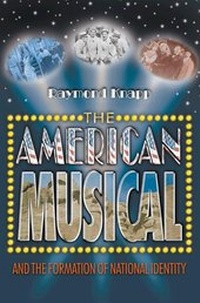
The American Musical and the Formation of National Identity
Published on 14. November 2004
Book
Hardback
360 pages
978-0-691-11864-2 (ISBN)
Description
The American musical has achieved and maintained relevance to more people in America than any other performance-based art. This thoughtful history of the genre, intended for readers of all stripes, offers probing discussions of how American musicals, especially through their musical numbers, advance themes related to American national identity. Written by a musicologist and supported by a wealth of illustrative audio examples (on the book's website), the book examines key historical antecedents to the musical, including the Gilbert and Sullivan operetta, nineteenth and early twentieth-century American burlesque and vaudeville, Tin Pan Alley, and other song types. It then proceeds thematically, focusing primarily on fifteen mainstream shows from the twentieth century, with discussions of such notable productions as Show Boat (1927), Porgy and Bess (1935), Oklahomal (1943), West Side Story (1957), Hair (1967), Pacific Overtures (1976), and Assassins (1991). The shows are grouped according to their treatment of themes that include defining America, mythologies, counter-mythologies, race and ethnicity, dealing with World War II, and exoticism.
Each chapter concludes with a brief consideration of available scholarship on related subjects; an extensive appendix provides information on each show discussed, including plot summaries and song lists, and a listing of important films, videos, audio recordings, published scores, and libretti associated with each musical.
Each chapter concludes with a brief consideration of available scholarship on related subjects; an extensive appendix provides information on each show discussed, including plot summaries and song lists, and a listing of important films, videos, audio recordings, published scores, and libretti associated with each musical.
Reviews / Votes
Knapp does an excellent job of tracing the roots of the musical, avoiding much of the received wisdom... When Knapp focuses on the structure of musicals, and how it works to move us and persuade us, he is very effective... hael Friedman," London Review of Books The breadth of Knapp's reading is astonishing, and his discussion of the historical background of the musical is admirable... Knapp writes extremely well, and not only his thoughts but also his suggestions for further study are well organized. So, too, is his consideration of the growth of the American union in the context of Oklahoma!, Guys and Dolls, and The Music Man. -- Andrew Lamb BBC Music Magazine Knapp's well-researched and comprehensive presentation transcends the purely musical point of view. In his exploration of the underlying sociocultural fabric of a number of works, he puts the American musical theater on a par with its contemporary arts of jazz and film. McCoy," History This is an intelligent, extremely well-written study which ... is as valuable for its demonstration of how musicals may be read as for its own insightful readings. -- Charles Hamm Kurt Weil NewsletterMore details
Language
English
Place of publication
New Jersey
United States
Target group
Professional and scholarly
College/higher education
Product notice
Trade binding
Illustrations
8 Abbildungen, 33 Fotos bzw. Rasterbilder, 8 Notenblätter
8 line illus. 33 halftones. 8 musical examples.
Dimensions
Height: 229 mm
Width: 152 mm
Weight
652 gr
ISBN-13
978-0-691-11864-2 (9780691118642)
Copyright in bibliographic data and cover images is held by Nielsen Book Services Limited or by the publishers or by their respective licensors: all rights reserved.
Schweitzer Classification
Other editions
Additional editions
E-Book
11/2018
1st Edition
Princeton University Press
€33.99
Available for download
Person
Raymond Knapp is Professor in the Department of Musicology at the University of California, Los Angeles. He is the author of "Symphonic Metamorposes: Subjectivity and Alienation in Mahler's Re-Cycled Songs and Brahms and the Challenge of the Symphony".
Content
List of Figures xi Explanatory Note about Audio Examples xiii Preface xv Part One INTRODUCTIONS 1 Chapter 1: Contexts and Strategies 3 Chapter 2: Nineteenth-Century European Roots: Models and Topics 19 Paris (and Berlin) 20 The Black Crook (1866) 20 London: W.S. Gilbert (1836-1911) and Arthur Sullivan (1842-1900) 29 H.M.S. Pinafore; or,The Lass That Loved a Sailor (1878) 34 Chapter 3: Early American Developments: Minstrelsy, Extravaganza, Pantomime, Burlesque, Vaudeville 47 Minstrelsy 49 Extravaganza 59 Pantomime 60 Burlesque 61 Vaudeville 62 A Gilbert and Sullivan Postscript on American Minstrelsy 63 Chapter 4: American Song through Tin Pan Alley 67 Minstrel Songs 67 The Early Tin Pan Alley Era 70 Classic Tin Pan Alley 77 Anything Goes (1934) 88 Part Two DEFINING AMERICA 101 Chapter 5: Whose (Who's) America? 103 Little Johnny Jones (1904) 104 The Cradle Will Rock (1938) 110 Chapter 6: American Mythologies 119 Oklahoma!(1943) 122 Guys and Dolls (1950) 134 The Music Man (1957) 144 Chapter 7: Counter-mythologies 153 Hair (1967-68) 154 Assassins (1991) 162 Part Three MANAGING AMERICA'S OTHERS 179 Chapter 8: Race and Ethnicity 181 Show Boat (1927) 185 Porgy and Bess (1935) 194 West Side Story (1957) 204 Fiddler on the Roof (1964) 215 Chapter 9: Dealing with the Second World War 228 The Sound of Music (1959) 230 Cabaret (1966) 239 Chapter 10: Exoticism 249 The Mikado; or, The Town of Titipu (1885) 250 The King and I (1951) 261 Pacific Overtures (1976) 268 Chapter 11: Afterword: Other Directions, Other Identities 282 Appendix A: Art and Commerce: The Business of Making Musicals 285 Appendix B: Additional Resources 289 Notes 319 Bibliography 341 Index 351