

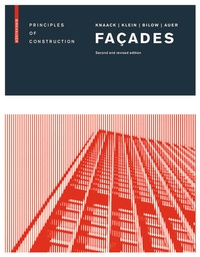
Façades
Description

Fassaden bestimmen die Erscheinung eines Gebäudes, sie verkörpern es gleichsam. Somit kommt ihnen in der Architektur große Bedeutung zu. Gleichzeitig nimmt die Gebäudehülle zentrale Aufgaben wahr - Belichtung, Wetterdichtigkeit, thermische Isolation, Lastenabtragung, Schallschutz, um nur die wichtigsten Funktionen zu nennen. Über die letzten 15 Jahre sind Fassaden erheblich komplexer geworden und die Entwicklung hält an: intelligente, klima-aktive Fassaden beispielsweise passen sich durch selbstregelnde Systeme den verschiedenen Licht- und Klimaverhältnissen an, neu entwickelte Materialien und Technologien haben die Funktionalität der Fassade stark erweitert. Dieses Buch zeigt die Prinzipien der Fassade. Zunächst werden die wichtigsten Typen wie Pfosten-Riegel-Fassade, Vorhangfassade, Elementfassade, Doppelfassade vorgestellt, dann werden ihre Anforderungen an Entwurf und Konstruktion verdeutlicht. Zahlreiche, eigens für dieses Buch entstandene Zeichnungen erklären die einzelnen Fassadentypen und zeigen diese dann am gebauten Beispiel. Für die Neuausgabe wurden die Kapitel aktualisiert, sämtliche Beispiele komplett neu erstellt und das neue Kapitel "Zukünftige Fassaden" gibt einen Ausblick.
More details
Other editions
Additional editions
Persons
Prof. Ulrich Knaack
, TU Darmstadt
Prof. Thomas Auer, Transsolar
Prof. Tillmann Klein, TU Delft
Dr. Marcel Bilow, TU Delft
Content
Building grid and positioning of components Combination of functions Detailing principles Layering of details Examples of detail development Masonry cladding Post-and-beam façade Unit system façade Parapet Plinth unit Joints Tolerances 5 Climate and Energy Façade as interface to the exterior User comfort Thermal requirements Visual requirements Hygienic requirements Acoustic requirements Regulating the comfort level with the façade Ventilation Heating Cooling Sun and glare protection Light-directing systems - Adaptive Façades
Sun Light Heat Greenhouse effect History of adaptive façades Collector façade Trombe wall Transparent heat insulation Exhaust-air façade Double façade Box-window façade Shaft-box façade Corridor façade Second-skin façade
Alternating façade Integrated façade
7 Case Studies Unit system façade: Debitel Headquarters, Stuttgart Solid concrete façade: Zollverein School of Management and Design, Essen Free-form metal façade: Guggenheim Museum, Bilbao Timber-frame structure with multiple cladding: Hageneiland Housing, Ypenburg 8 A Look Into the Future The forces driving new developments Materials and technology Technology transfer Nano coatings Adhesive materials technology Smart materials
Production and assembly Free-form façades Modular construction Composite building materials Generative manufacturing methods Computer technology Evaluation strategies Façade functionality Design tools The integrated envelope Appendix Authors Selected Bibliography Index Illustration Credits
