

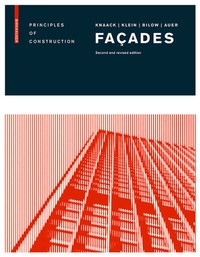
Façades
Principles of Construction
1st Edition
Published on 15. September 2014
Book
Hardback
135 pages
978-3-03821-044-3 (ISBN)
Description
Introduction to building façades as revised editionFaçades determine the appearance of a building. Hence, they constitute a major element in architecture. At the same time, the building's envelope has important functions to fulfil, such as lighting, weatherproofing, thermal insulation, load transfer and sound insulation. Over the past 15 years, façades have become increasingly complex - 'intelligent' facades, for instance, adapt to changing climate and lighting conditions. Newly developed materials and technologies have broadened the scope of façade functions. This book demonstrates the principles of façade construction. It systematically describes the most common types, such as post-and-beam façade, curtain wall, corridor façade or double façade, and provides guidelines for appropriate detailing. Numerous drawings made especially for the book explain the principles of different types of facades, which are then illustrated with built examples. For this second edition, all chapters were revised and all four examples in the case studies chapter were replaced by new material. The new chapter "Future Façades" offers insights into what's next.
More details
Edition
2., rev. ed.
Language
English
Place of publication
Basel/Berlin/Boston
Switzerland
Target group
Professional and scholarly
US School Grade: College Graduate Student
Illustrations
305 Abbildungen
305 b/w ill.
Dimensions
Height: 27 cm
Width: 21 cm
Weight
597 gr
ISBN-13
978-3-03821-044-3 (9783038210443)
Schweitzer Classification
Other editions
Additional editions
E-Book
09/2014
1st Edition
Birkhäuser
€34.95
Available for download
Previous edition

Book
07/2007
1st Edition
Birkhäuser
€32.95
Article exhausted; check for reprint
Persons
Prof. Ulrich Knaack, TU DarmstadtProf. Thomas Auer, Transsolar Prof. Tillmann Klein, TU DelftDr. Marcel Bilow, TU Delft
Content
1 Introduction 2 From Wall to Façade Solid wall construction Warm façade, cold façade Openings in solid wall construction Bridging the gap Single glazing Box window Insulated glazing Walls with skeletal structure Half-timbered construction Platform and balloon framing Resolution of the wall into loadbearing structure and façade Post-and-beam façade Post façade Beam façade Curtain wall System façade Double façades Second-skin façade Box-window façade Shaft-box façade Alternating façade Integrated façade 3 Principles of Construction Areas of construction Façade bearing structures and load transfer Grid and positioning of the façade within the building Systems used in façade construction Post-and-beam construction Unit system façade Designing with systems Openings in façade constructions Hardware Windows Assembly Detailing and Tolerances Building grid and positioning of components Combination of functions Detailing principles Layering of details Examples of detail development Masonry cladding Post-and-beam façade Unit system façade Parapet Plinth unit Joints Tolerances 5 Climate and Energy Façade as interface to the exterior User comfort Thermal requirements Visual requirements Hygienic requirements Acoustic requirements Regulating the comfort level with the façade Ventilation Heating Cooling Sun and glare protection Light-directing systems Adaptive Façades Sun Light Heat Greenhouse effect History of adaptive façades Collector façade Trombe wall Transparent heat insulation Exhaust-air façade Double façade Box-window façade Shaft-box façade Corridor façade Second-skin façadeAlternating façade Integrated façade 7 Case Studies Unit system façade: Debitel Headquarters, Stuttgart Solid concrete façade: Zollverein School of Management and Design, Essen Free-form metal façade: Guggenheim Museum, Bilbao Timber-frame structure with multiple cladding: Hageneiland Housing, Ypenburg 8 A Look Into the Future The forces driving new developments Materials and technology Technology transfer Nano coatings Adhesive materials technology Smart materials Production and assembly Free-form façades Modular construction Composite building materials Generative manufacturing methods Computer technology Evaluation strategies Façade functionality Design tools The integrated envelope Appendix Authors Selected Bibliography Index Illustration Credits