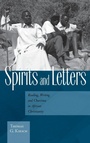
Spirits and Letters
Description
Alles über E-Books | Antworten auf Fragen rund um E-Books, Kopierschutz und Dateiformate finden Sie in unserem Info- & Hilfebereich.
More details
Other editions
Additional editions

Person
Thomas G. Kirsch is professor for Social and Cultural Anthropology at the University of Konstanz. He received his Ph.D. in anthropology from the European University Viadrina in Frankfurt (Oder) in 2002 and taught at the Department of Anthropology and Philosophy in Halle (Saale) and at the Department of Anthropology at Goldsmiths College, University of London, before coming to the University of Konstanz in 2009. Between 1993 and 2001, he conducted extensive ethnographic fieldwork in Zambia. He has published a book on African Christianity in Zambia and articles in some of the major refereed journals for anthropology and sociology in Germany. Other articles were published in the journals American Anthropologist (2004), Visual Anthropology (2006) and American Ethnologist (2007). Since 2003, he has also conducted fieldwork and published on issues of human safety, security and crime prevention in South Africa.

System requirements
File format: ePUB
Copy protection: Watermark-DRM (Digital Rights Management)
System requirements:
- Computer (Windows; MacOS X; Linux): Use a reading software that can process the file format ePUB: e.g., Adobe Digital Editions or FBReader – both free (see eBook Help).
- Tablet/Smartphone (Android; iOS): Before downloading, install the free app Adobe Digital Editions (see eBook Help).
- E-reader: Bookeen, Kobo, Pocketbook, Sony, Tolino and many more (not Kindle).
The file format ePUB works well for novels and non-fiction books – i.e., „flowing” text without complex layout. On an e-reader or smartphone, line and page breaks automatically adjust to fit the small displays.
This eBook uses Watermark-DRM, a „soft” copy protection. This means that there are no technical restrictions to prevent illegal distribution. However, there is a personalised watermark embedded in the eBook that can be used to identify the purchaser of the eBook in the event of misuse and to provide evidence for legal purposes.
For more information, see our eBook Help page.