

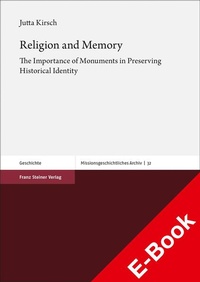
Religion and Memory
The Importance of Monuments in Preserving Historical Identity
1st Edition
Published on 18. May 2021
272 pages
978-3-515-13033-2 (ISBN)
Description

Two twentieth-century genocides set the context of this discussion of history and remembrance: Armenian Christians commemorate their victims from the 1915 Armenian Genocide in their memorial Tsitsernakaberd. And Yad Vashem is an international memorial site for the Jewish Shoah. In the process of coming to terms with the past and preserving the past, a transition to a comprehensive culture of remembrance followed. Memory as a cultural achievement provides ideal orientation for a modern approach and visualization of the traumatic past.
Both memorials represent multilingualism of postmodern architecture in their simple but modern construction. But already in the planning process symbols of traditional religions were vehemently overlooked. Nevertheless, the important questions were taken up: Where is the boundary between the profane and the sacred? How many sacred elements are allowed in the dialogue with the absentee? Despite all the assurances that religion should not play a role in the content of the memorial, Jutta Kirsch shows that behind the political staging and language of the postmodern architecture, a lot of religion is contained in narratives, symbols and biblically inspired texts and contents.
Both memorials represent multilingualism of postmodern architecture in their simple but modern construction. But already in the planning process symbols of traditional religions were vehemently overlooked. Nevertheless, the important questions were taken up: Where is the boundary between the profane and the sacred? How many sacred elements are allowed in the dialogue with the absentee? Despite all the assurances that religion should not play a role in the content of the memorial, Jutta Kirsch shows that behind the political staging and language of the postmodern architecture, a lot of religion is contained in narratives, symbols and biblically inspired texts and contents.
More details
Other editions
Additional editions
Book
05/2021
1st Edition
Franz Steiner Verlag
€61.00
Shipment within 5-7 days
Person
Author
Jutta Kirsch studied theology and religious studies at the University of Liverpool and Humboldt University; doctorate with time for research in Yerevan, and Jerusalem. Her main research fields are Church Dogma and History: Oriental Christianity under persecution, and modern culture and religion: Remembrance and commemoration in monuments and memorials.
Content
- Intro
- Acknowledgements
- Dedication
- Table of Contents
- List of Photographs
- Abstract
- Chapter One: Overview
- 1.1 Title
- 1.2 Introduction
- 1.3 Background
- 1.4 Problem Statement
- 1.5 Central Theoretical Argument
- 1.6 Aims and Objectives
- 1.7 Research Methods
- Chapter Two: The Tragedy of the 1915 Armenian Genocide
- 2.1 Introduction
- 2.2 Armenia Today
- 2.2.1 History and Fate of the Armenians
- 2.3 The Armenian Views of the Cause and Impact of the Genocide
- 2.3.1 The Regime of the Young Turks
- 2.4 Annihilation and Deportation of the Armenians
- 2.5 The German Role in the Armenian Conflict
- 2.5.1 The German Empire Supports Jihad
- 2.5.2 German's Confused Policy of Positioning Today
- 2.5.3 Summary of the Issue surrounding the Armenian Genocide
- 2.6 Primal Religion and Christianity in Armenia
- 2.6.1 The History of Christianity in Armenia
- 2.6.2 Mother Church Etchmiadzin
- 2.6.3 Bible Translation and Christian Culture in Armenia
- 2.7 Was the Armenian Genocide really a Genocide?
- 2.8 Conclusion
- Chapter Three: The Holocaust, Cause and Impact of National Socialism in Germany
- 3.1 Introduction
- 3.2 National Socialism as an Ideology and Pseudo-Religion
- 3.3 The History of the Holocaust
- 3.3.1 The Process of Coming to Terms with one's Past in the Soviet Zone of Divided Germany
- 3.3.2 The Process of Coming to Terms with the Past in Former West-Germany
- 3.4 The Blind Loyalty to Hitler's Religion, Transmission of Emotional Heritage
- 3.4.1 Transmission of Emotional Heritage through Perpetration
- 3.4.2 The Trauma of Holocaust Survivors
- Chapter Four: Theology, Reflection, Memory and Memorials
- 4.1 Introduction
- 4.2 Assmann's Communicative and Cultural Memory
- 4.2.1 Assmann's Analysis and how Cultural Memory works
- 4.3 Cultural Mnemonics as an Educational Memory in Judaism
- 4.3.1 Eight Different Methods of Culturally Shaped Memory in Deuteronomy
- 4.3.2 Memory and Remembrance in zkr as a Basic Category in the Hebrew Bible
- 4.4 Remembrance and Memory in Christianity
- 4.4.1 Christianity and Liturgy
- 4.5 Function of Memory in Profane Monuments and Memorials
- 4.5.1 The Monument
- 4.5.2 The Memorial Site
- 4.6 Conclusion
- Chapter Five: The Armenian Genocide Memorial Complex Tsitsernakaberd
- 5.1 Introduction
- 5.2 The Site and Space of Remembrance, Resistance against Forgetting
- 5.3 What makes Tsitsernakaberd a Special place?
- 5.4 Place for National and Political Memory
- 5.5 The Architectural Competition
- 5.6 Developments of the Model
- 5.7 The Construction of the Monument
- Chapter Six: An Analysis of the Monument and Memorial of Tsitsernakaberd
- 6.1 Introduction
- 6.2 The Basic Structure
- 6.3 The Mausoleum
- 6.4 The Rosette and the Eternal Flame
- 6.5 Martyrs as the Special Dead
- 6.6 Memorial Spire, the Top Tower
- 6.7 The Wall of Memory, Commemoration Wall
- 6.8 Construction for the Armenian People
- 6.9 Soviet Modernism or a Soviet War Memorial?
- 6.10 The Armenian Genocide Museum-Institute
- 6.11 The Entrance Portal
- 6.12 Common Description of the Museum
- 6.13 Outside Gallery and Atrium
- Chapter Seven: The Exhibition of the Armenian Genocide Museum
- 7.1 Introduction
- 7.2 The Topical Presentation of the Experience of Persecution and Eventual Genocide
- 7.3 The Turn from Propaganda and Disparagement to Genocide
- 7.4 The Massacres, Murder of Families, Deportations and the Destruction of Identity
- 7.5 Reflections on the Construction of the Monument Exhibition
- Chapter Eight: Yad Vashem - the Memorial Site
- 8.1 Introduction
- 8.2 The Idea for a Memorial Site for the Jews Who Lost Their Lives
- 8.3 The Zionist Founding Model and its Relationship to the Old Testament
- 8.4 Holocaust Memory and Traditional Characteristics in Modern Israeli Society
- 8.5 The Holocaust Survivors in Conflict with Heroism and Jewish Martyrdom
- Chapter Nine: Yad Vashem - the Culture of Remembrance and Monuments
- 9.1 Introduction: Israeli Culture of Remembrance in Terms
- 9.2 Monuments in Judaism
- 9.3 The Name Yad Vashem and its Special Location
- 9.4 The neighbourhood of Yad Vashem, the National Cemetery on the Herzlberg
- 9.5 A Short Analysis of Yad Vashem, the Memorial Complex
- 9.5.1 The Administration Building
- 9.5.2 The Hall of Remembrance
- 9.5.3 The Synagogue
- 9.5.4 The Garden of the Righteous
- 9.5.5 Monument of Heroism and Resistance on the Campus of Yad Vashem
- 9.5.6 Monument to Jewish Soldiers and Partisans
- 9.5.7 The Warsaw Ghetto Monument
- Chapter Ten: Monuments, Memorials and the Museumon Yad Vashem Campus with the Topic of the Shoah
- 10.1 The Cattle Car Memorial and the Shoah
- 10.2 Monument to the Prisoners in the Concentration Camps
- 10.3 The Six-Branched Candelabra
- 10.4 The Children's Memorial
- 10.5 Memorial for the Destroyed Jewish Communities in Europe
- 10.6 The Yad Vashem Museum
- 10.7.1 A New Museum and a New Architecture
- 10.7.2 The Exhibition in the New Museum
- 10.7.3 The Hall of Names
- 10.8 The Square of Hope
- 10.9 Archives and Libraries
- 10.10 Summary and Comparison of the Memorial Sites Tsitsernakaberd and Yad Vashem
- Chapter Eleven: Conclusion
- 11.1 Introduction
- 11.2 Summing up the Armenian Genocide
- 11.3 The Problem of Sources and Need for Further Research on the Armenian Genocide
- 11.4 Reflections on the Holocaust in Light of the Armenian Genocide
- 11.5 Reflecting on Memorials and Remembrance
- 11.6 Providing a Theological Perspective
- 11.7 Conclusion
- Annexure
- Research Interviews
- Appendix One
- 1.1 Individual memory and the episodic, autobiographical features
- 1.2 The Fathers of collective and cultural Memory
- 1.3 Halbwachs and the cadres sociaux: the socially-shaped individual conditions
- 1.4 Halbwachs' individually shaped Collective Memory
- 1.5 Between collective memory and memory of history
- 1.6 Cultural formation in Noras' Lieux de Mémoire (mnemotope)
- Appendix Two
- Appendix Three
- Appendix Four
- Appendix Five
- Reference List
