

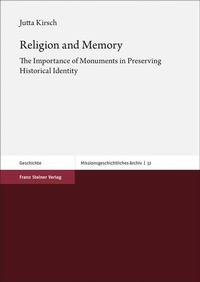
Religion and Memory
The Importance of Monuments in Preserving Historical Identity
1st Edition
Published on 3. May 2021
Book
Paperback/Softback
272 pages
978-3-515-13031-8 (ISBN)
Description
Two twentieth-century genocides set the context of this discussion of history and remembrance: Armenian Christians commemorate their victims from the 1915 Armenian Genocide in their memorial Tsitsernakaberd. And Yad Vashem is an international memorial site for the Jewish Shoah. In the process of coming to terms with the past and preserving the past, a transition to a comprehensive culture of remembrance followed. Memory as a cultural achievement provides ideal orientation for a modern approach and visualization of the traumatic past.
Both memorials represent multilingualism of postmodern architecture in their simple but modern construction. But already in the planning process symbols of traditional religions were vehemently overlooked. Nevertheless, the important questions were taken up: Where is the boundary between the profane and the sacred? How many sacred elements are allowed in the dialogue with the absentee? Despite all the assurances that religion should not play a role in the content of the memorial, Jutta Kirsch shows that behind the political staging and language of the postmodern architecture, a lot of religion is contained in narratives, symbols and biblically inspired texts and contents.
Both memorials represent multilingualism of postmodern architecture in their simple but modern construction. But already in the planning process symbols of traditional religions were vehemently overlooked. Nevertheless, the important questions were taken up: Where is the boundary between the profane and the sacred? How many sacred elements are allowed in the dialogue with the absentee? Despite all the assurances that religion should not play a role in the content of the memorial, Jutta Kirsch shows that behind the political staging and language of the postmodern architecture, a lot of religion is contained in narratives, symbols and biblically inspired texts and contents.
Reviews / Votes
"One of the strenghts of the book is its rare collection of striking images of the Armenian genocide and of the two museums. [.] The book is unique in offering a deep exploration of the meaning of genocide memorials and memory rituals from the standpoint of nationalism, religious and sectarian transmission, and literary and architectural culture."
More details
Series
Language
English
Place of publication
Germany
Product notice
Paperback (trade)
Unsewn / adhesive bound
Illustrations
63
23 s/w Abbildungen, 40 farbige Abbildungen
23 schw.-w. u. 40 farb. Abb.
Dimensions
Height: 24 cm
Width: 17 cm
Thickness: 240 mm
Weight
474 gr
ISBN-13
978-3-515-13031-8 (9783515130318)
Schweitzer Classification
Other editions
Additional editions
E-Book
05/2021
1st Edition
Franz Steiner Verlag
€61.00
Available for download
Person
Author
Jutta Kirsch studied theology and religious studies at the University of Liverpool and Humboldt University; doctorate with time for research in Yerevan, and Jerusalem. Her main research fields are Church Dogma and History: Oriental Christianity under persecution, and modern culture and religion: Remembrance and commemoration in monuments and memorials.