

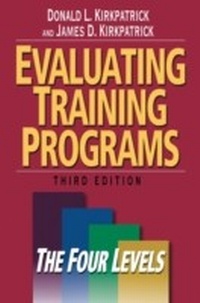
Evaluating Training Programs
The Four Levels
1st Edition
Published on 1. January 2006
393 pages
978-1-57675-796-3 (ISBN)
Description

The ",Kirkpatrick Model", for evaluating training programs is the most widely used approach in the corporate, government, and academic worlds. First developed in 1959, it focuses on four key areas: reaction, learning, behavior, and results. ",Evaluating Training Programs", provides a comprehensive guide to Kirkpatrick's four-level model, along with detailed case studies that show how the approach is used successfully in a wide range of programs and institutions. The third edition revises and updates existing material and includes new strategies for managing change effectively.
More details
Other editions
Additional editions
Book
01/2006
3rd Edition
Berrett-Koehler
€51.50
Shipment within 3-4 weeks
Content
- Intro
- Contents
- Foreword
- Foreword to the Third Edition
- Preface
- Part One: Concepts, Principles, Guidelines, and Techniques
- 1. Evaluating: Part of a Ten-Step Process
- 2. Reasons for Evaluating
- 3. The Four Levels: An Overview
- 4. Evaluating Reaction
- 5. Evaluating Learning
- 6. Evaluating Behavior
- 7. Evaluating Results
- 8. Implementing the Four Levels
- 9. Managing Change
- 10. Using Balanced Scorecards to Transfer Learning to Behavior
- 11. So How Is E-Learning Different?
- Part Two: Case Studies of Implementation
- 12. Developing an Effective Level 1 Reaction Form: Duke Energy Corporation
- 13. Evaluating a Training Program for Nonexempt Employees: First Union National Bank
- 14. Evaluating a Training Program on Developing Supervisory Skills: Management Institute, University of Wisconsin
- 15. Evaluating a Leadership Training Program: Gap Inc.
- 16. Evaluating a Leadership Development Program: U.S. Geological Survey
- 17. Evaluating a Leadership Development Program: Caterpillar, Inc.
- 18. Evaluating Desktop Application Courses: Pollak Learning Alliance (Australia)
- 19. Evaluating an Orientation Program for New Managers: Canada Revenue Agency, Pacific Region
- 20. Evaluating Training for an Outage Management System: PacifiCorp
- 21. Evaluating a Coaching and Counseling Course: Grupo Iberdrola (Spain)
- 22. Evaluating a Performance Learning Model: Defense Acquisition University
- 23. Evaluating an Information Technology Skills Training Program: The Regence Group
- 24. Evaluating a Performance Improvement Program: Toyota Motor Sales, U.S.A., Inc.
- 25. Evaluating a Career Development Initiative: Innovative Computer, Inc.
- 26. Evaluating the Four Levels by Using a New Assessment Process: Army and Air Force Exchange Service (AAFES)
- 27. Evaluating a Training Program at All Four Levels: Cisco Systems, Inc.
- Index
- A
- B
- C
- D
- E
- F
- G
- H
- I
- J
- K
- L
- M
- N
- O
- P
- Q
- R
- S
- T
- U
- V
- W
- The Authors
