

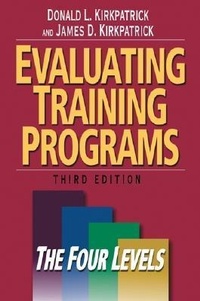
Evaluating Training Programs: The Four Levels
The Four Levels
3rd Edition
Published on 15. January 2006
Book
Hardback
392 pages
978-1-57675-348-4 (ISBN)
Description
Donald Kirkpatrick's four - level model for evaluating training programs has become the most widely used approach to training evaluation in the corporate, government and academic worlds.
In the third edition of this classic bestseller, Kirkpatrick offers new ideas and procedures for continued quality evaluation of the four levels in today's modern workplace.
More details
Edition
3rd edition
Language
English
Place of publication
San Francisco
United States
Target group
Professional and scholarly
Product notice
Unsewn / adhesive bound
Cloth over boards
With dust jacket
Dimensions
Height: 241 mm
Width: 163 mm
Thickness: 38 mm
Weight
770 gr
ISBN-13
978-1-57675-348-4 (9781576753484)
Schweitzer Classification
Other editions
Additional editions
E-Book
01/2006
1st Edition
Berrett-Koehler Publishers
€46.99
Available for download
Previous edition

Book
06/1998
2nd Edition
Pfeiffer Wiley
€51.57
Article exhausted; check for reprint
Persons
As Professor Emeritus, University of Wisconsin, Donald L. Kirkpatrick has been active giving Keynote Presentations at national conferences of professional organisations. He has also given presentations and conducted workshops for many chapters of ASTD and the Society For Human Resource Management (SHRM). In addition, he has conducted programs for many organizations including Knowledge Advisors, Pacificorp, IBM, and Ford.
Content
Foreword
Foreword to the Third Edition
Preface
Part One: Concepts, Principles, Guidelines, and Techniques
Chapter 1: Evaluating: Part of a Ten-Step Process
Chapter 2: Reasons for Evaluating
Chapter 3: The Four Levels: An Overview
Chapter 4: Evaluating Reaction
Chapter 5: Evaluating Learning
Chapter 6: Evaluating Behavior
Chapter 7: Evaluating Results
Chapter 8: Implementing the Four Levels
Chapter 9: Managing Change
Chapter 10: Using Balanced Scorecards to Transfer Learning to Behavior
Chapter 11: So How is E-Learning Different?
Part Two: Case Studies of Implementation
Chapter 12: Developing an Effective Level 1 Reaction Form: Duke Energy Corporation
Chapter 13: Evaluating a Training Program for Nonexempt Employees: First Union National Bank
Chapter 14: Evaluating a Training Program on Developing Supervisory Skills: Management Institute, University of Wisconsin
Chapter 15: Evaluating a Leadership Training Program: Gap Inc.
Chapter 16: Evaluating a Leadership Development Program: US Geological Survey.
Chapter 17: Evaluating a Leadership Development Program: Caterpillar, Inc
Chapter 18: Evaluating Desktop Application Courses: Pollak Learning Alliance (Australia)
Chapter 19: Evaluating an Orientation Program for New Managers: Canada Revenue Agency, Pacific Region
Chapter 20: Evaluating Training for an Outage Management System: Pacificorp
Chapter 21: Evaluating a Coaching and Counseling Course: Grupo Iberdola(Spain)
Chapter 22: Evaluating a Performance Learning Model: Defense Acquisition University
Chapter 23: Evaluating an Information Technology Skills Training Program: The Regence Group
Chapter 24: Evaluating a Performance Improvement Program: Toyota Motor Sales, U.S.A., Inc.
Chapter 25: Evaluating a Career Development Initiative: Innovative Computer, Inc.
Chapter 26: Evaluating the Four Levels by Using a New Assessment Process: Army and Air Force Exchange Services (AAFES)
Chapter 27: Evaluating Training Program at All Four Levels: Cisco Systems, Inc
Index
The Authors
Foreword to the Third Edition
Preface
Part One: Concepts, Principles, Guidelines, and Techniques
Chapter 1: Evaluating: Part of a Ten-Step Process
Chapter 2: Reasons for Evaluating
Chapter 3: The Four Levels: An Overview
Chapter 4: Evaluating Reaction
Chapter 5: Evaluating Learning
Chapter 6: Evaluating Behavior
Chapter 7: Evaluating Results
Chapter 8: Implementing the Four Levels
Chapter 9: Managing Change
Chapter 10: Using Balanced Scorecards to Transfer Learning to Behavior
Chapter 11: So How is E-Learning Different?
Part Two: Case Studies of Implementation
Chapter 12: Developing an Effective Level 1 Reaction Form: Duke Energy Corporation
Chapter 13: Evaluating a Training Program for Nonexempt Employees: First Union National Bank
Chapter 14: Evaluating a Training Program on Developing Supervisory Skills: Management Institute, University of Wisconsin
Chapter 15: Evaluating a Leadership Training Program: Gap Inc.
Chapter 16: Evaluating a Leadership Development Program: US Geological Survey.
Chapter 17: Evaluating a Leadership Development Program: Caterpillar, Inc
Chapter 18: Evaluating Desktop Application Courses: Pollak Learning Alliance (Australia)
Chapter 19: Evaluating an Orientation Program for New Managers: Canada Revenue Agency, Pacific Region
Chapter 20: Evaluating Training for an Outage Management System: Pacificorp
Chapter 21: Evaluating a Coaching and Counseling Course: Grupo Iberdola(Spain)
Chapter 22: Evaluating a Performance Learning Model: Defense Acquisition University
Chapter 23: Evaluating an Information Technology Skills Training Program: The Regence Group
Chapter 24: Evaluating a Performance Improvement Program: Toyota Motor Sales, U.S.A., Inc.
Chapter 25: Evaluating a Career Development Initiative: Innovative Computer, Inc.
Chapter 26: Evaluating the Four Levels by Using a New Assessment Process: Army and Air Force Exchange Services (AAFES)
Chapter 27: Evaluating Training Program at All Four Levels: Cisco Systems, Inc
Index
The Authors