

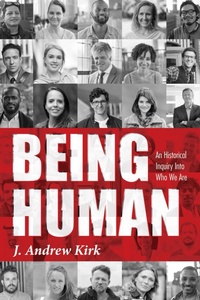
Being Human
An Historical Inquiry Into Who We Are
Published on 25. January 2019
416 pages
978-1-5326-6421-2 (ISBN)
Description

This book offers an introductory review to a wide range of thinking, formulated over the last half-millennium in the Western world, about the meaning of human existence. It will touch on a variety of issues of contemporary significance, such as the origin and uniqueness of the human species, freedom and determinism, the nature of good and evil, and the possibilities and limits of the sciences. The book will supply a number of explanatory comments, from a Christian perspective, on the various views uncovered. Insofar as human beings are fascinated by exploring the reality of their own selves, in relation to history, culture, the natural environment, and a variety of worldviews, this book will afford readers plenty of material to stimulate them in their own exploration.
More details
Other editions
Additional editions
Book
01/2019
Wipf & Stock Publishers
€46.60
Shipment within 3-4 weeks
Book
01/2019
Wipf & Stock Publishers
€71.40
Shipment within 3-4 weeks
Person
After completing three years in Finchley, North London, as an ordained Anglican minister (1963-1966), J. Andrew Kirk has spent much of his life teaching theology in tertiary educational institutions in Argentina and England. He has also taught courses on all six continents. Since retirement (in 2002), he has been involved on a part-time basis with graduate institutes in Eastern and Western Europe, the United Kingdom, and Canada, both teaching and supervising doctoral students. He has degrees in theology (missiology) from the Universities of London, Cambridge, and Nijmegen. He was a founder/member of the Latin American Theological Fraternity (1970), associate director of the London Institute for Contemporary Christianity (1982-1990), theologian missioner of the Church Mission Society (1982-1990), dean and head of the Department of Mission, Selly Oak Colleges (1990-1999), and senior lecturer for the Department of Theology, University of Birmingham (1999-2002). He and his wife have recently completed fifty years of marriage.
Content
- Intro
- Title Page
- Preface
- Acknowledgments
- Prologue
- Chapter 1: Initiating the Inquiry
- Chapter 2: Human Life in Renaissance Humanism
- Chapter 3: Human Reality in the Thought of John Locke
- Chapter 4: The Humanism of the Enlightenment
- Chapter 5: David Hume and Denis Diderot: Two Prominent Figures of the Enlightenment
- Chapter 6: Diagnosing the Human in the Thinking of Karl Marx and His Followers
- Chapter 7: The Human Species According to Charles Darwin
- Chapter 8: Friedrich Nietzsche and the Human Predicament
- Chapter 9: Sigmund Freud and Human Pathologies
- Chapter 10: Human Existence in the Thought of Secular Humanism
- Chapter 11: The Nature and Destiny of Humanity and the Messianic Hope
- Chapter 12: The Gaining of Wisdom?
- Bibliography
