

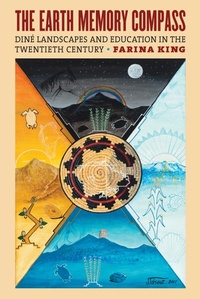
The Earth Memory Compass
Description

The Diné, or Navajo, have their own ways of knowing and being in the world, a cultural identity linked to their homelands through ancestral memory. The Earth Memory Compass traces this tradition as it is imparted from generation to generation, and as it has been transformed, and often obscured, by modern modes of education. An autoethnography of sorts, the book follows Farina King's search for her own Diné identity as she investigates the interconnections among Navajo students, their people, and Diné Bikéyah?or Navajo lands?across the twentieth century.
In her exploration of how historical changes in education have reshaped Diné identity and community, King draws on the insights of ethnohistory, cultural history, and Navajo language. At the center of her study is the Diné idea of the Four Directions, in which each of the cardinal directions takes its meaning from a sacred mountain and its accompanying element: East, for instance, is Sis Naajiní (Blanca Peak) and white shell; West, Dook'o'ooslííd (San Francisco Peaks) and abalone; North, Dibé Nitsaa (Hesperus Peak) and black jet; South, Tsoodzil (Mount Taylor) and turquoise. King elaborates on the meanings and teachings of the mountains and directions throughout her book to illuminate how Navajos have embedded memories in landmarks to serve as a compass for their people?a compass threatened by the dislocation and disconnection of Diné students from their land, communities, and Navajo ways of learning.
Critical to this story is how inextricably Indigenous education and experience is intertwined with American dynamics of power and history. As environmental catastrophes and struggles over resources sever the connections among peoplehood, land, and water, King's book holds out hope that the teachings, guidance, and knowledge of an earth memory compass still have the power to bring the people and the earth together.
Published in Cooperation with the William P. Clements Center for Southwest Studies, Southern Methodist University
More details
Other editions
Additional editions

Person
Content
List of Illustrations
Preface and Acknowledgments
Glossary
Introduction
1. Ha'a'aah (East): Beginnings of Diné Learning
2. Shádi'ááh (South): Challenges in Navajo Schooling
3. E'e'aah (West): Survival in Distant Education
4. Náhookos (North): New Hopes for Diné Students
Epilogue
Notes
Select Bibliography
Index
