

The Earth Memory Compass
Dine Landscapes and Education in the Twentieth Century
Published on 30. October 2018
Book
Paperback/Softback
264 pages
978-0-7006-2691-5 (ISBN)
Description
The Dine, or Navajo, have their own ways of knowing and being in the world, a cultural identity linked to their homelands through ancestral memory. The Earth Memory Compass traces this tradition as it is imparted from generation to generation, and as it has been transformed, and often obscured, by modern modes of education. An autoethnography of sorts, the book follows Farina King's search for her own Dine identity as she investigates the interconnections among Navajo students, their people, and Dine Bikeyah-or Navajo lands-across the twentieth century.
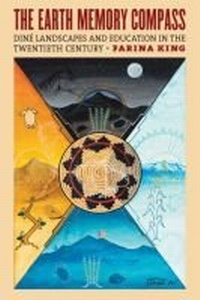
In her exploration of how historical changes in education have reshaped Dine identity and community, King draws on the insights of ethnohistory, cultural history, and Navajo language. At the center of her study is the Dine idea of the Four Directions, in which each of the cardinal directions takes its meaning from a sacred mountain and its accompanying element: East, for instance, is Sis Naajini (Blanca Peak) and white shell; West, Dook'o'oosliid (San Francisco Peaks) and abalone; North, Dibe Nitsaa (Hesperus Peak) and black jet; South, Tsoodzil (Mount Taylor) and turquoise. King elaborates on the meanings and teachings of the mountains and directions throughout her book to illuminate how Navajos have embedded memories in landmarks to serve as a compass for their people-a compass threatened by the dislocation and disconnection of Dine students from their land, communities, and Navajo ways of learning.
Critical to this story is how inextricably Indigenous education and experience is intertwined with American dynamics of power and history. As environmental catastrophes and struggles over resources sever the connections among peoplehood, land, and water, King's book holds out hope that the teachings, guidance, and knowledge of an earth memory compass still have the power to bring the people and the earth together.
In her exploration of how historical changes in education have reshaped Dine identity and community, King draws on the insights of ethnohistory, cultural history, and Navajo language. At the center of her study is the Dine idea of the Four Directions, in which each of the cardinal directions takes its meaning from a sacred mountain and its accompanying element: East, for instance, is Sis Naajini (Blanca Peak) and white shell; West, Dook'o'oosliid (San Francisco Peaks) and abalone; North, Dibe Nitsaa (Hesperus Peak) and black jet; South, Tsoodzil (Mount Taylor) and turquoise. King elaborates on the meanings and teachings of the mountains and directions throughout her book to illuminate how Navajos have embedded memories in landmarks to serve as a compass for their people-a compass threatened by the dislocation and disconnection of Dine students from their land, communities, and Navajo ways of learning.
Critical to this story is how inextricably Indigenous education and experience is intertwined with American dynamics of power and history. As environmental catastrophes and struggles over resources sever the connections among peoplehood, land, and water, King's book holds out hope that the teachings, guidance, and knowledge of an earth memory compass still have the power to bring the people and the earth together.
Reviews / Votes
Farina King's study offers a passionate and thoughtful account of how the Dine, by holding on to their sacred ways of knowing and living, have withstood the long ordeal of educational colonialism. Beautifully written, bold in conception, and packed with intimate stories, this is a must-read for those interested in how indigenous peoples might maintain or rediscover ancestral identities."" - David W. Adams, author of Education for Extinction: American Indians and the Boarding School Experience, 1875-1928 and Three Roads to Magdalena: Coming of Age in a Southwest Borderland, 1890-1990""In engaging and readable prose, Farina King has produced a compelling autoethnography wherein she introduces readers to the concept of the Earth Memory Compass in order to get academics and laypeople alike to rethink the history of twentieth-century Dine educational experiences. In the process, she helps readers think about land, knowledge, and collective identity creation in ways that will help subsequent generations of scholars forge new work."" - Erika Bsumek, author of Indian-Made: Navajo Culture in the Marketplace, 1868-1940
More details
Language
English
Place of publication
Kansas
United States
Target group
Professional and scholarly
Dimensions
Height: 229 mm
Width: 152 mm
Thickness: 22 mm
Weight
446 gr
ISBN-13
978-0-7006-2691-5 (9780700626915)
Copyright in bibliographic data and cover images is held by Nielsen Book Services Limited or by the publishers or by their respective licensors: all rights reserved.
Schweitzer Classification
Other editions
Additional editions
E-Book
10/2018
University Press of Kansas
€29.49
Available for download
Person
Farina King is assistant professor of history and affiliate of the Cherokee and Indigenous Studies Department at Northeastern State University, Tahlequah, Oklahoma.