

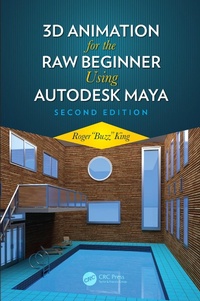
3D Animation for the Raw Beginner Using Autodesk Maya 2e
2nd Edition
Published on 7. February 2019
452 pages
978-1-351-17266-0 (ISBN)
Description

3D Animation for the Raw Beginner Using Autodesk Maya is a hands-on academic textbook as well as a do-it-yourself training manual for the individual animator. This second edition has been completely rewritten to take into account updates to Autodesk Maya, including Autodesk's renderer, Arnold. It contains entirely new examples and tutorial lessons. All 612 images are in full color. The book directs the reader to the parts of Maya that must be mastered in order to create complete 3D projects, and thus it simplifies the process of taking on Maya's vast and intricate interface, while giving the reader a firm foundation on which to build future knowledge of Maya. It also presents brief examples of other popular 3D applications and rendering engines. This principles-based, yet pragmatic book:
Introduces the basic steps of the 3D modeling, materials, animation, lighting, and rendering processes.
Presents clear and concise tutorials that link key concepts to practical techniques.
Includes access to a webpage for the book: https://buzzking.com/AnimationTextbook/AnimationTextbook.html. On this webpage are videos that cover many of the lessons in the book, as well as video tutorials that present bonus material not included in the book.
Frees instructors from the painstaking task of developing step-by-step examples to present Maya's complex interface and basic capabilities.
Boasts an easy-to-follow, tutorial-based learning style ideal for individual study by aspiring animators and do-it yourselfers.
Roger "Buzz" King is a Professor Emeritus at the University of Colorado at Boulder, where he teaches 3D Animation for the Computer Science Department and the Alliance for Technology, Learning, and Society (ATLAS), an institute dedicated to the application of technology to the arts. Buzz is an independent 3D animator who serves on the board of directors of a 3D animation startup. Buzz has a B.A. in Mathematics from Occidental College, an M.S. and Ph.D. in Computer Science from the University of Southern California, and an M.Div. from the Iliff School of Theology.
Key Features
Introduces critical aspects of the 3D animation process
Presents clear and concise tutorials that link key concepts to practical techniques
Includes access to a dedicated Web site, http://3dbybuzz.com, featuring useful videos, lessons, and updates
Frees instructors from developing step-by-step examples to present Maya's complex interface and basic
Boasts an easy-to-follow, hands-on learning style ideal for individual study by aspiring animators and do-ityourselfers
Introduces the basic steps of the 3D modeling, materials, animation, lighting, and rendering processes.
Presents clear and concise tutorials that link key concepts to practical techniques.
Includes access to a webpage for the book: https://buzzking.com/AnimationTextbook/AnimationTextbook.html. On this webpage are videos that cover many of the lessons in the book, as well as video tutorials that present bonus material not included in the book.
Frees instructors from the painstaking task of developing step-by-step examples to present Maya's complex interface and basic capabilities.
Boasts an easy-to-follow, tutorial-based learning style ideal for individual study by aspiring animators and do-it yourselfers.
Roger "Buzz" King is a Professor Emeritus at the University of Colorado at Boulder, where he teaches 3D Animation for the Computer Science Department and the Alliance for Technology, Learning, and Society (ATLAS), an institute dedicated to the application of technology to the arts. Buzz is an independent 3D animator who serves on the board of directors of a 3D animation startup. Buzz has a B.A. in Mathematics from Occidental College, an M.S. and Ph.D. in Computer Science from the University of Southern California, and an M.Div. from the Iliff School of Theology.
Key Features
Introduces critical aspects of the 3D animation process
Presents clear and concise tutorials that link key concepts to practical techniques
Includes access to a dedicated Web site, http://3dbybuzz.com, featuring useful videos, lessons, and updates
Frees instructors from developing step-by-step examples to present Maya's complex interface and basic
Boasts an easy-to-follow, hands-on learning style ideal for individual study by aspiring animators and do-ityourselfers
More details
Edition
2nd edition
Language
English
Place of publication
London
United Kingdom
Publishing group
Taylor & Francis Ltd
Target group
Professional and scholarly
Product notice
Reflowable
Illustrations
606 Halftones, color; 4 Illustrations, color
File size
42,88 MB
ISBN-13
978-1-351-17266-0 (9781351172660)
Copyright in bibliographic data and cover images is held by Nielsen Book Services Limited or by the publishers or by their respective licensors: all rights reserved.
Schweitzer Classification
Other editions
Additional editions
Book
02/2019
2nd Edition
CRC Press
€283.40
Shipment within 15-20 days
Book
02/2019
2nd Edition
CRC Press
€80.71
Shipment within 15-20 days
Person
Roger "Buzz" King is a professor at the University of Colorado, Boulder, where he teaches 3D animation for the Computer Science Department and ATLAS, an institute dedicated to the application of technology to the arts. He is a member of the board of advisors for a graphics startup, the cofounder of a second graphics startup, and currently focusing on his 3D modeling studio (http://BuzzWorks.buzz). He holds an AB from Occidental College, Los Angeles and a Ph.D from USC. His research has been funded by the US Air Force, Navy, NASA, DARPA, DOE, NREL, Smithsonian, IBM, and AT&T. He has served as an expert FBI witness and been involved in the original development of the Encyclopedia of Life.
Content
The 3D Surface Modeling World: Viewing 3D Vector Models in a 2D Pixel Space. Crafting Polygon Models. What Is Polygon
Modeling: Why Is It Still the Gold Standard?. Doing A Lot with A Little: A Core Set of Polygon & Sculpting Tools. The Top-Down
Crafting of a Basic Polygon Mesh: A Moai from Rapa Nui. Placing Polygon Meshes into Object Hierarchies: Furniture. Adding Detail
to Models and Smoothing Organic Polygon Surfaces: Plant-life. Building Complete Scenes & the 3D Workflow. Going Deeper:
More Polygon Primitives, Reuse of Components & Issues of Scale. A Basic Interior Architectural Scene: A Prison Cell. A Basic
Exterior Architectural Scene: A Modern Greenhouse. A More Complex Interior Architectural Scene: A Modern Home. A More
Complex Exterior Architectural Scene: A Modern Home & Grounds. Bringing Polygon Meshes to Life: Materials, Lights, Ray-
Tracing & Rendering. Organic Modeling with Curves and NURBS Curves. Organic Modeling: The Mathematics of Bezier and
NURBS Curve Mathematics. Two Ways of Being Organic: Smoothing Polygon Models VS Curve-Based Models. Doing A Lot with A
Little: A Core Set of Curve-Based Modeling & Sculpting Tools. Basic Organic Models: Bottles & Glasses, Trees & Plants. Advanced
Curve-Based Modeling Tools: Adding Organic Detail to Our Moai. Advanced Materials, Lights, and Rendering. Photorealistic
Rendering: The Interplay of Materials, Lights, and Rendering. Lighting Approaches: Point/Area/Spot/Directional, HDRI & 3-Point
Lighting. Shaders: Seamless Textures, uv Mapping & Bump/Displacement/Normal Maps. Materials: Brick/Stone/Plaster/Marble,
Metals/Glass, Wood, Soil/Rocks & Skies. Blending Texture Layers: Aging & Grunging Materials. Using Plugins: Natural Terrain,
Dynamics, Lighting, Painting & Renderers. Popular 3D Applications: Maya, Houdini, MODO, Rhino3D, 3DS Max & ZBrush.
Renderers: mental ray, Arnold, Redshift, Octane, V-Ray, Renderman & Maxwell. Animating a Scene. Basic Animation:
Rotate/Scale/Translate, Keyframing & Motion Paths. Hard/Soft Dynamics: Pool Balls & Metal Deformations. Emitters & Particle
Dynamics: Rain, Smoke, Water & Pouring Cold Cereal. Deformers & Blendshapes: Coiled Hoses, Pool Covers & Human Faces.
Character Animation: Skeletons, Rigging & Skinning. Finishing a Basic 3D Workflow: Video & Audio Editing.
Modeling: Why Is It Still the Gold Standard?. Doing A Lot with A Little: A Core Set of Polygon & Sculpting Tools. The Top-Down
Crafting of a Basic Polygon Mesh: A Moai from Rapa Nui. Placing Polygon Meshes into Object Hierarchies: Furniture. Adding Detail
to Models and Smoothing Organic Polygon Surfaces: Plant-life. Building Complete Scenes & the 3D Workflow. Going Deeper:
More Polygon Primitives, Reuse of Components & Issues of Scale. A Basic Interior Architectural Scene: A Prison Cell. A Basic
Exterior Architectural Scene: A Modern Greenhouse. A More Complex Interior Architectural Scene: A Modern Home. A More
Complex Exterior Architectural Scene: A Modern Home & Grounds. Bringing Polygon Meshes to Life: Materials, Lights, Ray-
Tracing & Rendering. Organic Modeling with Curves and NURBS Curves. Organic Modeling: The Mathematics of Bezier and
NURBS Curve Mathematics. Two Ways of Being Organic: Smoothing Polygon Models VS Curve-Based Models. Doing A Lot with A
Little: A Core Set of Curve-Based Modeling & Sculpting Tools. Basic Organic Models: Bottles & Glasses, Trees & Plants. Advanced
Curve-Based Modeling Tools: Adding Organic Detail to Our Moai. Advanced Materials, Lights, and Rendering. Photorealistic
Rendering: The Interplay of Materials, Lights, and Rendering. Lighting Approaches: Point/Area/Spot/Directional, HDRI & 3-Point
Lighting. Shaders: Seamless Textures, uv Mapping & Bump/Displacement/Normal Maps. Materials: Brick/Stone/Plaster/Marble,
Metals/Glass, Wood, Soil/Rocks & Skies. Blending Texture Layers: Aging & Grunging Materials. Using Plugins: Natural Terrain,
Dynamics, Lighting, Painting & Renderers. Popular 3D Applications: Maya, Houdini, MODO, Rhino3D, 3DS Max & ZBrush.
Renderers: mental ray, Arnold, Redshift, Octane, V-Ray, Renderman & Maxwell. Animating a Scene. Basic Animation:
Rotate/Scale/Translate, Keyframing & Motion Paths. Hard/Soft Dynamics: Pool Balls & Metal Deformations. Emitters & Particle
Dynamics: Rain, Smoke, Water & Pouring Cold Cereal. Deformers & Blendshapes: Coiled Hoses, Pool Covers & Human Faces.
Character Animation: Skeletons, Rigging & Skinning. Finishing a Basic 3D Workflow: Video & Audio Editing.
