

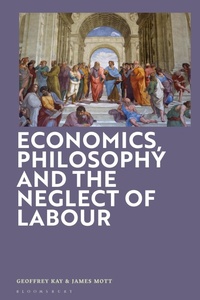
Economics, Philosophy and the Neglect of Labour
1st Edition
Published on 5. February 2026
208 pages
978-1-350-53474-2 (ISBN)
Description

Economics, Philosophy and the Neglect of Labour reasserts the significance of labour in economics and philosophy, both within and beyond the Marxist tradition. It explores how labour has been systematically neglected and misunderstood in Western thought - from its reductive treatment in biblical and classical texts, through its displacement during the scholastic period and the Enlightenment, to its marginalisation in modern political economy and law.
Tracing this long history of neglect, Geoffrey Kay and James Mott challenge the assumption that labour is merely instrumental - a view rooted in the British moralists and perpetuated by Adam Smith and his followers. In contrast, they draw on Aristotelian ideas of teleology, and their transformation in Hegel and Marx, to recover a purposive and creative tradition of labour. While Heidegger's ontology of Being, for example, excludes labour and creativity, Kay and Mott position labour as the vital site of creative activity. This not only challenges Heidegger's appropriation of techne but also affirms the enduring relevance of Aristotelianism in Marx's thought.
Revisiting the labour theory of value in light of technological transformation, financialisation and the expansion of consumption, Economics, Philosophy and the Neglect of Labour argues that labour remains central to understanding the dynamics and contradictions of the contemporary world.
Tracing this long history of neglect, Geoffrey Kay and James Mott challenge the assumption that labour is merely instrumental - a view rooted in the British moralists and perpetuated by Adam Smith and his followers. In contrast, they draw on Aristotelian ideas of teleology, and their transformation in Hegel and Marx, to recover a purposive and creative tradition of labour. While Heidegger's ontology of Being, for example, excludes labour and creativity, Kay and Mott position labour as the vital site of creative activity. This not only challenges Heidegger's appropriation of techne but also affirms the enduring relevance of Aristotelianism in Marx's thought.
Revisiting the labour theory of value in light of technological transformation, financialisation and the expansion of consumption, Economics, Philosophy and the Neglect of Labour argues that labour remains central to understanding the dynamics and contradictions of the contemporary world.
More details
Edition
1. Auflage
Language
English
Place of publication
London
United Kingdom
Publishing group
Bloomsbury Publishing PLC
Target group
Professional and scholarly
Illustrations
10 bw illus
ISBN-13
978-1-350-53474-2 (9781350534742)
Copyright in bibliographic data and cover images is held by Nielsen Book Services Limited or by the publishers or by their respective licensors: all rights reserved.
Schweitzer Classification
Other editions
Additional editions
Geoffrey Kay | James Mott
Economics, Philosophy and the Neglect of Labour
Book
approx. 02/2026
Bloomsbury Academic
€117.20
Not yet published
Persons
Geoffrey Kay was Senior Lecturer in Economics at City University, UK. His publications include Development and Underdevelopment: A Marxist Analysis (1975), The Economic Theory of the Working Class (1979), and Political Order and the Law of Labour (1982), co-authored with James Mott.
James Mott was Lecturer in Sociology at City University and Chair of the sociology and philosophy group until retirement. He is co-author of Political Order and the Law of Labour (1982).
James Mott was Lecturer in Sociology at City University and Chair of the sociology and philosophy group until retirement. He is co-author of Political Order and the Law of Labour (1982).
Content
Preface
1. Creativity and Toil
2. The Mechanical Arts
3. Instrumental Labour
4. Purposive Labour
5. Philosophy and Labour
6. The Philosophical Negation of Labour
7. The Philosophical Affirmation of Labour: György Lukács
8. Labour and Capital
9. Beyond the Labour Theory of Value
Bibliography
1. Creativity and Toil
2. The Mechanical Arts
3. Instrumental Labour
4. Purposive Labour
5. Philosophy and Labour
6. The Philosophical Negation of Labour
7. The Philosophical Affirmation of Labour: György Lukács
8. Labour and Capital
9. Beyond the Labour Theory of Value
Bibliography
