

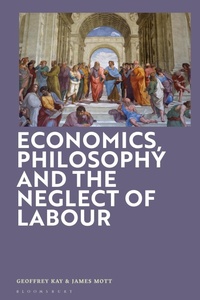
Economics, Philosophy and the Neglect of Labour
Will be published approx. on 5. February 2026
Book
Hardback
208 pages
978-1-350-53473-5 (ISBN)
Description
Economics, Philosophy and the Neglect of Labour reasserts the significance of labour in economics and philosophy, both within and beyond the Marxist tradition.
It explores how labour has been systematically neglected and misunderstood in Western thought - from its reductive treatment in biblical and classical texts, through its displacement during the scholastic period and the Enlightenment, to its marginalisation in modern political economy and law. By tracing this long history of neglect, Geoffrey Kay and James Mott challenge the assumption that labour is merely instrumental, a view rooted in the British moralists and perpetuated by Adam Smith and his followers. In contrast, they recover a tradition in which labour is purposive and creative, drawing on Aristotelian ideas of teleology and their transformation in Hegel and Marx.
The book presents a critical examination of Heidegger's attempt to undermine this perspective. While Heidegger's ontology of Being excludes labour and creativity, Kay and Mott position labour as the vital site of creative activity, drawing on Lukacs's integration of Aristotelian concepts of teleology and social praxis. This not only challenges Heidegger's appropriation of techne but also affirms the enduring relevance of Aristotelianism in Marx's thought. The impoverished conception of labour within the development of economics perpetuates its neglect, obscuring its true significance. Revisiting the labour theory of value in light of technological transformation, financialisation and the expansion of consumption, Economics, Philosophy and the Neglect of Labour argues that labour remains central to understanding the dynamics and contradictions of the contemporary world.
It explores how labour has been systematically neglected and misunderstood in Western thought - from its reductive treatment in biblical and classical texts, through its displacement during the scholastic period and the Enlightenment, to its marginalisation in modern political economy and law. By tracing this long history of neglect, Geoffrey Kay and James Mott challenge the assumption that labour is merely instrumental, a view rooted in the British moralists and perpetuated by Adam Smith and his followers. In contrast, they recover a tradition in which labour is purposive and creative, drawing on Aristotelian ideas of teleology and their transformation in Hegel and Marx.
The book presents a critical examination of Heidegger's attempt to undermine this perspective. While Heidegger's ontology of Being excludes labour and creativity, Kay and Mott position labour as the vital site of creative activity, drawing on Lukacs's integration of Aristotelian concepts of teleology and social praxis. This not only challenges Heidegger's appropriation of techne but also affirms the enduring relevance of Aristotelianism in Marx's thought. The impoverished conception of labour within the development of economics perpetuates its neglect, obscuring its true significance. Revisiting the labour theory of value in light of technological transformation, financialisation and the expansion of consumption, Economics, Philosophy and the Neglect of Labour argues that labour remains central to understanding the dynamics and contradictions of the contemporary world.
Reviews / Votes
This work presents a historical survey of the ways in which labour has been conceived by leading thinkers of the ages. The scholarship of Kay and Mott is very impressive, as they move surefootedly from the Old Testament to Karl Marx. With regard to the latter they present a challenging alternative to his labour theory of value. * Christopher J. Arthur, author of The Spectre of Capital: Idea and Reality (2022) and The New Dialectic and Marx's 'Capital' (2002), Formerly of University of Sussex, UK * Marxism needs a deep rethink of concepts of labour and value. Dramatic changes in technology and employment law are now transforming labour's link to work and its claims to value production. This book opens that project. Its encyclopaedic exploration of the conceptual history of labour enables Kay and Mott to construct a profound yet straightforward reframing of Marx's project. This analysis is a monumental achievement and a lifeline to the future of a Marxian theory of value. * Dick Bryan and Mike Rafferty, authors of Capitalism with Derivatives (2006) *More details
Language
English
Place of publication
London
United Kingdom
Publishing group
Bloomsbury Publishing PLC
Target group
Professional and scholarly
Illustrations
10 bw illus
Dimensions
Height: 240 mm
Width: 161 mm
Thickness: 16 mm
Weight
473 gr
ISBN-13
978-1-350-53473-5 (9781350534735)
Copyright in bibliographic data and cover images is held by Nielsen Book Services Limited or by the publishers or by their respective licensors: all rights reserved.
Schweitzer Classification
Other editions
Additional editions
Geoffrey Kay | James Mott
Economics, Philosophy and the Neglect of Labour
E-Book
02/2026
1st Edition
Bloomsbury Academic
€94.49
Available for download
Geoffrey Kay | James Mott
Economics, Philosophy and the Neglect of Labour
E-Book
02/2026
1st Edition
Bloomsbury Academic
€94.49
Available for download
Persons
Geoffrey Kay was Senior Lecturer in Economics at City University, UK. His publications include Development and Underdevelopment: A Marxist Analysis (1975), The Economic Theory of the Working Class (1979), and Political Order and the Law of Labour (1982), co-authored with James Mott.
James Mott was Lecturer in Sociology at City University and Chair of the sociology and philosophy group until retirement. He is co-author of Political Order and the Law of Labour (1982).
James Mott was Lecturer in Sociology at City University and Chair of the sociology and philosophy group until retirement. He is co-author of Political Order and the Law of Labour (1982).
Content
Preface
1. Creativity and Toil
2. The Mechanical Arts
3. Instrumental Labour
4. Purposive Labour
5. Philosophy and Labour
6. The Philosophical Negation of Labour
7. The Philosophical Affirmation of Labour: Gyorg Lukcs
8. Labour and Capital
9. Beyond the Labour Theory of Value
Bibliography
1. Creativity and Toil
2. The Mechanical Arts
3. Instrumental Labour
4. Purposive Labour
5. Philosophy and Labour
6. The Philosophical Negation of Labour
7. The Philosophical Affirmation of Labour: Gyorg Lukcs
8. Labour and Capital
9. Beyond the Labour Theory of Value
Bibliography