

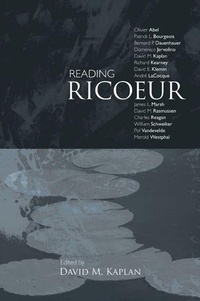
Reading Ricoeur
Description

In Reading Ricoeur, fourteen well-known scholars interpret, evaluate, and criticize the works of Paul Ricoeur, one of the twentieth century's most important and far-reaching philosophers. The contributors discuss Ricoeur's entire philosophical career: from his existentialist-phenomenology of the 1940s and '50s; his hermeneutics and critique of structuralism in the 1960s and '70s; his narrative and moral philosophy of the 1980s; his political and legal philosophy of the 1990s; his recent work on memory, forgiveness, and recognition; as well as his enduring interests in religious language and the problem of evil. The contributors not only explain the central concepts and structures of Ricoeur's philosophy, but they also bring him into dialogue with his contemporaries, including Sartre, Heidegger, Gadamer, Habermas, Rawls, and Lyotard. Reading Ricoeur demonstrates the central role of Paul Ricoeur in the development of twentieth-century philosophy.
David M. Kaplan is Assistant Professor of Philosophy at the University of North Texas and the author of Ricoeur's Critical Theory, also published by SUNY Press.
More details
Other editions
Additional editions
Person
David M. Kaplan is Assistant Professor of Philosophy at the University of North Texas and the author of Ricoeur's Critical Theory, also published by SUNY Press.
Content
Introduction: "Reading Ricoeur"
David M. Kaplan
1. Ricoeur's Phenomenology of Freedom as an Answer to Sartre"
James L. Marsh
2. What Makes Us Think? Two Views
Bernard Dauenhauer
3. Philosophy and Kerygma: Ricoeur as Reader of the Bible
David E. Klemm
4. On the Hermeneutics of Evil
Richard Kearney
5. Paul Ricoeur and the Prospects of a New Humanism
William Schweiker
6. Ricoeur's Hermeneutic Phenomenology of Religion
Merold Westphal
7. Love Proceeds by Poetic Amplification
André LaCocque
8. The Challenge of the "such as it was": Ricoeur's Theory of Narratives"
Pol Vandevelde
9. Ricoeur and Lyotard in Postmodern Dialogue: Symbol and the Sublime
Patrick L. Bourgeois
10. Paul Ricoeur's Hermeneutics: From Critique to Poetics
Olivier Abel
10. Ricoeur's Critical Theory
David M. Kaplan
12. Justice and Interpretation
David Rasmussen
13. Rethinking Ricoeur: The Unity of His Work and the Paradigm of Translation"
Domenico Jervolino
14. Binding and Loosing, Promising and Pardoning, Memory and Forgetfulness
Charles E. Reagan
Contributors
