

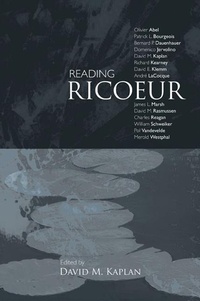
Reading Ricoeur
Published on 24. July 2008
Book
Hardback
270 pages
978-0-7914-7525-6 (ISBN)
Description
Introduces readers to the work of Paul Ricoeur, one of the twentieth century's leading philosophers.
In Reading Ricoeur, fourteen well-known scholars interpret, evaluate, and criticize the works of Paul Ricoeur, one of the twentieth century's most important and far-reaching philosophers. The contributors discuss Ricoeur's entire philosophical career: from his existentialist-phenomenology of the 1940s and '50s; his hermeneutics and critique of structuralism in the 1960s and '70s; his narrative and moral philosophy of the 1980s; his political and legal philosophy of the 1990s; his recent work on memory, forgiveness, and recognition; as well as his enduring interests in religious language and the problem of evil. The contributors not only explain the central concepts and structures of Ricoeur's philosophy, but they also bring him into dialogue with his contemporaries, including Sartre, Heidegger, Gadamer, Habermas, Rawls, and Lyotard. Reading Ricoeur demonstrates the central role of Paul Ricoeur in the development of twentieth-century philosophy.
In Reading Ricoeur, fourteen well-known scholars interpret, evaluate, and criticize the works of Paul Ricoeur, one of the twentieth century's most important and far-reaching philosophers. The contributors discuss Ricoeur's entire philosophical career: from his existentialist-phenomenology of the 1940s and '50s; his hermeneutics and critique of structuralism in the 1960s and '70s; his narrative and moral philosophy of the 1980s; his political and legal philosophy of the 1990s; his recent work on memory, forgiveness, and recognition; as well as his enduring interests in religious language and the problem of evil. The contributors not only explain the central concepts and structures of Ricoeur's philosophy, but they also bring him into dialogue with his contemporaries, including Sartre, Heidegger, Gadamer, Habermas, Rawls, and Lyotard. Reading Ricoeur demonstrates the central role of Paul Ricoeur in the development of twentieth-century philosophy.
Reviews / Votes
"Anyone with an interest in Ricoeur will profit from this exceptionally well-conceived and well-crafted compilation; it touches on every significant aspect of the thinker's oeuvre ... the Ricoeur that emerges here embodies all that his audience esteems in the engaged intellectual's efforts to forge a living connection between critical reflection and responsible action." - CHOICE"I fully believe that Ricoeur's work is crucial to contemporary theory. In philosophy, religious studies, aesthetics, humanities, and social sciences in general, Ricoeur has a clear place and this collection covers the wide range that is needed." - Farhang Erfani, American University
More details
Language
English
Place of publication
Albany, NY
United States
Target group
College/higher education
US School Grade: From College Freshman to College Graduate Student
Product notice
Unsewn / adhesive bound
Paper over boards
Dimensions
Height: 229 mm
Width: 157 mm
Thickness: 23 mm
Weight
499 gr
ISBN-13
978-0-7914-7525-6 (9780791475256)
Copyright in bibliographic data and cover images is held by Nielsen Book Services Limited or by the publishers or by their respective licensors: all rights reserved.
Schweitzer Classification
Other editions
Additional editions
David M. Kaplan
Reading Ricoeur
E-Book
07/2008
State University of New York Press
€35.99
Available for download
Person
David M. Kaplan is Assistant Professor of Philosophy at the University of North Texas and the author of Ricoeur's Critical Theory, also published by SUNY Press.
Content
Introduction: "Reading Ricoeur"
David M. Kaplan
1. Ricoeur's Phenomenology of Freedom as an Answer to Sartre"
James L. Marsh
2. What Makes Us Think? Two Views
Bernard Dauenhauer
3. Philosophy and Kerygma: Ricoeur as Reader of the Bible
David E. Klemm
4. On the Hermeneutics of Evil
Richard Kearney
5. Paul Ricoeur and the Prospects of a New Humanism
William Schweiker
6. Ricoeur's Hermeneutic Phenomenology of Religion
Merold Westphal
7. Love Proceeds by Poetic Amplification
Andre LaCocque
8. The Challenge of the "such as it was": Ricoeur's Theory of Narratives"
Pol Vandevelde
9. Ricoeur and Lyotard in Postmodern Dialogue: Symbol and the Sublime
Patrick L. Bourgeois
10. Paul Ricoeur's Hermeneutics: From Critique to Poetics
Olivier Abel
10. Ricoeur's Critical Theory
David M. Kaplan
12. Justice and Interpretation
David Rasmussen
13. Rethinking Ricoeur: The Unity of His Work and the Paradigm of Translation"
Domenico Jervolino
14. Binding and Loosing, Promising and Pardoning, Memory and Forgetfulness
Charles E. Reagan
Contributors
David M. Kaplan
1. Ricoeur's Phenomenology of Freedom as an Answer to Sartre"
James L. Marsh
2. What Makes Us Think? Two Views
Bernard Dauenhauer
3. Philosophy and Kerygma: Ricoeur as Reader of the Bible
David E. Klemm
4. On the Hermeneutics of Evil
Richard Kearney
5. Paul Ricoeur and the Prospects of a New Humanism
William Schweiker
6. Ricoeur's Hermeneutic Phenomenology of Religion
Merold Westphal
7. Love Proceeds by Poetic Amplification
Andre LaCocque
8. The Challenge of the "such as it was": Ricoeur's Theory of Narratives"
Pol Vandevelde
9. Ricoeur and Lyotard in Postmodern Dialogue: Symbol and the Sublime
Patrick L. Bourgeois
10. Paul Ricoeur's Hermeneutics: From Critique to Poetics
Olivier Abel
10. Ricoeur's Critical Theory
David M. Kaplan
12. Justice and Interpretation
David Rasmussen
13. Rethinking Ricoeur: The Unity of His Work and the Paradigm of Translation"
Domenico Jervolino
14. Binding and Loosing, Promising and Pardoning, Memory and Forgetfulness
Charles E. Reagan
Contributors