

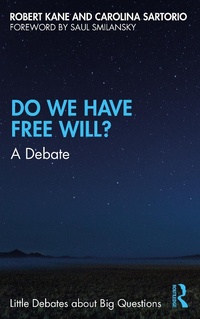
Do We Have Free Will?
A Debate
1st Edition
Published on 30. September 2021
232 pages
978-1-000-44945-7 (ISBN)
Description

In this little but profound volume, Robert Kane and Carolina Sartorio debate a perennial question: Do We Have Free Will?
Kane introduces and defends libertarianism about free will: free will is incompatible with determinism; we are free; we are not determined. Sartorio introduces and defends compatibilism about free will: free will is compatible with determinism; we can be free even while our actions are determined through and through. Simplifying tricky terminology and complicated concepts for readers new to the debate, the authors also cover the latest developments on a controversial topic that gets us entangled in questions about blameworthiness and responsibility, coercion and control, and much more.
Each author first presents their own side, and then they interact through two rounds of objections and replies. Pedagogical features include standard form arguments, section summaries, bolded key terms and principles, a glossary, and annotated reading lists. Short, lively and accessible, the debate showcases diverse and cutting-edge work on free will. As per Saul Smilansky's foreword, Kane and Sartorio, "present the readers with two things at once: an introduction to the traditional free will problem; and a demonstration of what a great yet very much alive and relevant philosophical problem is like."
Key Features:
Covers major concepts, views and arguments about free will in an engaging format
Accessible style and pedagogical features for students and general readers
Cutting-edge contributions by preeminent scholars on free will.
Kane introduces and defends libertarianism about free will: free will is incompatible with determinism; we are free; we are not determined. Sartorio introduces and defends compatibilism about free will: free will is compatible with determinism; we can be free even while our actions are determined through and through. Simplifying tricky terminology and complicated concepts for readers new to the debate, the authors also cover the latest developments on a controversial topic that gets us entangled in questions about blameworthiness and responsibility, coercion and control, and much more.
Each author first presents their own side, and then they interact through two rounds of objections and replies. Pedagogical features include standard form arguments, section summaries, bolded key terms and principles, a glossary, and annotated reading lists. Short, lively and accessible, the debate showcases diverse and cutting-edge work on free will. As per Saul Smilansky's foreword, Kane and Sartorio, "present the readers with two things at once: an introduction to the traditional free will problem; and a demonstration of what a great yet very much alive and relevant philosophical problem is like."
Key Features:
Covers major concepts, views and arguments about free will in an engaging format
Accessible style and pedagogical features for students and general readers
Cutting-edge contributions by preeminent scholars on free will.
Reviews / Votes
'This superb introduction to free will is highly accessible without paying the price in over-simplification. The debate format does a wonderful job of highlighting the pros and cons of Kane's and Sartorio's competing positions on free will. Ideal for an undergraduate course on free will.' - Alfred R. Mele, Florida State University, USA'This is an outstanding book by two of the very top philosophers working on free will and moral responsibility. They are each perfect representatives of the best recent developments of two important positions: libertarianism and compatibilism. The book is clear and lively, and it is a perfect text for an undergraduate course on these topics. Highly recommended!' - John Martin Fischer, University of California, Riverside, USA
More details
Series
Edition
1. Auflage
Language
English
Place of publication
London
United Kingdom
Publishing group
Taylor & Francis Ltd
Target group
College/higher education
Product notice
Reflowable
Illustrations
1 Line drawings, black and white; 1 Illustrations, black and white
ISBN-13
978-1-000-44945-7 (9781000449457)
Copyright in bibliographic data and cover images is held by Nielsen Book Services Limited or by the publishers or by their respective licensors: all rights reserved.
Schweitzer Classification
Other editions
Additional editions
Book
09/2021
1st Edition
Routledge
€207.30
Shipment within 15-20 days
Book
09/2021
1st Edition
Routledge
€47.60
Shipment within 15-20 days
Book
09/2021
Routledge
Unfortunately, price unknown
Available (delivery time upon request)
Persons
Robert Kane is University Distinguished Professor of Philosophy and Law Emeritus at the University of Texas at Austin, USA. He is the author of Free Will and Values (1985), Through the Moral Maze (1993), The Significance of Free Will (1996), A Contemporary Introduction to Free Will (2005), Ethics and the Quest for Wisdom (2010), as well as editor of The Oxford Handbook of Free Will (2002, 2011), and author of more than eighty journal articles.
Carolina Sartorio is Professor of Philosophy at the University of Arizona, USA. Her research expertise focuses on issues in causation, agency, free will, and moral responsibility. She is the author of numerous leading research articles in these areas and the book, Causation and Free Will (2016).
Saul Smilansky is Professor of Philosophy at the University of Haifa, Israel.
Carolina Sartorio is Professor of Philosophy at the University of Arizona, USA. Her research expertise focuses on issues in causation, agency, free will, and moral responsibility. She is the author of numerous leading research articles in these areas and the book, Causation and Free Will (2016).
Saul Smilansky is Professor of Philosophy at the University of Haifa, Israel.
Content
Series Preface Foreword Saul Smilansky Opening Statements 1. The Problem of Free Will: A Libertarian Perspective Robert Kane 2. Free Will and Determinism: A Compatibilism Carolina Sartorio First Round of Replies 3. Reply to Carolina Sartorio's Opening Statement Robert Kane 4. Reply to Bob Kane's Opening Statement Carolina Sartorio Second Round of Replies 5. Reply to Carolina Sartorio's Reply Robert Kane 6. Reply to Bob Kane's Reply Carolina Sartorio Further Readings Glossary References Index
