

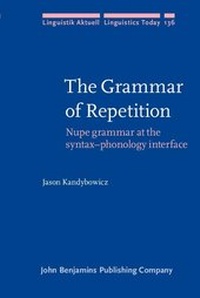
The Grammar of Repetition
Nupe grammar at the syntax-phonology interface
1st Edition
Published on 27. November 2008
XIII, 168 pages
978-90-272-9065-6 (ISBN)
Description

Displacement is a fundamental property of grammar. Typically, when an occurrence moves it is pronounced in only one environment. This was previously viewed as a primitive/irreducible property of grammar. Recent work, however, suggests that it follows from principled interactions between the syntactic and phonological components of grammar. As such, the phonetic character of movement chains can be seen as both a reflection of and probe into the syntax-phonology interface. This volume deals with repetition, an atypical outcome of movement operations in which displaced elements are pronounced multiple times. Although cross-linguistically rare, the phenomenon obtains robustly in Nupe, a Benue-Congo language of Nigeria. Repetition raises a tension of the descriptive-explanatory variety. In order to achieve both measures of adequacy, movement theory must be supplemented with an account of the conditions that drive and constrain multiple pronunciation. This book catalogs these conditions, bringing to light a number of undocumented aspects of Nupe grammar.
More details
Other editions
Additional editions
Book
11/2008
John Benjamins Publishing Co
€111.30
Shipment within 10-15 days
Person
Content
- The Grammar of Repetition
- Editorial page
- Title page
- LCC data
- Dedication
- Table of contents
- Overview and orientation
- 1.1. Movement operations in generative grammar
- 1.1.1 Substitution
- 1.1.2 Trace theory
- 1.1.3 Copy theory
- 1.1.3.1 Multiple copy spell-out
- 1.1.3.2 The focus and contribution of this book
- 1.2. Theoretical background and assumptions
- 1.2.1 The minimalist program
- 1.2.2 Distributed morphology
- 1.2.3 Theories of chain resolution/linearization
- 1.3. Organization of the book
- 1.3.1 Chapter 2: Prefatory remarks on nupe grammar
- 1.3.2 Chapter 3: Repetition via morphophonological conditioning
- 1.3.3 Chapter 4: Repetition via parallel chain formation
- 1.3.4 Chapter 5: Repetition via prosodic conditioning
- 1.3.5 Chapter 6: Repetition and beyond
- Prefatory remarks on Nupe grammar
- 2.1. Language background and preliminaries
- 2.2. Directionality and the middle field of the clause
- 2.2.1 Nupe phrase structure: Head-initial, head-final, or both?
- 2.2.2 Against a head-final approach to Nupe directionality
- 2.2.3 Head-initial Nupe verb phrases and their structure
- 2.2.4 From verb phrase directionality to Nupe word order
- 2.3. The C layer
- 2.3.1 Rudiments of the Nupe left periphery
- 2.3.2 Left peripheral adverbs
- 2.3.3 Embedded clauses
- Bare root verbal repetition
- 3.1. Setting the stage
- 3.2. Initial considerations
- 3.2.1 Descriptive preliminaries
- 3.2.2 Derivational status
- 3.3. Analysis
- 3.3.1 BRVRCs in the narrow syntax
- 3.3.1.1 Assembling the ingredients
- 3.3.1.2 Putting the ingredients together
- 3.3.2 BRVRCs at the syntax-phonology interface
- 3.3.2.1 Spell-out of the lower copy
- 3.3.2.2 Spell-out of the higher copy
- 3.3.2.3 Linearization
- 3.4. Summary and concluding remarks
- Predicate cleft
- 4.1. An overview of sorts
- 4.2. Core properties of nupe PCCs
- 4.2.1 Basic observations
- 4.2.2 Duality of movement
- 4.2.3 Nominalization and category conversion
- 4.2.4 Semantic properties
- 4.2.5 Interim summary
- 4.3. Analysis and derivation
- 4.3.1 Against an independent-generation analysis of nupe PCCs
- 4.3.1.1 Against PCCs as left dislocation constructions
- 4.3.1.2 Against independently generated VP structures as inputs
- 4.3.2 Against a phrasal movement analysis
- 4.3.3 The derivation of nupe PCCs
- 4.3.3.1 The bi-locational realization of V
- 4.3.3.2 The source of the peripheral root's nominal features
- 4.4. Parallel chain formation and repetition
- 4.5. Summary and concluding remarks
- Lower copy resumption
- 5.1. A change of scenery
- 5.2. The Nupe Comp-trace effect
- 5.2.1 Descriptive overview
- 5.2.2 Analysis
- 5.3. The finer points of lower copy resumption
- 5.3.1 The nature of the resumptive occurrence
- 5.3.2 The PF status of the resumptive occurrence
- 5.4. Summary and concluding remarks
- Repetition and beyond
- References
- Index
- The series Linguistik Aktuell/Linguistics Today
