

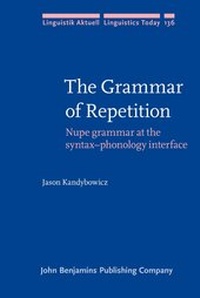
The Grammar of Repetition
Nupe grammar at the syntax-phonology interface
Published on 27. November 2008
Book
Hardback
168 pages
978-90-272-5519-8 (ISBN)
Description
Displacement is a fundamental property of grammar. Typically, when an occurrence moves it is pronounced in only one environment. This was previously viewed as a primitive/irreducible property of grammar. Recent work, however, suggests that it follows from principled interactions between the syntactic and phonological components of grammar. As such, the phonetic character of movement chains can be seen as both a reflection of and probe into the syntax-phonology interface. This volume deals with repetition, an atypical outcome of movement operations in which displaced elements are pronounced multiple times. Although cross-linguistically rare, the phenomenon obtains robustly in Nupe, a Benue-Congo language of Nigeria. Repetition raises a tension of the descriptive-explanatory variety. In order to achieve both measures of adequacy, movement theory must be supplemented with an account of the conditions that drive and constrain multiple pronunciation. This book catalogs these conditions, bringing to light a number of undocumented aspects of Nupe grammar.
More details
Series
Language
English
Place of publication
Amsterdam
Netherlands
Target group
College/higher education
Dimensions
Height: 245 mm
Width: 164 mm
Weight
490 gr
ISBN-13
978-90-272-5519-8 (9789027255198)
Copyright in bibliographic data and cover images is held by Nielsen Book Services Limited or by the publishers or by their respective licensors: all rights reserved.
Schweitzer Classification
Other editions
Additional editions
E-Book
11/2008
1st Edition
John Benjamins Publishing Company
€130.99
Available for download
Person
Content
1. Preface; 2. List of abbreviations; 3. Chapter 1. Overview and orientation; 4. Chapter 2. Prefatory remarks on Nupe grammar; 5. Chapter 3. Bare root verbal repetition: Repetition via morphophonological conditioning; 6. Chapter 4. Predicate cleft: Repetition via parallel chain formation; 7. Chapter 5. Lower copy resumption: Repetition via prosodic conditioning; 8. Chapter 6. Repetition and beyond; 9. References; 10. Index