

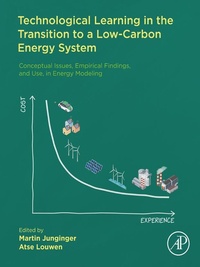
Technological Learning in the Transition to a Low-Carbon Energy System
Conceptual Issues, Empirical Findings, and Use, in Energy Modeling
Published on 25. November 2019
340 pages
978-0-12-818763-0 (ISBN)
Description

Technological Learning in the Transition to a Low-Carbon Energy System: Conceptual Issues, Empirical Findings, and Use in Energy Modeling quantifies key trends and drivers of energy technologies deployed in the energy transition. It uses the experience curve tool to show how future cost reductions and cumulative deployment of these technologies may shape the future mix of the electricity, heat and transport sectors. The book explores experience curves in detail, including possible pitfalls, and demonstrates how to quantify the 'quality' of experience curves. It discusses how this tool is implemented in models and addresses methodological challenges and solutions.
For each technology, current market trends, past cost reductions and underlying drivers, available experience curves, and future prospects are considered. Electricity, heat and transport sector models are explored in-depth to show how the future deployment of these technologies-and their associated costs-determine whether ambitious decarbonization climate targets can be reached - and at what costs. The book also addresses lessons and recommendations for policymakers, industry and academics, including key technologies requiring further policy support, and what scientific knowledge gaps remain for future research.
- Provides a comprehensive overview of trends and drivers for major energy technologies expected to play a role in the energy transition
- Delivers data on cost trends, helping readers gain insights on how competitive energy technologies may become, and why
- Reviews the use of learning curves in environmental impacts for lifecycle assessments and energy modeling
- Features social learning for cost modeling and technology diffusion, including where consumer preferences play a major role
More details
Other editions
Additional editions
Martin Junginger | Atse Louwen
Technological Learning in the Transition to a Low-Carbon Energy System
Conceptual Issues, Empirical Findings, and Use, in Energy Modeling
Book
11/2019
Academic Press
€127.50
Shipment within 15-20 days
Content
Part I1. Introduction2. The Experience Curve: Concept, History, Methods and Issues3. Implementation of Experience Curves in Energy energy-system models4. Application of experience curves and learning to other fieldsPart II Case Studies5. Photovoltaic solar energy6. Onshore wind energy7. Offshore wind energy8. Grid-scale energy storage9. Electric Vehicles10. Power to gas (H2): alkaline electrolysis11. Heating and cooling in the built environment12. Concentrating solar power13. Light-emitting diode lighting productsPart III Application of Experience Curves in Modeling14. Experience Curves in Energy Models by Lessons Learned from the REFLEX project15. Global electric car market deployment considering endogenous battery price developmentPart IV Final words16. Synthesis, conclusions, and recommendations
