

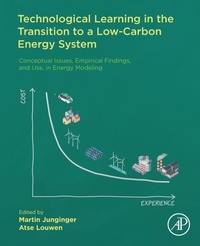
Technological Learning in the Transition to a Low-Carbon Energy System
Conceptual Issues, Empirical Findings, and Use, in Energy Modeling
Published on 22. November 2019
Book
Paperback/Softback
340 pages
978-0-12-818762-3 (ISBN)
Description
Technological Learning in the Transition to a Low-Carbon Energy System: Conceptual Issues, Empirical Findings, and Use in Energy Modeling quantifies key trends and drivers of energy technologies deployed in the energy transition. It uses the experience curve tool to show how future cost reductions and cumulative deployment of these technologies may shape the future mix of the electricity, heat and transport sectors. The book explores experience curves in detail, including possible pitfalls, and demonstrates how to quantify the 'quality' of experience curves. It discusses how this tool is implemented in models and addresses methodological challenges and solutions.
For each technology, current market trends, past cost reductions and underlying drivers, available experience curves, and future prospects are considered. Electricity, heat and transport sector models are explored in-depth to show how the future deployment of these technologies-and their associated costs-determine whether ambitious decarbonization climate targets can be reached - and at what costs. The book also addresses lessons and recommendations for policymakers, industry and academics, including key technologies requiring further policy support, and what scientific knowledge gaps remain for future research.
For each technology, current market trends, past cost reductions and underlying drivers, available experience curves, and future prospects are considered. Electricity, heat and transport sector models are explored in-depth to show how the future deployment of these technologies-and their associated costs-determine whether ambitious decarbonization climate targets can be reached - and at what costs. The book also addresses lessons and recommendations for policymakers, industry and academics, including key technologies requiring further policy support, and what scientific knowledge gaps remain for future research.
More details
Language
English
Place of publication
San Diego
United States
Publishing group
Elsevier Science Publishing Co Inc
Target group
Professional and scholarly
Early career researchers studying energy technologies. Energy system modelers. Energy economists. Utilities, technology manufacturers, grid operators. Policy makers involved in energy policy.
Product notice
Paperback (trade)
Dimensions
Height: 235 mm
Width: 191 mm
Thickness: 18 mm
Weight
590 gr
ISBN-13
978-0-12-818762-3 (9780128187623)
Copyright in bibliographic data and cover images is held by Nielsen Book Services Limited or by the publishers or by their respective licensors: all rights reserved.
Schweitzer Classification
Other editions
Additional editions
Martin Junginger | Atse Louwen
Technological Learning in the Transition to a Low-Carbon Energy System
Conceptual Issues, Empirical Findings, and Use, in Energy Modeling
E-Book
11/2019
Academic Press
€109.00
Available for download
Persons
Prof. Dr. Martin Junginger leads the biobased economy research cluster of Utrecht University's Energy & Resources group of the Copernicus Institute of Sustainable Development. Martin's work encompasses analysis of (bio)energy systems, including technology assessment and experience curve analyses of more than a dozen technologies. His wider work includes research on biomass potentials and resource assessments in both developed and developing countries, related sustainability assessment of biomass production for energy and materials (including GHG emissions and other environmental impacts), international bioenergy trade and policy evaluation. He (co-) published over 90 titles in peer-reviewed scientific journals. He is the editor of several books on technological learning in the energy sector, international bioenergy trade and mobilisation of biomass from boreal and temperate forests, and bioenergy section editor of the journal Energies. Dr. Atse Louwen is a senior researcher at the Institute for Renewable Energy at Eurac Research in Bolzano, Italy. His current work focuses on analysis of PV system performance and reliability using large datasets, machine learning and PV performance and irradiance modelling. Before his current position, he worked as a postdoctoral researcher at Utrecht University's Copernicus Institute of Sustainable Development. In his position as a postdoc, Atse was a work package leader in the EU H2020 project REFLEX, where he studied experience curves for a large variety of energy technologies, and was responsible for coordinating data collection in a European consortium of private and public research institutes. His wider work includes lifecycle assessment and techno-economic assessment of PV and other renewable energy technologies. He obtained his PhD at Utrecht University in January 2017 for his research on photovoltaic assessment. His PhD research involved the environmental and economic assessment of existing and prospective silicon heterojunction photovoltaic cells and modules, and performance analyses of a variety of commercial and prototype PV modules.
Editor
Professor Biobased Economy, Copernicus Institute of Sustainable Development, Utrecht University, Utrecht, the Netherlands
Researcher, Copernicus Institute of Sustainable Development, Utrecht University, Utrecht, Netherlands & Institute for Renewable Energy, Eurac Research, Bolzano/Bozen, Italy
Content
Part I
1. Introduction
2. The Experience Curve: Concept, History, Methods and Issues
3. Implementation of Experience Curves in Energy energy-system models
4. Application of experience curves and learning to other fields
Part II Case Studies
5. Photovoltaic solar energy
6. Onshore wind energy
7. Offshore wind energy
8. Grid-scale energy storage
9. Electric Vehicles
10. Power to gas (H2): alkaline electrolysis
11. Heating and cooling in the built environment
12. Concentrating solar power
13. Light-emitting diode lighting products
Part III Application of Experience Curves in Modeling
14. Experience Curves in Energy Models by Lessons Learned from the REFLEX project
15. Global electric car market deployment considering endogenous battery price development
Part IV Final words
16. Synthesis, conclusions, and recommendations
1. Introduction
2. The Experience Curve: Concept, History, Methods and Issues
3. Implementation of Experience Curves in Energy energy-system models
4. Application of experience curves and learning to other fields
Part II Case Studies
5. Photovoltaic solar energy
6. Onshore wind energy
7. Offshore wind energy
8. Grid-scale energy storage
9. Electric Vehicles
10. Power to gas (H2): alkaline electrolysis
11. Heating and cooling in the built environment
12. Concentrating solar power
13. Light-emitting diode lighting products
Part III Application of Experience Curves in Modeling
14. Experience Curves in Energy Models by Lessons Learned from the REFLEX project
15. Global electric car market deployment considering endogenous battery price development
Part IV Final words
16. Synthesis, conclusions, and recommendations