

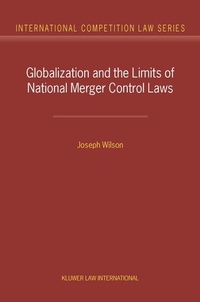
Globalization and the Limits of National Merger Control Laws
Published on 1. January 2003
402 pages
978-90-411-7184-9 (ISBN)
Description

Companies today pursue their goals with little regard for national borders. However, it remains true that business activity is regulated to a significant extent by each national jurisdiction. This is particularly true of mergers; as anyone knows who has ever been involved in a transnational merger in multiple jurisdictions, the knottiest problems and issues arise from variations in national competition and merger laws.
This extremely valuable new book offers an in-depth proposal for an international merger control regime that is firmly grounded in and supported by a framework of economic and legal theory. It arrives at its conclusions along three major avenues:
- a study of the concepts of global public good and consumer welfare that underlie
the progress of globalization;
- detailed analyses of the two most important and highly developed merger law
systems, those of the European Union and the United States; and
- a systematic and comprehensive review of the major existing proposals, both institutional and scholarly, for an international merger control regime.
A special chapter is devoted to the complex custodial role of the World Trade Organization, both in its present activity and as is envisioned in various proposals for global competition law.
Globalization and the Limits of National Merger Control Laws takes a significant step toward breaking down one of the last and most intransigent barriers to global free trade. It will be avidly studied and put to use by business lawyers and policymakers everywhere, and will quickly take its place as a fundamental work for teachers and students of international trade and international relations.
This extremely valuable new book offers an in-depth proposal for an international merger control regime that is firmly grounded in and supported by a framework of economic and legal theory. It arrives at its conclusions along three major avenues:
- a study of the concepts of global public good and consumer welfare that underlie
the progress of globalization;
- detailed analyses of the two most important and highly developed merger law
systems, those of the European Union and the United States; and
- a systematic and comprehensive review of the major existing proposals, both institutional and scholarly, for an international merger control regime.
A special chapter is devoted to the complex custodial role of the World Trade Organization, both in its present activity and as is envisioned in various proposals for global competition law.
Globalization and the Limits of National Merger Control Laws takes a significant step toward breaking down one of the last and most intransigent barriers to global free trade. It will be avidly studied and put to use by business lawyers and policymakers everywhere, and will quickly take its place as a fundamental work for teachers and students of international trade and international relations.
More details
Other editions
Additional editions
Book
02/2003
Kluwer Law International
€291.17
Shipment within 10-20 days
Content
- Cover
- Half Title Page
- Title Page
- Copyright Page
- Dedication
- Table of Contents
- ACKNOWLEDGEMENTS
- ABSTRACT
- RÉSUMÉ
- TABLE OF ACRONYMS
- PREFACE
- INTRODUCTION
- CHAPTER I GLOBALIZATION: HOW AND IMPACT
- PART I
- A. WHAT IS GLOBALIZATION?
- 1. Globalization: Factors Contributing to the Phenomenon
- 2. Globalization as Denationalization
- 3. Globalization and the Limits of National Laws
- a. Absence of Vision
- b. Absence of Dispute Resolution Techniques
- 4. Globalization: A Normative Concept that Promotes Global Welfare
- B. GLOBAL CONSUMER WELFARE AS A GLOBAL PUBLIC GOOD
- 1. Defining Global Consumer Welfare
- 2. Defining Public Goods
- a. Supply Problem
- i. The Free-Rider Problem
- ii. The Prisoner's Dilemma
- 3. Defining Global Public Goods
- a. Intermediate Global Public Goods
- b. The Supply Problem of Global Public Goods
- 4. Global Public Good Qualities of Global Consumer Welfare
- a. Supply Problems
- i. Free-rider Problem
- ii. Prisoner's Dilemma
- C. CONCLUDING REMARKS
- PART II
- D. WHY MERGE?
- E. GROWING TREND OF TRANSNATIONAL M&AS
- 1. Growing Concentration in the Global Market
- a. Financial Industry
- b. Airline Industry
- c. Telecommunications Industry
- d. Petroleum Industry
- e. Automobile Industry
- f. Pharmaceuticals
- 2. Effects of Growing Concentration
- F. MERGER REVIEW: OBJECTIVE
- G. PROLIFERATION OF MERGER CONTROL LAWS: WHY?
- 1. Benefits of Merger Control Laws
- 2. Deregulation Paved the Way for Competition
- 3. External Pressure for Reform
- H. COSTS OF PROLIFERATING MERGER CONTROL LAWS
- 1. Cost to Merging Parties
- 2. Cost to Competition Agencies
- 3. Diverse Approaches
- Diverse Outcomes
- 4. Friction among Jurisdictions
- 5. Limits on Sovereign Control
- I. GAPS IN GLOBAL GOVERNANCE AND THE NEED FOR AN IMCR
- Table 1. M&As in Major Overseas Markets in 2000 by Number of Deals
- Table 2. Worldwide Antitrust Merger Notification Systems
- CHAPTER II US ANTITRUST AND MERGER CONTROL LAWS
- A. RAISON D'ÊTRE OF ANTITRUST AND MERGER CONTROL LAWS
- 1. Origin of the US Antitrust Laws
- a. The First Merger Wave: 1889-1902
- b. Formation of Trusts
- 2. The Birth of Federal Antitrust Laws: The Sherman Act (1890)
- a. Enforcement of the Sherman Act
- b. Sherman Act and the Merger Wave
- 3. The Clayton Act, 1914
- a. Private Parties and State Attorneys General Right to Challenge
- B. DUAL FEDERAL ANTITRUST ENFORCEMENT AGENCIES
- 1. The Federal Trade Commission Act, 1914
- a. Institutional Framework of the FTC
- b. Authority of the FTC
- 2. The Establishment of the Antitrust Division of the DoJ: 1933
- 3. Interrelation Between the Antitrust Division and the FTC
- C. THE DEVELOPMENT OF MERGER ANALYSIS JURISPRUDENCE
- 1. Clayton Act During the War Era: 1914-1950
- a. The Second Merger Wave: 1925-1930
- b. The Third Merger Wave: 1940-1947
- 2. The Celler-Kefauver Antimerger Act, 1950: Amendment to the Clayton Act
- a. Merger Analysis Under § 7 Clayton Act: Sole Reliance on Market Share
- i. Brown Shoe Co. v. United States (1962)
- ii. United States v. Philadelphia National Bank (1963)
- iii. United States v. Von's Grocery Co. (1966)
- b. The Fourth Merger Wave: Mid-1960s
- 3. The DoJ's Merger Enforcement Guidelines 1968
- 4. Antitrust Revolution
- a. US v. General Dynamics: Demise of the 1968 Guidelines
- b. The Chicago School
- c. Reaganomics
- D. MERGER ENFORCEMENT GUIDELINES
- 1. The DoJ's Merger Enforcement Guidelines 1982: Efficiencies Recognized
- a. Product Market
- b. Geographic Market
- c. Determination of Market Concentration
- 2. The DoJ's Merger Enforcement Guidelines 1984
- a. Market Definition and Measurement
- b. Treatment of Foreign Competition
- c. Efficiencies
- d. Failing Divisions of Healthy Firms
- 3. DoJ/FTC's Horizontal Merger Enforcement Guidelines, 1992/1997
- 4. Antitrust Enforcement Guidelines for International Operations, 1995
- E. PREMERGER NOTIFICATION REGIME AND REVIEW PROCESS
- 1. Hart-Scott-Rodino Antitrust Improvement Act, 1976
- a. Title I of the HSR Act
- b. Title II: The Premerger Notification Act
- i. Notification Thresholds
- (a) The Size-of-Person Test
- (b) The Size-of-Transaction Test
- ii. Filing Fees
- iii. Transactions Subject to Foreign Antitrust Reporting Requirements
- iv. Exemptions From Premerger Notification Requirements
- v. Application of HSR on Foreign Persons
- c. Title III: The Parens Patriae Act
- 2. Merger Review Process
- a. Relevant Markets
- i. Relevant Product Market
- ii. Relevant Geographic Market
- b. Identification of Competitors
- c. Market Shares
- d. Assessment of the Likely Adverse Effects
- e. Market Entry Conditions
- f. Efficiencies Defense
- g. Failing Firm Defense
- F. CO-ORDINATION AMONG STATE AND FEDERAL ANTITRUST AGENCIES
- 1. Association of State Attorneys General (NAAG)
- 2. NAAG Voluntary Premerger Disclosure Compact
- 3. Information Sharing Protocol
- 4. NAAG, DoJ/FTC Protocol for Joint State/Federal Merger Investigations
- a. Confidentiality
- b. Procedure Involving the Merging Parties
- c. Conduct of Joint Investigation
- d. Settlement Discussions
- e. Statements to the Press
- G. COMMENTARY: LESSONS TO BE LEARNED
- 1. Raison d'être of Antitrust Laws
- 2. Development in the Merger Analysis Jurisprudence
- 3. Enforcement Guidelines
- 4. Dual Federal Antitrust Enforcement Agencies
- 5. Coordination Among the State and Federal Antitrust Agencies
- 6. Premerger Notification Regime
- a. Notification Thresholds
- b. A Two-Tier Merger Review Process
- c. Triggering Events
- d. Tiered Fee Structure
- e. Voluntary Disclosure of Other Antitrust Agencies Involved
- 7. Summary of the Lessons Learned
- CHAPTER III EC COMPETITION AND MERGER CONTROL LAWS
- A. FOUNDATION OF THE EUROPEAN UNION AND ITS SUPRANATIONAL INSTITUTIONS
- 1. The European Coal and Steel Community: Treaty of Paris (1951)
- 2. The European Economic Community: Treaty of Rome (1958)
- a. The Council of Ministers
- b. The Commission
- c. The European Parliament
- d. The Court of Justice
- B. ENHANCED ECONOMIC INTEGRATION
- 1. European Free Trade Association (1960)
- 2. New Membership of the EEC
- 3. The Single European Act (1987)
- 4. The Treaty on European Union (Treaty of Maastricht,1992)
- 5. European Economic Area (1994)
- 6. The Treaty of Nice (2001): The EU's Enlargement
- C. EC COMPETITION AND MERGER CONTROL LAWS
- 1. Origins of the EC Competition and Merger Control Laws: The ECSC Treaty
- 2. The Treaty of Rome
- 3. The 1966 Memorandum
- 4. Continental Can (1973): Application of Article 82 to Concentrations
- 5. Commission's Proposals for Coherent Merger Control: Political Gridlock
- 6. Philip Morris (1987): Application of Article 81 to Concentrations
- 7. Merger Wave: 1987-
- 8. The Need for a Community-Wide Merger Control Regulation
- 9. The Rebirth of Proposals for Merger Regulation
- D. MERGER REGULATION: INSTRUMENT FOR TRANSNATIONAL MERGER REVIEW
- 1. One-Stop-Shop
- 2. Community Dimension: Notification Thresholds
- 3. Exceptions to Community-Dimension
- a. Referral to National Competition Authority: The "German Clause"
- b. Jurisdiction Over Mergers Without Community Dimension: The "Dutch Clause"
- c. Legitimate National Interest: The "British Clause"
- 4. Premerger Notification
- 5. Merger Analysis
- a. Substantive Evaluation
- i. Pure Competition Standards v. Industrial Policy
- ii. Dominant Position
- iii. Relevant Product and Geographic Markets
- iv. Market Shares
- v. Significant Impediment to Effective Competition
- vi. Efficiencies Defense
- vii. Failing Firm Defense
- b. Initial Review
- c. Second-Phase Investigation
- 6. Extraterritorial Application of the Merger Regulation
- E. COOPERATION BETWEEN THE COMMISSION AND ESA: THE LEAD JURISDICTION MODEL
- F. RECENT DEVELOPMENTS IN THE EC COMPETITION POLICY: ESTABLISHING A NETWORK FOR COOPERATION
- G. COMMENTARY: LESSONS TO BE LEARNED
- 1. Creating a Global Supranational Institution for Merger Control
- 2. Delegation of Merger Review to a Supranational Institution
- 3. Recent Reform to the Competition Policy: Adoption of a Lead Jurisdiction Approach
- 4. Protocol 24: The Lead Jurisdiction Model
- 5. Notification Procedure Under the Merger Regulation
- 6. Decision-Making Procedure Under the Merger Regulation
- 7. Summary of the Lessons Learned
- CHAPTER IV COMPARISON BETWEEN THE US AND EC MERGER CONTROL LAWS
- A. OBJECTIVE OF COMPETITION LAWS IN THE US AND THE EU
- B. GENERAL PROCEDURAL DISSIMILARITIES
- 1. Powers of the Relevant Agencies
- 2. Private Parties Right to Challenge
- C. PREMERGER NOTIFICATION PROCEDURAL DISSIMILARITIES
- 1. Information Requirements: One-Step Filing v. Two-Step Filing
- 2. Notification Thresholds
- 3. Triggering Events
- 4. Review Period
- D. SUBSTANTIVE EVALUATION
- 1. Points of Convergence
- a. Substantive Test: Dominant Position v. Substantial Lessening of Competition
- b. Definition of Relevant Markets
- 2. Differences
- a. Defining Market Concentration
- b. Efficiencies Defense
- c. Failing Firm Defense
- E. CONCLUDING REMARKS
- CHAPTER V RECOGNITION OF LIMITS: NEED FOR COOPERATION AND CONVERGENCE
- A. CONVERGENCE THROUGH COOPERATION AT A BILATERAL LEVEL
- 1. US-EU Cooperation Agreement
- a. Notification
- b. Exchange of Information
- c. Cooperation and Coordination in Enforcement Activities
- d. Positive Comity
- e. Avoidance of Conflicts over Enforcement Activities: Traditional Comity
- f. Confidentiality of Information
- 2. Advantages of the US-EU Cooperation Agreement
- 3. Limits of the US-EU Cooperation Agreement
- a. The Boeing-McDonnell Douglas Case (1997)
- b. GE-Honeywell Case (2001)
- 4. Limits of Bilateralism
- B. CONVERGENCE THROUGH HARMONIZATION AT A MULTILATERAL LEVEL
- 1. Havana Charter
- 2. The Treaty of Rome (1958)
- 3. United Nations Conference on Trade and Development (UNCTAD)
- 4. Organization for Economic Cooperation and Development (OECD)
- 5. Australia-New Zealand Closer Economic Relations Trade Agreement
- 6. North American Free Trade Agreement (NAFTA)
- 7. MERCOSUR: The Southern Cone
- 8. WTO Fourth Protocol's Reference Paper on Pro-Competitive Regulatory Principles
- a. Adoption Technique
- b. Success of the Reference Paper
- C. CONCLUDING REMARKS
- CHAPTER VI THE WTO AS THE CUSTODIAN FOR THE IMCR
- A. CREATION OF THE WTO
- 1. Organizational Structure
- a. Membership
- b. Ministerial Conference
- c. General Council
- d. The Secretariat
- 2. Dispute Resolution Mechanism
- a. Consultation
- b. Panel Proceedings
- c. Appeal
- d. Implementation
- B. COMPETITION LAW IN THE WTO
- 1. WTO's Working Group on Interaction Between Trade and Competition Policy
- 2. EU's Support for Competition Law in the WTO
- 3. US Position on Competition Law in the WTO
- C. CONCLUDING REMARKS
- CHAPTER VII PROPOSALS ADVANCED FOR TRANSNATIONAL MERGER REVIEW
- A. INTERNATIONAL COMPETITION POLICY ADVISORY COMMITTEE
- 1. Bridging the Differences Between Systems
- a. Increased Transparency
- b. Development of Disciplines for Merger Review
- c. Continue to Enhance Cross-Border Cooperation
- 2. Enhanced Work Sharing: Seamless Multijurisdictional Merger Review
- a. Work Sharing at the Remedy Stage
- b. Work Sharing at the Review Stage
- 3. Reform of the Merger Review Process
- a. Casting the Merger Review Net Appropriately: Notification Thresholds
- b. Authority to Override Thresholds
- c. Filing Fees
- d. Two-Stage Review Process
- e. Review Periods and Timing
- f. Triggering Events
- g. Notification Forms and Information Requests
- 4. International Mediation of Competition Disputes
- 5. Separate Statement by Eleanor Fox
- 6. Critique/Comments
- B. DRAFT INTERNATIONAL ANTITRUST CODE: THE MUNICH GROUP
- 1. Scope and Notification Thresholds
- 2. Premerger Notification Procedure
- 3. Appraisal of Concentrations
- 4. Decision-Making
- 5. Global Welfare/Interest of Other Nations
- 6. International Antitrust Agency
- 7. International Antitrust Panel
- 8. Critique/Comments
- a. Notification Thresholds
- b. Premerger Notification Procedure
- c. Time for Decision-Making
- d. Separate Body for Providing Exemptions
- e. Lack of Mechanism for Coordination and Dispute Resolution
- C. OECD
- 1. Critique/Comments
- D. AMERICAN BAR ASSOCIATION
- 1. Reporting Requirements
- 2. Conflicts in Enforcement/Enhanced Inter-Agency Consultation
- 3. Confidential Information
- 4. Private Suits
- 5. Discovery Abroad
- 6. Agencies to Publish Detailed Merger Enforcement Guidelines
- 7. Critique/Comments
- E. CAMPBELL AND TREBILCOCK
- 1. Harmonization of Domestic Laws
- a. Procedural Harmonization
- i. Premerger Filing
- ii. Waiting Period
- iii. Fixed Time Limits for Decision-Making
- iv. Confidentiality Rules
- b. Substantive Harmonization
- 2. Use of Lead Review Jurisdiction
- a. Lead Jurisdiction as a Coordinating Agency
- b. Lead Jurisdiction Appointed Through Consultation
- c. Lead Jurisdiction Appointed by an International Authority
- 3. Decision-Making by Supranational Institution
- a. Supranational Investigation and Adjudication
- b. Supranational Dispute Resolution
- 4. Critique/Comments
- a. Harmonization of Domestic Law
- i. Procedural Harmonization
- ii. Substantive Law Harmonization
- b. Lead Review Jurisdiction Models
- c. Decision-Making by Supranational Institution
- F. ELEANOR M. FOX
- 1. Premerger Notification
- a. Premerger Notification Form
- b. Common Clearing-House
- c. Triggering Events
- d. Time Periods for Review
- e. Notification Thresholds
- 2. Substantive Standards and Begger-Thy-Neighbour Policies
- 3. Resolution of Conflicts
- 4. Critique/Comments
- a. Premerger Notification
- b. Common Clearing-House
- c. Notification Thresholds
- d. Substantive Standards
- e. Resolution of Conflicts
- G. ELEANOR M. FOX AND JANUSZ A. ORDOVER
- 1. Critique/Comments
- H. BAKER, CAMPBELL, REYNOLDS & ROWLEY
- 1. Pre-filing Consultations with Merging Parties
- 2. Pre-notifiable Transactions
- 3. Disclosure of Domestic Notifications
- 4. Two Stage Premerger Notification
- 5. Time Limits
- 6. Notification Forms (Stage One)
- 7. Supplementary Requests for Information (Stage Two)
- 8. Information Sharing and Confidentiality
- 9. Interagency Communications
- 10. Enforcement Guidelines
- 11. Announcement of Filings and Decisions
- 12. Clearance and Authorizations
- 13. Critique/Comments
- a. Pre-filing Consultations with Merging Parties
- b. Pre-notifiable Transactions
- c. Disclosure of Domestic Notifications
- d. Concluding Remarks
- I. ANDRE FIEBIG
- 1. WTO Premerger Office
- 2. International Merger Control Regime
- 3. Drawbacks
- 4. Critique/Comments
- CHAPTER VIII INTERNATIONAL MERGER CONTROL REGIME
- A. IMPLICATIONS OF THE REVIEW OF THE PROPOSALS
- 1. Procedural Elements
- a. Premerger Filing Stages
- b. Harmonized Premerger Notification Form
- c. Requirement to Disclose other Agencies Involved
- d. Waiting Period Before Consummation
- e. Fixed Time Limits for Decision-Making
- f. Disclosure of Confidential Information
- g. Triggering Events
- h. Notification Thresholds
- i. Nature of the Regimes (Voluntary/Compulsory)
- j. Transparency and Merger Enforcement Guidelines
- k. Foreign Nation's Interest/Global Impact
- l. Central Filing System
- m. Dispute Resolution Mechanism
- n. Interagency Coordination
- o. Pre-filing Consultation
- p. Public Notification of Filing and Decisions
- 2. Model for an IMCR: Supranational Institution v. a Lead Jurisdiction
- a. A Democratic Form of Governance
- b. A Socially Responsible Form of Governance
- c. An Organic Form of Governance
- 3. Substantive Law
- B. A DRAFT IMCR
- 1. Draft Agreement on Competition Law
- 2. Draft Annex on Transnational Merger Review
- C. TEST CASE FOR THE IMCR
- CONCLUSION
- BIBLIOGRAPHY
- ANNEX: SUMMARY OF THE PROPOSALS REVIEWED AND THE IMCR
- TABLE OF CASES
- NAME INDEX
- SUBJECT INDEX
- Back Cover
