

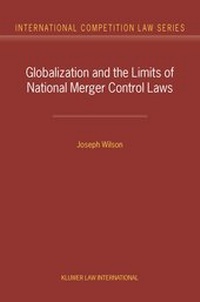
Globalization and the Limits of National Merger Control Laws
Published on 1. February 2003
Book
Hardback
400 pages
978-90-411-1996-4 (ISBN)
Description
Companies today pursue their goals with little regard for national borders. However, it remains true that business activity is regulated to a significant extent by each national jurisdiction. This is particularly true of mergers; as anyone knows who has ever been involved in a transnational merger in multiple jurisdictions, the knottiest problems and issues arise from variations in national competition and merger laws. This extremely valuable new book offers an in-depth proposal for an international merger control regime that is firmly grounded in and supported by a framework of economic and legal theory. It arrives at its conclusions along three major avenues: a study of the concepts of global public good and consumer welfare that underlie the progress of globalization; detailed analyses of the two most important and highly developed merger law systems, those of the European Union and the United States; and a systematic and comprehensive review of the major existing proposals, both institutional and scholarly, for an international merger control regime. A special chapter is devoted the complex custodial role of the World Trade Organization, both in its present activity and as it is envisioned in the various proposals. Globalization and the Limits of National Merger Control Laws takes a giant step toward breaking down one of the last and most intransigent barriers to global free trade. It will be avidly studied and put to use by business lawyers and policymakers everywhere, and will quickly take its place as a fundamental work for teachers and students of international trade and international relations.
More details
Other editions
Additional editions
E-Book
01/2003
Kluwer Law International
€242.99
Available for download
Content
<ol class=copymedium><b>I. Globalization: How and Impact
</b>
A. What Is Globalization?
B. Global Consumer Welfare as a Global Public Good
C. Concluding Remarks
D. Why Merge?
E. Growing Trend of Transnational M&As
F. Merger Review: Objective
G. Proliferation of Merger Control Laws: Why?
H. Costs of Proliferating Merger Control Laws
I. Gap in Global Governance and the Need for an IMCR
<b><p class=copymedium>II. US Antitrust and Merger Control Laws
</b>
A. Raison d'Ê tre of Antitrust and Merger Control Laws
B. Dual Federal Antitrust Enforcement Agencies
C. The Development of Merger Analysis Jurisprudence
D. Merger Enforcement Guidelines
E. Premerger Notification Regime and Review Process
F. Co-ordination Among State and Federal Antitrust Agencies
G. Commentary: Lessons to be Learned
<p class=copymedium><b>III. EC Competition and Merger Control Laws
</b>
A. Foundation of the European Union and its Supranational Institutions
B. Enhanced Economic Integration
C. EC Competition and Merger Control Laws
D. Merger Regulation: Instrument for Transnational Merger Review
E. Cooperation between the Commission and ESA: The Lead Jurisdiction Model
F. Recent Developments in the EC Competition Policy: Establishing a Network for Cooperation
G. Commentary: Lessons to be Learned
<p class=copymedium>IV. Comparison between the US and EC Merger Control Laws
A. Objective of Competition Laws in the US and the EU
B. General Procedural Dissimilarities
C. Premerger Notification Procedural Dissimilarities
D. Substantive Evaluation
E. Concluding Remarks
<p class=copymedium>V. Recognition of Limits: Need for Cooperation and Convergence
A. Convergence Through Cooperation at a Bilateral Level
B. Convergence through Harmonization at a Multilateral Level
C. Concluding Remarks
<p class=copymedium>VI. The WTO as the Custodian for the IMCR
A. Creation of the WTO
B. Competition Law in the WTO
C. Concluding Remarks
<p class=copymedium>VII. Proposals Advanced for Transnational Merger Review
A. International Competition Policy Advisory Committee
B. Draft International Antitrust Code: The Munich Group
C. OECD
D. American Bar Association
E. Campbell and Trebilcock
F. Eleanor M. Fox
G. Eleanor M. Fox and Janusz A. Ordover
H. Baker, Campbell, Reynolds & Rowley
I. Andre Fiebig
<p class=copymedium>VIII. International Merger Control Regime
A. Implications of the Review of the Proposals
B. A Draft IMCR
C. Test Case for the IMCR
Conclusion
Annex 1: Summary of the Proposals Reviewed
Bibliography</ol>
</b>
A. What Is Globalization?
B. Global Consumer Welfare as a Global Public Good
C. Concluding Remarks
D. Why Merge?
E. Growing Trend of Transnational M&As
F. Merger Review: Objective
G. Proliferation of Merger Control Laws: Why?
H. Costs of Proliferating Merger Control Laws
I. Gap in Global Governance and the Need for an IMCR
<b><p class=copymedium>II. US Antitrust and Merger Control Laws
</b>
A. Raison d'Ê tre of Antitrust and Merger Control Laws
B. Dual Federal Antitrust Enforcement Agencies
C. The Development of Merger Analysis Jurisprudence
D. Merger Enforcement Guidelines
E. Premerger Notification Regime and Review Process
F. Co-ordination Among State and Federal Antitrust Agencies
G. Commentary: Lessons to be Learned
<p class=copymedium><b>III. EC Competition and Merger Control Laws
</b>
A. Foundation of the European Union and its Supranational Institutions
B. Enhanced Economic Integration
C. EC Competition and Merger Control Laws
D. Merger Regulation: Instrument for Transnational Merger Review
E. Cooperation between the Commission and ESA: The Lead Jurisdiction Model
F. Recent Developments in the EC Competition Policy: Establishing a Network for Cooperation
G. Commentary: Lessons to be Learned
<p class=copymedium>IV. Comparison between the US and EC Merger Control Laws
A. Objective of Competition Laws in the US and the EU
B. General Procedural Dissimilarities
C. Premerger Notification Procedural Dissimilarities
D. Substantive Evaluation
E. Concluding Remarks
<p class=copymedium>V. Recognition of Limits: Need for Cooperation and Convergence
A. Convergence Through Cooperation at a Bilateral Level
B. Convergence through Harmonization at a Multilateral Level
C. Concluding Remarks
<p class=copymedium>VI. The WTO as the Custodian for the IMCR
A. Creation of the WTO
B. Competition Law in the WTO
C. Concluding Remarks
<p class=copymedium>VII. Proposals Advanced for Transnational Merger Review
A. International Competition Policy Advisory Committee
B. Draft International Antitrust Code: The Munich Group
C. OECD
D. American Bar Association
E. Campbell and Trebilcock
F. Eleanor M. Fox
G. Eleanor M. Fox and Janusz A. Ordover
H. Baker, Campbell, Reynolds & Rowley
I. Andre Fiebig
<p class=copymedium>VIII. International Merger Control Regime
A. Implications of the Review of the Proposals
B. A Draft IMCR
C. Test Case for the IMCR
Conclusion
Annex 1: Summary of the Proposals Reviewed
Bibliography</ol>