

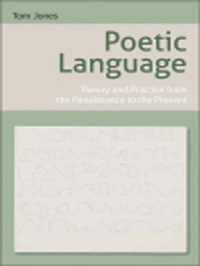
Poetic Language
Description

The first study of poetic language from a historical and philosophical perspective
In a series of 12 chapters, exemplary poems - by Walter Ralegh, John Milton,William Cowper, William Wordsworth, Gerard Manley Hopkins, Wallace Stevens, Ezra Pound, Frank O''Hara, Robert Creeley, W. S. Graham, Tom Raworth, Denise Riley and Thomas A. Clark - are read alongside theoretical discussions of poetic language.
The discussions provide a jargon-free account of a wide range of historical and contemporary schools of thought about poetic language, and an organised, coherent critique of those schools (including analytical philosophy, cognitive poetics, structuralism and post-structuralism). Via close readings of poems from 1600 to the present readers are taken through a wide range of styles including modernist, experimental and innovative poetries. Paired chapters within a chronological structure allow lecturers and students to approach the material in a variety of ways (by individual chapters, paired historical periods) that are appropriate to different courses.
Key Features:
- Surveys a variety of linguistic and philosophical approaches to poetic language: analytical, cognitive, post-structuralist, pragmatic
- Provides readings of complete poems and places those readings within the wider context of each poet''s work
- Combines theory and practice
- Includes a Glossary, Notes on Poets and Suggested Further Reading
More details
Other editions
Additional editions
Content
- COVER
- Copyright
- Contents
- Acknowledgements
- How to Use this Book
- CHAPTER ONE Introduction
- CHAPTER TWO Figure: Walter Ralegh
- CHAPTER THREE Selection: William Cowper
- CHAPTER FOUR Measure: William Wordsworth
- CHAPTER FIVE Equivalence: Gerard Manley Hopkins
- CHAPTER SIX Spirit: Wallace Stevens
- CHAPTER SEVEN Spirit: Frank O'Hara
- CHAPTER EIGHT Measure: Robert Creeley
- CHAPTER NINE Deviance: W. S. Graham
- CHAPTER TEN Figure: Tom Raworth
- CHAPTER ELEVEN Selection: Denise Riley
- CHAPTER TWELVE Equivalence: Thomas A. Clark
- CHAPTER THIRTEEN Epilogue: Deviance: Robert Creeley
- Further Reading
- Notes on Poets
- Glossary
- Index
