

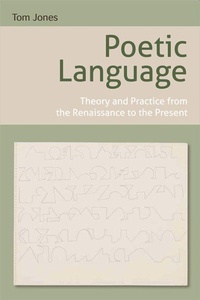
Poetic Language
Theory and Practice from the Renaissance to the Present
Published on 4. July 2012
Book
Hardback
240 pages
978-0-7486-5617-2 (ISBN)
Description
The first study of poetic language from a historical and philosophical perspective
In a series of 12 chapters, exemplary poems - by Walter Ralegh, John Milton,William Cowper, William Wordsworth, Gerard Manley Hopkins, Wallace Stevens, Ezra Pound, Frank O'Hara, Robert Creeley, W. S. Graham, Tom Raworth, Denise Riley and Thomas A. Clark - are read alongside theoretical discussions of poetic language.
The discussions provide a jargon-free account of a wide range of historical and contemporary schools of thought about poetic language, and an organised, coherent critique of those schools (including analytical philosophy, cognitive poetics, structuralism and post-structuralism). Via close readings of poems from 1600 to the present readers are taken through a wide range of styles including modernist, experimental and innovative poetries. Paired chapters within a chronological structure allow lecturers and students to approach the material in a variety of ways (by individual chapters, paired historical periods) that are appropriate to different courses.
Key Features:
Surveys a variety of linguistic and philosophical approaches to poetic language: analytical, cognitive, post-structuralist, pragmatic
Provides readings of complete poems and places those readings within the wider context of each poet's work
Combines theory and practice
Includes a Glossary, Notes on Poets and Suggested Further Reading
In a series of 12 chapters, exemplary poems - by Walter Ralegh, John Milton,William Cowper, William Wordsworth, Gerard Manley Hopkins, Wallace Stevens, Ezra Pound, Frank O'Hara, Robert Creeley, W. S. Graham, Tom Raworth, Denise Riley and Thomas A. Clark - are read alongside theoretical discussions of poetic language.
The discussions provide a jargon-free account of a wide range of historical and contemporary schools of thought about poetic language, and an organised, coherent critique of those schools (including analytical philosophy, cognitive poetics, structuralism and post-structuralism). Via close readings of poems from 1600 to the present readers are taken through a wide range of styles including modernist, experimental and innovative poetries. Paired chapters within a chronological structure allow lecturers and students to approach the material in a variety of ways (by individual chapters, paired historical periods) that are appropriate to different courses.
Key Features:
Surveys a variety of linguistic and philosophical approaches to poetic language: analytical, cognitive, post-structuralist, pragmatic
Provides readings of complete poems and places those readings within the wider context of each poet's work
Combines theory and practice
Includes a Glossary, Notes on Poets and Suggested Further Reading
Reviews / Votes
Fully and carefully documented, this study builds on the work of scholars such as Jan Mukarovsky, Derek Attridge, and Julia Kristeva. Recommended. -- D.D. Cummings, University of Wisconsin, Parkside * Choice *More details
Language
English
Place of publication
Edinburgh
United Kingdom
Target group
Professional and scholarly
Product notice
sewn/stitched
Cloth over boards
Dimensions
Height: 236 mm
Width: 160 mm
Thickness: 20 mm
Weight
431 gr
ISBN-13
978-0-7486-5617-2 (9780748656172)
Copyright in bibliographic data and cover images is held by Nielsen Book Services Limited or by the publishers or by their respective licensors: all rights reserved.
Schweitzer Classification
Other editions
Additional editions
E-Book
07/2012
Edinburgh University Press
€0.00
Available for download
Person
Tom Jones teaches English at the University of St Andrews, specialising in eighteenth-century literature and philosophy, and poetic theory and practice. He is the author of Pope and Berkeley: The Language of Poetry and Philosophy (Palgrave Macmillan, 2005) and essays on Pope, Berkeley, eighteenth-century philosophies of language, and contemporary poetry and poetics.
Content
Acknowledgements; How to use this book; 1. Introduction; 2. Figure: Ralegh; 3. Selection: Cowper; 4. Measure: Wordsworth; 5. Equivalence: Hopkins; 6. Spirit: Stevens; 7. Spirit: O'Hara; 8. Measure: Creeley; 9. Deviance: Graham; 10. Figure: Raworth; 11. Selection: Riley; 12. Equivalence: Clark; 13. Epilogue: Deviance: Creeley; Further Reading.