

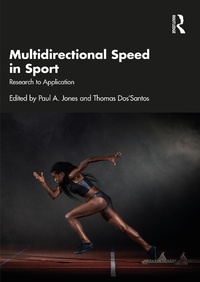
Multidirectional Speed in Sport
Research to Application
1st Edition
Published on 30. June 2023
385 pages
978-1-000-90190-0 (ISBN)
Description

During field- and court-based sports, players are continually required to perceive their environment within a match and select and perform the most appropriate action to achieve their immediate goal within that match instance. This ability is commonly known as agility, considered a vital quality in such sports and may incorporate a variety of locomotion and instantaneous actions.
Multidirectional speed is a global term to describe the competency and capacity to perform such actions: accelerate, decelerate, change direction, and ultimately maintain speed in multiple directions and movements within the context of sports-specific scenarios, encompassing agility, speed, and many other related qualities. Multidirectional speed in sport depends on a multitude of factors, including perceptual-cognitive abilities, physical qualities, and the technical ability to perform the previously mentioned actions.
Multidirectional Speed in Sport: Research to Application reviews the science of multidirectional speed and translates this information into real-world application in order to provide a resource for practitioners to develop multidirectional speed with athletes, bringing together knowledge from a wealth of world-leading researchers and applied practitioners in the area of speed and agility to provide a complete resource to assist practitioners in designing effective multidirectional speed development programmes.
This text is critical reading for undergraduate and graduate sports science students, all individuals involved in training athletes (e.g. coaches, physiotherapists, athletic trainers), and researchers in the field of sports science and sports medicine.
Multidirectional speed is a global term to describe the competency and capacity to perform such actions: accelerate, decelerate, change direction, and ultimately maintain speed in multiple directions and movements within the context of sports-specific scenarios, encompassing agility, speed, and many other related qualities. Multidirectional speed in sport depends on a multitude of factors, including perceptual-cognitive abilities, physical qualities, and the technical ability to perform the previously mentioned actions.
Multidirectional Speed in Sport: Research to Application reviews the science of multidirectional speed and translates this information into real-world application in order to provide a resource for practitioners to develop multidirectional speed with athletes, bringing together knowledge from a wealth of world-leading researchers and applied practitioners in the area of speed and agility to provide a complete resource to assist practitioners in designing effective multidirectional speed development programmes.
This text is critical reading for undergraduate and graduate sports science students, all individuals involved in training athletes (e.g. coaches, physiotherapists, athletic trainers), and researchers in the field of sports science and sports medicine.
More details
Edition
1. Auflage
Language
English
Place of publication
London
United Kingdom
Publishing group
Taylor & Francis Ltd
Target group
College/higher education
Professional and scholarly
Illustrations
47 Tables, black and white; 52 Line drawings, black and white; 25 Halftones, black and white; 77 Illustrations, black and white
ISBN-13
978-1-000-90190-0 (9781000901900)
Copyright in bibliographic data and cover images is held by Nielsen Book Services Limited or by the publishers or by their respective licensors: all rights reserved.
Schweitzer Classification
Other editions
Additional editions
Book
06/2023
1st Edition
Routledge
€207.40
Shipment within 10-20 days
Book
06/2023
1st Edition
Routledge
€62.30
Shipment within 10-20 days
Persons
Paul A. Jones is a Lecturer in Sports Biomechanics/ Strength and Conditioning (S&C) at the University of Salford. Paul earned a BSc (Hons) and MSc in Sports Science from Liverpool John Moores University and a PhD in Sports Biomechanics at the University of Salford. He has over 20 years' experience in Biomechanics and S&C support to athletes and teams, primarily in athletics, football and rugby and was a former sports science co-ordinator for UK disability athletics. He is a BASES Fellow, has been BASES Accredited for over 17 years, a Chartered Scientist and currently serves on the BASES accreditation committee. Paul has also been a certified strength and conditioning specialist (CSCS) with the NSCA for over 18 years recertifying with Distinction on the last 2 occasions. Paul has authored/ co-authored over 100 peer reviewed journal articles and 6 book chapters mainly in change of direction biomechanics, assessment and development of change of direction speed and strength diagnostics and previously co-edited a book by Routledge titled 'Performance Assessment in Strength and Conditioning'.
Thomas Dos'Santos, PhD, MSc*D, PGCLTHE*D, BSc (Hons), CSCS*D, FHEA is a lecturer in Strength and Conditioning and Sports Biomechanics at Manchester Metropolitan University (MMU), having completed his PhD in Sports Biomechanics at the University of Salford (2020) where he investigated the biomechanical determinants of performance and injury risk during change of direction. Thomas has published over 80 peer-reviewed journal articles, with research interests including change of direction biomechanics, anterior cruciate ligament injury screening and intervention, inter-limb asymmetry, and assessment and development of strength and power characteristics, and he is also a research member of the Musculoskeletal Science and Sports Medicine Research Centre (MMU), Football Science Institute (Granada, Spain), Human Braking Performance Research Group (UCLAN), and the England Para-football Research Centre. Thomas is an NSCA certified Strength and Conditioning Specialist (with distinction), having previously worked as a strength and conditioning coach for Manchester United FC, Salford City FC, England North-West Netball, England Lacrosse academy, and Manchester BMX club. Thomas is currently a Physical Performance Coach for England Para-Football, and he consults on strength and movement profiling with sport technology companies and sports teams such as Sale Sharks Rugby and Manchester United FC, and has previously consulted with the England Football Association on change of direction biomechanics. Thomas is also a visiting lecturer on postgraduate programmes at Middlesex University, University of Girona, Chinese University of Hong Kong, and the Football Science Institute, and he is an editor for the International Journal of Strength and Conditioning and International Journal of Environmental Research and Public Health.
Thomas Dos'Santos, PhD, MSc*D, PGCLTHE*D, BSc (Hons), CSCS*D, FHEA is a lecturer in Strength and Conditioning and Sports Biomechanics at Manchester Metropolitan University (MMU), having completed his PhD in Sports Biomechanics at the University of Salford (2020) where he investigated the biomechanical determinants of performance and injury risk during change of direction. Thomas has published over 80 peer-reviewed journal articles, with research interests including change of direction biomechanics, anterior cruciate ligament injury screening and intervention, inter-limb asymmetry, and assessment and development of strength and power characteristics, and he is also a research member of the Musculoskeletal Science and Sports Medicine Research Centre (MMU), Football Science Institute (Granada, Spain), Human Braking Performance Research Group (UCLAN), and the England Para-football Research Centre. Thomas is an NSCA certified Strength and Conditioning Specialist (with distinction), having previously worked as a strength and conditioning coach for Manchester United FC, Salford City FC, England North-West Netball, England Lacrosse academy, and Manchester BMX club. Thomas is currently a Physical Performance Coach for England Para-Football, and he consults on strength and movement profiling with sport technology companies and sports teams such as Sale Sharks Rugby and Manchester United FC, and has previously consulted with the England Football Association on change of direction biomechanics. Thomas is also a visiting lecturer on postgraduate programmes at Middlesex University, University of Girona, Chinese University of Hong Kong, and the Football Science Institute, and he is an editor for the International Journal of Strength and Conditioning and International Journal of Environmental Research and Public Health.
Content
Part 1: Theoretical Basis for Developing Multidirectional Speed. 1. Introduction to Multidirectional Speed. 2. Contextual Importance of Multidirectional Speed in Field- and Court-Based Sports. 3. Biomechanical Basis of Linear and Curvilinear Sprint Performance. 4. Biomechanical and Physical Basis of Change of Direction for Performance and Injury Risk. 5. Deceleration in Sport: Incidence, Demands, and Implications for Training. Part 2: Assessment and Development of Multidirectional Speed. 6. Assessment of Multidirectional Speed Qualities. 7. Assessment of Physical Qualities Associated with Multidirectional Speed. 8. Development of Physical Qualities Related to Multidirectional Speed. 9. Strategies to Develop Linear and Curvilinear Sprinting Technique. 10. Developing Change of Direction and Agility Technique and Movement Solutions. 11. Coaching for Multidirectional Speed: Motor Learning Principles for Developing Sprint and Change-of-Direction Techniques for Performance and Injury Risk Mitigation. 12. Metabolic Conditioning for Multidirectional Speed. 13. Developing Perceptual-Cognitive Factors in Relation to Agility Performance Enhancement. Part 3: Programming for Multidirectional Speed. 14. Programming for Multidirectional Speed in Sport. 15. Monitoring Multidirectional Speed Training. 16. Rehabilitation and Return to Play from Deceleration and Change-of-Direction Specific Injuries. 17. Long-Term Athlete Development for Multidirectional Speed.
