

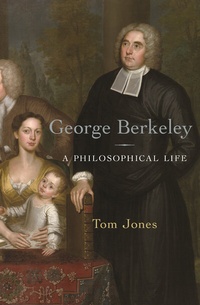
George Berkeley
A Philosophical Life
1st Edition
Published on 7. June 2021
648 pages
978-0-691-21748-2 (ISBN)
Description

A comprehensive intellectual biography of the Enlightenment philosopher
In George Berkeley: A Philosophical Life, Tom Jones provides a comprehensive account of the life and work of the preeminent Irish philosopher of the Enlightenment. From his early brilliance as a student and fellow at Trinity College Dublin to his later years as Bishop of Cloyne, Berkeley brought his searching and powerful intellect to bear on the full range of eighteenth-century thought and experience.
Jones brings vividly to life the complexities and contradictions of Berkeley's life and ideas. He advanced a radical immaterialism, holding that the only reality was minds, their thoughts, and their perceptions, without any physical substance underlying them. But he put forward this counterintuitive philosophy in support of the existence and ultimate sovereignty of God. Berkeley was an energetic social reformer, deeply interested in educational and economic improvement, including for the indigenous peoples of North America, yet he believed strongly in obedience to hierarchy and defended slavery. And although he spent much of his life in Ireland, he followed his time at Trinity with years of travel that took him to London, Italy, and New England, where he spent two years trying to establish a university for Bermuda, before returning to Ireland to take up an Anglican bishopric in a predominantly Catholic country.
Jones draws on the full range of Berkeley's writings, from philosophical treatises to personal letters and journals, to probe the deep connections between his life and work. The result is a richly detailed and rounded portrait of a major Enlightenment thinker and the world in which he lived.
In George Berkeley: A Philosophical Life, Tom Jones provides a comprehensive account of the life and work of the preeminent Irish philosopher of the Enlightenment. From his early brilliance as a student and fellow at Trinity College Dublin to his later years as Bishop of Cloyne, Berkeley brought his searching and powerful intellect to bear on the full range of eighteenth-century thought and experience.
Jones brings vividly to life the complexities and contradictions of Berkeley's life and ideas. He advanced a radical immaterialism, holding that the only reality was minds, their thoughts, and their perceptions, without any physical substance underlying them. But he put forward this counterintuitive philosophy in support of the existence and ultimate sovereignty of God. Berkeley was an energetic social reformer, deeply interested in educational and economic improvement, including for the indigenous peoples of North America, yet he believed strongly in obedience to hierarchy and defended slavery. And although he spent much of his life in Ireland, he followed his time at Trinity with years of travel that took him to London, Italy, and New England, where he spent two years trying to establish a university for Bermuda, before returning to Ireland to take up an Anglican bishopric in a predominantly Catholic country.
Jones draws on the full range of Berkeley's writings, from philosophical treatises to personal letters and journals, to probe the deep connections between his life and work. The result is a richly detailed and rounded portrait of a major Enlightenment thinker and the world in which he lived.
More details
Other editions
Additional editions
Book
03/2025
Princeton University Press
€28.50
Shipment within 10-20 days
Book
05/2021
Princeton University Press
€43.33
Shipment within 10-20 days
Person
Tom Jones is Reader in the School of English at the University of St Andrews. His books include Pope and Berkeley: The Language of Poetry and Philosophy and an edition of Pope's Essay on Man (Princeton). He lives in Dundee, Scotland.
Content
- Cover
- Contents
- List of Illustrations
- Acknowledgements
- Abbreviations and Dating
- Chapter 1. Introduction
- ''Tis Plain, We Do Not See a Man'
- 'Participation of the Divinity'
- Itinerary
- Chapter 2. Birth to the New Doctrine
- Birth, Family, and Education
- Earliest Writings
- An Essay towards a New Theory of Vision
- Chapter 3. Immaterialism
- The New Doctrine
- Adjustments
- Philosophical Personae
- Chapter 4. Passive Obedience and Early Politics
- Early Politics
- Passive Obedience
- William King and Other Activities
- Chapter 5. Philosopher of Education
- Berkeley's Educational Projects
- Locke, Astell, Fénelon
- Chapter 6. London and Italy
- The Guardian
- The Ladies Library
- Italy
- Chapter 7. Others
- The Native Irish
- The Italians
- Americans and Enslaved People
- Chapter 8. London and Italy Again
- The Rebellion
- Italy
- Venice
- Sicily, De Motu
- Tarantulas and Spirits
- Chapter 9. Love and Marriage
- Berkeley's Wives
- The Berkeleys' Views of Marriage
- Chapter 10. Bermuda and Rhode Island
- 'The Greatest Hurry of Business'
- Rivals to Bermuda
- Bermuda, Trade, Corruption
- Bermuda and Independence
- The Church Disillusioned with the State
- Chapter 11. Alciphron
- Apology
- Natural Humans
- Chapter 12. The True End of Speech
- Signifying Ideas
- Passions, Actions, Rules for Conduct
- Chapter 13. Cloyne: Discipline
- Preferment
- The Analyst
- Church, State, and the Discourse Addressed to Magistrates
- Cloyne and Diocesan Discipline
- Chapter 14. 'Early Hours as a Regimen'
- Early Rising
- Sociability and Conversation
- Pleasure and Temperance
- Death
- Chapter 15. Cloyne: Therapy
- Patriotism and Charity
- The Querist
- Sectarianism
- Encouraging and Restraining Appetites
- Money and Banks
- Luxury and the Arts
- Siris: Medicine for the Soul
- Air, Aether, and Fire
- Plants
- Eclectic Philosophy
- Natural Laws
- Leaving Cloyne
- Chapter 16. Afterlife
- Chapter 17. Conclusion
- Bibliography
- Index
