

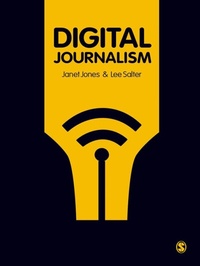
Digital Journalism
1st Edition
Published on 10. November 2011
208 pages
978-1-4462-9189-4 (ISBN)
Description

How can we make sense of the ongoing technological changes affecting journalism and journalists today?
Will the new digital generation break down barriers for journalism, or will things just stay the same?
These and other pertinent questions will be asked and explored throughout this exciting new book that looks at the changing dynamics of journalism in a digital era. Examining issues and debates through cultural, social, political and economic frameworks, the book gets to grip with today's new journalism by understanding its historical threats and remembering its continuing resilience and ability to change with the times. In considering new forms of journalistic practice the book covers important topics such as:
* truth in the new journalism
* the changing identity of the journalist
* the economic implications for the industry
* the impact on the relationship between the journalist and their audience
* the legal framework of doing journalism online.
Vibrant in style and accessible to all, Digital Journalism is a captivating read for anyone looking to understand the advent of a new journalism that has been altered by the latest digital technologies.
Will the new digital generation break down barriers for journalism, or will things just stay the same?
These and other pertinent questions will be asked and explored throughout this exciting new book that looks at the changing dynamics of journalism in a digital era. Examining issues and debates through cultural, social, political and economic frameworks, the book gets to grip with today's new journalism by understanding its historical threats and remembering its continuing resilience and ability to change with the times. In considering new forms of journalistic practice the book covers important topics such as:
* truth in the new journalism
* the changing identity of the journalist
* the economic implications for the industry
* the impact on the relationship between the journalist and their audience
* the legal framework of doing journalism online.
Vibrant in style and accessible to all, Digital Journalism is a captivating read for anyone looking to understand the advent of a new journalism that has been altered by the latest digital technologies.
Reviews / Votes
The most comprehensive book I've read on the issues facing online journalism in the UK. Digital Journalism manages to combine an understanding of technological and cultural developments with a commercial and political awareness that prevents it falling into the trap of technological determinism. Essential reading for journalism studentsPaul Bradshaw
City University and Birmingham City University
Digital Journalism uses current language to tell the story of journalism in transition. Using historical context, contemporary examples, and relevant theory, Jones and Salter discuss the meaning of digital technology for the practice of journalism. Their approach is globally focused and examines how different traditions of journalism adopt and adapt to technological innovation, creating new cultures of journalism and redefining existing ones. A must read for students and practitioners of online journalism
Zizi Papacharissi
University of Illinois at Chicago
Janet Jones and Lee Salter contribute an engaged and engaging analysis of journalism in the digital age that dispenses with the cheer-leading and the doom-mongering that all too frequently drown out more subtle voices. Their book discusses new and emerging technologies within the political, economic, cultural and social contexts that are so vital to an understanding of what is going on around us. Digital Journalism is highly recommended reading for journalists and scholars alike
Tony Harcup
University of Sheffield
Janet Jones and Lee Salter have condesed a vast array of information about the theory and practice of journalism before, but mostly after, the 'digital disruption' of media. The book leads with an insightful introduction that sketches out contemporary journalism as a practice with historically entrenched concepts facing transition... Most of Jones and Salter's examples are drawn from the UK media, but Digital Journalism has a global perspective, and Australian readers will be able to find some references to local cases... The content of the chapters is well sourced and referenced, and the book unfolds in a logical way... A comprehensive guide to the state of journalism, the book will be invaluable to students of journalism.
Ekaterina Loy
Media International Australia
More details
Edition
1. Auflage
Language
English
Place of publication
London
United Kingdom
Target group
College/higher education
Product notice
Reflowable
ISBN-13
978-1-4462-9189-4 (9781446291894)
Copyright in bibliographic data and cover images is held by Nielsen Book Services Limited or by the publishers or by their respective licensors: all rights reserved.
Schweitzer Classification
Other editions
Additional editions
Janet Jones | Lee Salter
Digital Journalism
Book
11/2011
1st Edition
SAGE Publications Inc
€200.89
Shipment within 10-20 days
Janet Jones | Lee Salter
Digital Journalism
Book
11/2011
1st Edition
SAGE Publications Inc
€86.80
Shipment within 10-20 days
Persons
Professor Janet Jones is Dean of the Arts and Creative Industries School at London South Bank University. Dr Lee Salter is Senior Lecturer in media and communications at the University of Sussex.
Content
Introduction
Journalism as a Practice
A Political Economy of Online Journalism
Digitally Challenged Business Models
Truth Trust Transparency
Public Service News
Local Digital Journalism
News Customization
Mobile Journalism: From Desktop to Pocket
Media Law and the Challenges of the Internet
Afterward: The End of News?
Journalism as a Practice
A Political Economy of Online Journalism
Digitally Challenged Business Models
Truth Trust Transparency
Public Service News
Local Digital Journalism
News Customization
Mobile Journalism: From Desktop to Pocket
Media Law and the Challenges of the Internet
Afterward: The End of News?
