

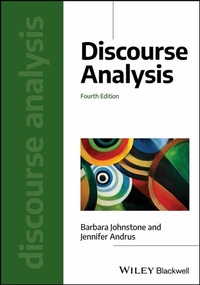
Discourse Analysis
Description

Discourse Analysis explains how to collect and analyze spoken, written, and multimodal language. Now in its fourth edition, this popular textbook encourages students to think systematically and critically about different sources of discourse to better understand why spoken utterances and written texts have the meanings and uses they do. Throughout the book, the authors offer real-life examples of what discourse analysis can reveal about language, individuals, groups, and society.
Student-friendly chapters describe discourse analysis with a goal of helping students master the fundamental concepts of this important area of linguistic research. Each chapter contains discussion questions that encourage students to relate the material to their own experiences, perform their own analyses, and consider important issues in research design and research ethics. The new edition of Discourse Analysis includes new discussion questions and ideas for research projects, up-to-date supplementary readings, and expanded discussions of corpus analysis methods, rhetorical legitimation, and social identities. This textbook:
* Teaches students to apply discourse analysis to answer research questions in disciplines across the humanities and social sciences
* Explains the complex relationships between discourse and various aspects of context, such as linguistic structure, participants, and prior discourse
* Provides instructors with the flexibility to re-order chapters to meet the needs of their students
* Features exercises that incorporate extensive data from a variety of languages and situations, including discourse in electronic media
* Contains discussion questions, activities, research projects suggestions, further readings, chapter summaries, and other pedagogical features
Discourse Analysis, Fourth Edition, remains the ideal primary text for undergraduate and graduate courses in language and linguistics, language pedagogy, rhetoric and composition, and linguistic ethnography.
More details
Other editions
Additional editions
Persons
BARBARA JOHNSTONE is Professor Emeritus of Rhetoric and Linguistics at Carnegie Mellon University. Her research is at the intersection of rhetoric, linguistics, and critical theory. She is interested in how the relationships between individuals and communities are created and maintained through discourse.
JENNIFER ANDRUS is Professor of Writing and Rhetoric Studies at the University of Utah, where she teaches courses on discourse analysis, legal rhetoric, and rhetorical theory. She is a founding board member of Fight Against Domestic Violence and the author of numerous articles and two books.
Content
List of Figures xi
List of Tables xii
Preface xiii
1 Introduction 1
1.1 What Is Discourse Analysis? 1
1.1.1 "Discourse" 2
1.1.2 "Analysis" 3
1.2 Some Uses of Discourse Analysis 5
1.2.1 Discourse Analysis in Linguistic Research 5
1.2.2 Discourse Analysis in Other Disciplines 6
1.2.3 From Text Outward 6
1.3 Facets of Discourse Analysis 7
1.3.1 A Heuristic for Analysis 8
1.3.2 Texts and Interpretations of Texts are Shaped by the World, and They Shape the World 9
1.3.3 Discourse Is Shaped by Purpose and Discourse Shapes Possible Purposes 11
1.3.4 Discourse Is Shaped by the Possibilities and Limitations of Language, and Discourse Shapes Language 12
1.3.5 Discourse Is Shaped by Interpersonal Relations, and Discourse Helps to Shape Interpersonal Relations 14
1.3.6 Discourse Is Shaped by Expectations Created by Familiar Discourse, and New Instances of Discourse Help to Shape Our Expectations about What Future Discourse Will Be Like and How It Should Be Interpreted 15
1.3.7 Discourse Is Shaped by the Limitations and Possibilities of Its Media, and the Possibilities of Communications Media are Shaped by Their Uses in Discourse 16
1.4 Texts, Transcripts, and Corpora: Data for Discourse Analysis 17
1.4.1 Corpus Analysis 19
1.4.2 Transcription: Representing Speech in Writing 19
1.4.3 "Descriptive" and "Critical" Goals 24
1.5 Locations of Meaning 26
1.6 Discourse as Strategy, Discourse as Adaptation 28
1.7 Language and Languaging 30
1.8 Particularity, Theory, and Method 31
1.9 Chapter Summary 33
Further Reading 34
2 Discourse and World 35
2.1 Introduction 35
2.2 Linguistic Categories and Worldviews 38
2.3 Discourse, Culture, and Ideology 44
2.3.1 Metaphor and Conceptual Frames 46
2.3.2 Poetics, Grammar, and Culture: Parallelism and Text Metricality 49
2.3.3 Critical Discourse Analysis 53
2.3.3.1 Representing Actions, Actors, and Events 54
2.3.3.2 Evaluating: Affect, Judgment, Appreciation, Graduation 56
2.3.3.3 Representing Knowledge Status: Evidentiality 57
2.3.3.4 Naming and Wording 59
2.3.3.5 Representing Other Voices: Heteroglossia and Appropriation 60
2.3.3.6 Collocation and Semantic Preference: Cumulative Effects of Text-level Choices 62
2.3.4 Legitimation and Truth 67
2.4 Language Ideology 71
2.5 Silence 74
2.6 Chapter Summary 77
Further Reading 78
3 Intention and Interpretation 80
3.1 Introduction 80
3.2 Speech Acts, Conversational Implicature, and Relevance Theory 81
3.3 Contextualization Cues and Discourse Marking 87
3.4 Rhetorical Aims, Strategies, and Styles 93
3.5 Verbal Art and Performance 102
3.6 Chapter Summary 105
Further Reading 105
4 Discourse Structure: Parts and Sequences 107
4.1 Introduction 107
4.2 Words and Lines 109
4.3 Old and New Information and the Organization of Sentences 115
4.4 Cohesion 119
4.5 Paragraphs and Episodes 125
4.6 Discourse Schemata and the Structure of Narrative 127
4.7 The Emergent Organization of Conversation 136
4.8 Structures and Rules 145
4.9 Chapter Summary 147
Further Reading 148
5 Participants in Discourse: Relationships, Roles, Identities 149
5.1 Introduction 149
5.2 Audience, Politeness, and Accommodation 150
5.3 Power and Solidarity 155
5.4 Indexicality 160
5.5 Social Roles and Participant Frameworks 162
5.6 Performances of Identity 167
5.6.1 Gender and Sexual Identity in Discourse 169
5.6.2 Race and Racialization in Discourse 170
5.6.3 Performing Place Identity 170
5.7 Stance and Style 172
5.8 Personal Identity: Discourse and the Self 179
5.9 The Linguistic Individual in Discourse 181
5.10 Chapter Summary 183
Further Reading 184
6 Prior Texts, Prior Discourses 186
6.1 Introduction 186
6.2 Intertextuality and Interdiscursivity 187
6.3 Repetition in Conversation 194
6.4 Situational Registers 199
6.5 Enregisterment 204
6.6 Genre: Recurrent Forms in Recurrent Actions 205
6.7 Frames, Plots, and Coherence 210
6.8 Chapter Summary 213
Further Reading 215
7 Discourse and Medium 216
7.1 Introduction 216
7.2 Writing and Speaking 217
7.2.1 Early Research About "Orality and Literacy" 217
7.2.2 Literacy and Literacies 221
7.3 Mediation: Communication and Technology 226
7.3.1 Medium and Discourse Form 229
7.3.2 Medium and Discourse Processing: Fixity, Fluidity, And Coherence 233
7.3.3 Medium and Interpersonal Relations 237
7.3.4 Medium, Expertise, and Knowledge-making 240
7.4 Analyzing Multimodal Discourse 242
7.4.1 Speech and the Body 242
7.4.2 Writing and Seeing 247
7.4.2.1 What Writing Looks Like 248
7.4.2.2 Reading Images 250
7.4.2.3 Words and Images 255
7.5 Chapter Summary 259
Further Reading 260
Glossary 261
References 267
Index 295
Preface
This book is intended to be a first-level text for undergraduates and beginning graduate students taking their first (or only) course about discourse analysis. The subject matter of discourse analysis is vast - "language in use," as Brown and Yule (1983) put it, "utterances," according to Schiffrin (1994), "verbal communication" for Renkema (2004) - and most discourse analysts would be hard-pressed to describe what, if anything, makes discourse analysis a discipline. Yet, discourse analysis is implicitly treated as if it were a discipline in texts that are organized as a series of overviews of research topics (institutional discourse, discourse and gender, narrative, media discourse, and so on) or theories (pragmatics, conversation analysis, politeness theory, and so on). The approach we take in this book is different. We treat discourse analysis not as a discipline (or as a subdiscipline of linguistics) but as a systematic, rigorous way of suggesting answers to research questions posed in and across disciplines throughout the humanities and social sciences and beyond. In other words, we see discourse analysis as a research method that can be (and is being) used by scholars with a variety of academic and nonacademic affiliations, coming from a variety of disciplines, to answer a variety of questions.
For this reason, this book is meant to encourage students not to think of discourse analysis as a collection of facts or canonical studies or as a body of theory. As we will see, discourse analysts set out to answer many kinds of questions about language, about speakers, and about society and culture. However, they all approach their tasks by paying close and systematic attention to particular situations and particular texts or utterances or sets of texts or utterances. This book attempts to separate the techniques of discourse analysis clearly from its results, trying to make sure that students understand and practice the former before concentrating on the latter. This will, we hope, help alleviate a problem we have had again and again in teaching discourse analysis - that of ending up with students who are fascinated by the results of sensitive analyses of discourse but unable themselves to perform analyses that go much beyond paraphrase. Discourse analysis, as we approach it here, is an open-ended heuristic, a research method consisting of a set of topics to consider in connection with any instance of discourse. This heuristic can help ensure that discourse analysts are systematically paying attention to every possible element of the potential meaning of a stretch of talk, writing, or multimodal text: every kind of context, every resource for creativity, and every source of limitation and constraint on creativity. Our focus is thus less on providing detailed descriptions of the results of discourse analysts' work than on asking students to think systematically about a variety of sources of constraint on and creativity in discourse, a variety of reasons why spoken utterances and visual texts have the meanings and uses they do. Discussion questions which, in many cases, ask readers to think about what they and other people in their field do or might do with discourse analysis, as well as ideas for small research projects using discourse analysis, are interspersed throughout the chapters.
Except for the first, the chapters in this book are self-contained, so they could be handled in any order. The order we have selected reflects a combination of what we have found students' interests and expectations to be. People often come to language study because their attention has been captured by the ways in which language, culture, and the world seem to be intertwined. (This can happen, for example, when one studies a foreign language or interacts with people in a foreign place.) This is why we have put the chapter about discourse and world directly after the introduction. It is followed by a chapter that raises the important issue of the role of intentions in discourse processing. People expect language study to be about structures and rules, so the chapter about discourse and structure is also close to the beginning. No textbook author can expect to control how their book is used. We would like, however, to urge that readers of this book to touch on every chapter in it. To pick and choose among the ways in which discourse is multiply constrained and enabled would be contrary to the overall purpose of the book, because it would encourage the kind of one-dimensional approach to explaining texts against which this book constitutes an argument.
Each chapter ends with a set of suggested supplementary readings. These are not intended as comprehensive bibliographies. Particularly in the areas in which most work is being done at the moment, it would be impossible to have included all the most recent sources, and such literature reviews would, in any case, have been outdated by the time the book was published. Instead, we have tried to make suggestions for one or two things a person might profitably read in connection with each section of the chapter. Some are particularly influential studies, often ones done relatively early on. Others are overviews and literature reviews. Instructors could use these lists to choose supplementary readings for the course, and students could use them as a way to get started with background reading in the areas they decide to focus on.
Although some are trained in departments of linguistics, most discourse analysts, at least in the United States, do not teach in linguistics departments, but rather in departments of English, anthropology, communication, education, or foreign languages, among others. This means that most students in courses about discourse analysis are not linguistics majors or graduate students in linguistics. We have made every effort in designing this book not to lose sight of this fact. We have tried to avoid the temptation to write at such an advanced level and in such a discipline-specific way that students' frequent suspicions that linguistics is difficult and irrelevant to their other interests are simply confirmed. A course in discourse analysis is an ideal place to encourage interdisciplinary exploration, since discourse is a focus of study in most of the humanities and social sciences. Discourse analysis is practiced in one way or another by at least some people in most of the academic disciplines in which human life is the focus: anthropologists analyze discourse, as do communications scholars, rhetoricians, literary and cultural critics, sociologists, psychologists, political scientists, geographers, and medical, legal, and educational researchers, among others. Nonlinguists can be drawn into the study of language through discourse analysis, and linguists can be drawn into interdisciplinary work. We have written this book specifically with a nonspecialist, interdisciplinary audience in mind. Although readers might benefit from having had a general introduction to linguistics first (particularly if the introduction was not limited to formal theories of semantics, syntax, and phonology), we assume that many readers will be newcomers to the field. In the text, we try to explain concepts from linguistics when they first arise. There is a glossary at the end of the book in which terms that may be unfamiliar, as well as specialized uses of familiar words, are briefly defined.
In order to make it possible for instructors to adapt the book to more specialized audiences, some of the discussion questions are geared to teachers and students in one field or another. For example, some discussion questions require students to produce translations or do detailed grammatical analysis. These will obviously not work for students who do not know foreign languages or who are unfamiliar with basic grammatical concepts and terms. Other discussion questions are on topics that will particularly interest people in one field or another: some deal with literary discourse, for example, others with technical genres; some deal with writing and some with spoken language. It is not intended, nor would it be possible, for a class to do all the discussion questions. Students and instructors are meant to develop a system for choosing among them.
Since many of the texts around which the questions revolve were selected and/or collected by our students, there is an inevitable North American bias. We have tried to counteract this to a certain extent in the body of the text by discussing and drawing examples from research done elsewhere. Unfortunately, it has simply not been practical to include anything approaching a representative sampling of work about languages other than English. Good discourse analysis usually cannot be done in translation (although good translation requires careful discourse analysis), and English is the only language readers of this book will, more or less, share.
Instructors who have used previous editions of this book will find that this edition preserves the overall structure of the third edition. In addition to reordering some parts of the chapters in the service of clarity and updating the lists of further reading, we have sharpened the focus on corpus linguistics in Chapter 1 and elsewhere. Chapter 2 includes a new section on legitimation. In Chapter 5, there is an expanded discussion of performances of identity and new sections on gender and sexual identity, race and racialization, and place identity. Throughout, we have supplemented discussions of key studies with references to newer research, much of it based on online data. We have made sure that at least one Discussion Question in each chapter helps introduce students to the research design process.
As will...
