

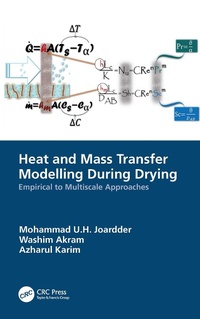
Heat and Mass Transfer Modelling During Drying
Empirical to Multiscale Approaches
1st Edition
Published on 30. September 2021
220 pages
978-0-429-86553-4 (ISBN)
Description

Most conventional dryers use random heating to dry diverse materials without considering their thermal sensitivity and energy requirements for drying. Eventually, excess energy consumption is necessary to attain a low-quality dried product. Proper heat and mass transfer modelling prior to designing a drying system for selected food materials can overcome these problems. Heat and Mass Transfer Modelling During Drying: Empirical to Multiscale Approaches extensively discusses the issue of predicting energy consumption in terms of heat and mass transfer simulation.
A comprehensive mathematical model can help provide proper insight into the underlying transport phenomena within the materials during drying. However, drying of porous materials such as food is one of the most complex problems in the engineering field that is also multiscale in nature. From the modelling perspective, heat and mass transfer phenomena can be predicted using empirical to multiscale modelling. However, multiscale simulation methods can provide a comprehensive understanding of the physics of drying food materials.
KEY FEATURES
Includes a detailed discussion on material properties that are relevant for drying phenomena
Presents an in-depth discussion on the underlying physics of drying using conceptual visual content
Provides appropriate formulation of mathematical modelling from empirical to multiscale approaches
Offers numerical solution approaches to mathematical models
Presents possible challenges of different modelling strategies and potential solutions
The objective of this book is to discuss the implementation of different modelling techniques ranging from empirical to multiscale in order to understand heat and mass transfer phenomena that take place during drying of porous materials including foods, pharmaceutical products, paper, leather materials, and more.
A comprehensive mathematical model can help provide proper insight into the underlying transport phenomena within the materials during drying. However, drying of porous materials such as food is one of the most complex problems in the engineering field that is also multiscale in nature. From the modelling perspective, heat and mass transfer phenomena can be predicted using empirical to multiscale modelling. However, multiscale simulation methods can provide a comprehensive understanding of the physics of drying food materials.
KEY FEATURES
Includes a detailed discussion on material properties that are relevant for drying phenomena
Presents an in-depth discussion on the underlying physics of drying using conceptual visual content
Provides appropriate formulation of mathematical modelling from empirical to multiscale approaches
Offers numerical solution approaches to mathematical models
Presents possible challenges of different modelling strategies and potential solutions
The objective of this book is to discuss the implementation of different modelling techniques ranging from empirical to multiscale in order to understand heat and mass transfer phenomena that take place during drying of porous materials including foods, pharmaceutical products, paper, leather materials, and more.
More details
Edition
1. Auflage
Language
English
Place of publication
London
United Kingdom
Publishing group
Taylor & Francis Ltd
Target group
Professional and scholarly
Illustrations
36 Tables, black and white; 35 Line drawings, color; 41 Line drawings, black and white; 3 Halftones, color; 7 Halftones, black and white; 38 Illustrations, color; 48 Illustrations, black and white
ISBN-13
978-0-429-86553-4 (9780429865534)
Copyright in bibliographic data and cover images is held by Nielsen Book Services Limited or by the publishers or by their respective licensors: all rights reserved.
Schweitzer Classification
Other editions
Additional editions
Mohammad U.H. Joardder | Washim Akram | Azharul Karim
Heat and Mass Transfer Modelling During Drying
Empirical to Multiscale Approaches
Book
10/2024
1st Edition
CRC Press
€116.70
Shipment within 10-20 days
Mohammad U.H. Joardder | Washim Akram | Azharul Karim
Heat and Mass Transfer Modelling During Drying
Empirical to Multiscale Approaches
Book
09/2021
1st Edition
CRC Press
€278.40
Shipment within 10-20 days
Persons
Dr. Mohammad U. H. Joardder received his BSc in Mechanical Engineering from Rajshahi University of Engineering and Technology (RUET), and PhD from QUT, Australia. He is now serving as a faculty member in Mechanical Engineering of RUET. His research interests include bio-transport, Innovative food drying, modelling of novel food processing, food microstructure, as well as Renewable energy. Moreover, his research focuses on applying state-of-the-art computational methods to Multiphysics- Multiscale transport phenomena, and deformation of porous biomaterials. He authored three popular books with the springer-nature publication, three books chapter and more than 40 peer-reviewed journal publications. Most of his journal articles are in highly ranked journals and have been well cited. He is a regular reviewer of several high ranked journals of prominent publishers including Nature, Springer, Elsevier, Willey, and Taylor and Francis.
Md. Washim Akram has completed his B.Sc. in Mechanical Engineering from Rajshahi University of Engineering & Technology (RUET), Bangladesh. He is a Faculty Member in the Department of Mechanical Engineering at the Bangladesh Army University of Science and Technology (BAUST), Saidpur, Bangladesh. He has published several Journal and Conference papers. His research interest includes drying technology, waste management and energy conversion technology, energy harvesting from renewable sources, and composite materials.
Dr Azharul Karim is currently working as an Associate Professor in the Mechanical Engineering Discipline, Science and Engineering Faculty, Queensland University of Technology, Australia. He received his PhD degree from Melbourne University in 2007. Through his scholarly, innovative, high quality research, he has established a national and international standing. Dr Karim has authored over 194 peer-reviewed articles, including 94 high quality journal papers, 13 peer-reviewed book chapters, and four books. His papers have attracted about 3100 citations with h-index 30. His research has very high impact worldwide as demonstrated by his overall field weighted citation index (FWCI) of 2.99. He is editor/board member of six reputed journals including Drying Technology and Nature Scientific Reports and supervisor of 26 past and current PhD students. He has been keynote/distinguished speaker at scores of international conferences and invited/keynote speaker in seminars in many reputed universities worldwide. He has won multiple international awards for his outstanding contributions in multidisciplinary fields. His research is directed towards solving acute food industry problems by advanced multiscale and multiphase food drying models of cellular water using theoretical/computational and experimental methodologies. Due to the multidisciplinary framework of food drying models, his research spans engineering, mathematics, biology, physics and chemistry. To address this multidisciplinary challenge, he established the 'Energy and Drying' Research Group consisting of academics and researchers across disciplines.
Md. Washim Akram has completed his B.Sc. in Mechanical Engineering from Rajshahi University of Engineering & Technology (RUET), Bangladesh. He is a Faculty Member in the Department of Mechanical Engineering at the Bangladesh Army University of Science and Technology (BAUST), Saidpur, Bangladesh. He has published several Journal and Conference papers. His research interest includes drying technology, waste management and energy conversion technology, energy harvesting from renewable sources, and composite materials.
Dr Azharul Karim is currently working as an Associate Professor in the Mechanical Engineering Discipline, Science and Engineering Faculty, Queensland University of Technology, Australia. He received his PhD degree from Melbourne University in 2007. Through his scholarly, innovative, high quality research, he has established a national and international standing. Dr Karim has authored over 194 peer-reviewed articles, including 94 high quality journal papers, 13 peer-reviewed book chapters, and four books. His papers have attracted about 3100 citations with h-index 30. His research has very high impact worldwide as demonstrated by his overall field weighted citation index (FWCI) of 2.99. He is editor/board member of six reputed journals including Drying Technology and Nature Scientific Reports and supervisor of 26 past and current PhD students. He has been keynote/distinguished speaker at scores of international conferences and invited/keynote speaker in seminars in many reputed universities worldwide. He has won multiple international awards for his outstanding contributions in multidisciplinary fields. His research is directed towards solving acute food industry problems by advanced multiscale and multiphase food drying models of cellular water using theoretical/computational and experimental methodologies. Due to the multidisciplinary framework of food drying models, his research spans engineering, mathematics, biology, physics and chemistry. To address this multidisciplinary challenge, he established the 'Energy and Drying' Research Group consisting of academics and researchers across disciplines.
Content
Introduction. Basic Heat and Mass Transfer. Heat and Mass Transfer During Different Drying Process. Comparison of Different Mathematical Modelling of Transport Phenomena. Empirical Modelling. Single-Phase Physics Based Model. Multiphase Modelling. Micro-Scale Modelling. Multi-Scale Modelling. CFD Model for Dryers. Conclusion.
