
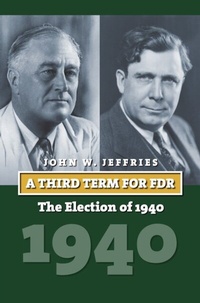
A Third Term for FDR
Description
Alles über E-Books | Antworten auf Fragen rund um E-Books, Kopierschutz und Dateiformate finden Sie in unserem Info- & Hilfebereich.
In 1940, for the first time since America's founding, a sitting president sought a third term in office. But this was only one remarkable aspect of that year's election, which was, as John Jeffries makes clear in his new book, one of the most interesting and important elections in American history.
Franklin Roosevelt's plan to pack the Supreme Court had failed; in the wake of a recent recession, his New Deal had hardened support and opposition among both parties; and the German advance across Europe, along with Japanese aggression in Asia, was stirring fierce debate over America's role in the world. Adding to the moment of profound uncertainty was FDR's procrastination over whether to run again. Jeffries explores how these tensions played out and what they meant, not just for the presidential election but also for domestic politics and policy generally, and for state and local contests. In the context of the Roosevelt Coalition and the New Deal party system, he parses the debates and struggles within both the Democratic and Republican parties as Roosevelt deliberated over running and Wendell Wilkie, a businessman from Indiana and New York City, got the nod from Republicans over a field including the rising moderate Thomas E. Dewey, the conservative Michigan senator Arthur Vandenburg, and the isolationist Ohio senator Robert Taft.
A Third Term for FDR reveals how domestic policy more than international events influenced Roosevelt's decision to run and his victory in November. A detailed analysis of the results offers insights into the impact of the year's events on voting, and into the election's long-term implications and ramifications?many of which continue to this day.
All prices
More details
Other editions
Additional editions
Person
Content
Editors' Foreword
Acknowledgments
Introduction
1. Roosevelt and the Democrats in the 1930s: Triumph and Troubles
2. The Republicans: ?We Want Wilkie?
3. The Democrats: ?The Sphinx?
4. The Campaign: The Callenger vs. The ?Champ?
5. The Election: ?Another Great Democratic Victory?
Epilogue
Appendix A. Franklin D. Roosevelt's Address Accepting the Democratic Party Nomination for President, July 19, 1940
Appendix B: 1940 Presidential Election Results
Appendix C: Franklin Roosevelt's Inaugural Speech, January 20, 1941
Notes
Bibliographical Essay
Index

System requirements
File format: ePUB
Copy protection: Adobe-DRM (Digital Rights Management)
System requirements:
- Computer (Windows; MacOS X; Linux): Install the free reader Adobe Digital Editions prior to download (see eBook Help).
- Tablet/smartphone (Android; iOS): Install the free app Adobe Digital Editions or the app PocketBook before downloading (see eBook Help).
- E-reader: Bookeen, Kobo, Pocketbook, Sony, Tolino and many more (not Kindle).
The file format ePub works well for novels and non-fiction books – i.e., „flowing” text without complex layout. On an e-reader or smartphone, line and page breaks automatically adjust to fit the small displays.
This eBook uses Adobe-DRM, a „hard” copy protection. If the necessary requirements are not met, unfortunately you will not be able to open the eBook. You will therefore need to prepare your reading hardware before downloading.
Please note: We strongly recommend that you authorise using your personal Adobe ID after installation of any reading software.
For more information, see our ebook Help page.
File format: PDF
Copy-Protection: Adobe-DRM (Digital Rights Management)
System requirements:
- Computer (Windows; MacOS X; Linux): Install the free reader Adobe Digital Editions prior to download (see eBook Help).
- Tablet/smartphone (Android; iOS): Install the free app Adobe Digital Editions or the app PocketBook before downloading (see eBook Help).
- E-reader: Bookeen, Kobo, Pocketbook, Sony, Tolino and many more (only limited: Kindle).
The file format PDF always displays a book page identically on any hardware. This makes PDF suitable for complex layouts such as those used in textbooks and reference books (images, tables, columns, footnotes). Unfortunately, on the small screens of e-readers or smartphones, PDFs are rather annoying, requiring too much scrolling.
This eBook uses Adobe-DRM, a „hard” copy protection. If the necessary requirements are not met, unfortunately you will not be able to open the eBook. You will therefore need to prepare your reading hardware before downloading.
Please note: We strongly recommend that you authorise using your personal Adobe ID after installation of any reading software.
For more information, see our eBook Help page.
File format: ePUB
Copy protection: Watermark-DRM (Digital Rights Management)
System requirements:
- Computer (Windows; MacOS X; Linux): Use a reading software that can process the file format ePUB: e.g., Adobe Digital Editions or FBReader – both free (see eBook Help).
- Tablet/Smartphone (Android; iOS): Before downloading, install the free app Adobe Digital Editions (see eBook Help).
- E-reader: Bookeen, Kobo, Pocketbook, Sony, Tolino and many more (not Kindle).
The file format ePUB works well for novels and non-fiction books – i.e., „flowing” text without complex layout. On an e-reader or smartphone, line and page breaks automatically adjust to fit the small displays.
This eBook uses Watermark-DRM, a „soft” copy protection. This means that there are no technical restrictions to prevent illegal distribution. However, there is a personalised watermark embedded in the eBook that can be used to identify the purchaser of the eBook in the event of misuse and to provide evidence for legal purposes.
For more information, see our eBook Help page.
