

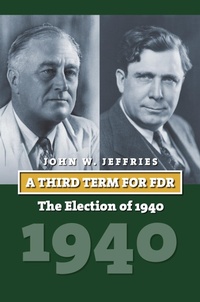
A Third Term for FDR
The Election of 1940
Published on 17. March 2017
Book
Hardback
264 pages
978-0-7006-2402-7 (ISBN)
Description
In 1940, for the first time since America's founding, a sitting president sought a third term in office. But this was only one remarkable aspect of that year's election, which was, as John Jeffries makes clear in his new book, one of the most interesting and important elections in American history.
Franklin Roosevelt's plan to pack the Supreme Court had failed; in the wake of a recent recession, his New Deal had hardened support and opposition among both parties; and the German advance across Europe, along with Japanese aggression in Asia, was stirring fierce debate over America's role in the world. Adding to the moment of profound uncertainty was FDR's procrastination over whether to run again. Jeffries explores how these tensions played out and what they meant, not just for the presidential election but also for domestic politics and policy generally, and for state and local contests. In the context of the Roosevelt Coalition and the New Deal party system, he parses the debates and struggles within both the Democratic and Republican parties as Roosevelt deliberated over running and Wendell Wilkie, a businessman from Indiana and New York City, got the nod from Republicans over a field including the rising moderate Thomas E. Dewey, the conservative Michigan senator Arthur Vandenburg, and the isolationist Ohio senator Robert Taft.
A Third Term for FDR reveals how domestic policy more than international events influenced Roosevelt's decision to run and his victory in November. A detailed analysis of the results offers insights into the impact of the year's events on voting, and into the election's long-term implications and ramifications-many of which continue to this day.
Franklin Roosevelt's plan to pack the Supreme Court had failed; in the wake of a recent recession, his New Deal had hardened support and opposition among both parties; and the German advance across Europe, along with Japanese aggression in Asia, was stirring fierce debate over America's role in the world. Adding to the moment of profound uncertainty was FDR's procrastination over whether to run again. Jeffries explores how these tensions played out and what they meant, not just for the presidential election but also for domestic politics and policy generally, and for state and local contests. In the context of the Roosevelt Coalition and the New Deal party system, he parses the debates and struggles within both the Democratic and Republican parties as Roosevelt deliberated over running and Wendell Wilkie, a businessman from Indiana and New York City, got the nod from Republicans over a field including the rising moderate Thomas E. Dewey, the conservative Michigan senator Arthur Vandenburg, and the isolationist Ohio senator Robert Taft.
A Third Term for FDR reveals how domestic policy more than international events influenced Roosevelt's decision to run and his victory in November. A detailed analysis of the results offers insights into the impact of the year's events on voting, and into the election's long-term implications and ramifications-many of which continue to this day.
More details
Language
English
Place of publication
Kansas
United States
Target group
Professional and scholarly
Product notice
sewn/stitched
Cloth over boards
Dimensions
Height: 236 mm
Width: 163 mm
Thickness: 27 mm
Weight
547 gr
ISBN-13
978-0-7006-2402-7 (9780700624027)
Copyright in bibliographic data and cover images is held by Nielsen Book Services Limited or by the publishers or by their respective licensors: all rights reserved.
Schweitzer Classification
Other editions
Additional editions
E-Book
03/2017
1st Edition
University Press of Kansas
from
€92.99
Available for download
Person
John W. Jeffries is Dean Emeritus of Arts, Humanities, and Social Sciences, and Professor Emeritus of History at the University of Maryland, Baltimore County. He is the author of Wartime America: The World War II Home Front.