

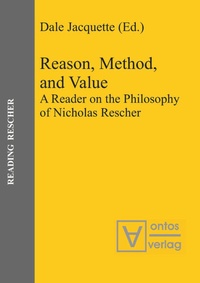
Reason, Method, and Value
Description

Nicholas Rescher has enjoyed a long and distinguished career in philosophy, writing on many different areas from logic to philosophy of language, epistemology, pragmatism, ethics and political philosophy, and metaphilosophy. Reason, Method, and Value: A Reader on the Philosophy of Nicholas Rescher offers a selection of Rescher's writings over a span of decades representing the core of his prodigious research interests in six key areas. Each section of the *Reader* is accompanied by a compact critical introduction written by a leading philosophical scholar with spezial expertise in Rescher's philosophy, and the volume opens with an appreciative introduction written by the editor and a concluding retrospective by Rescher, looking back over his oeuvre and explaining connecting themes and the unity of system contained in this extensive body of work. Taken together, the volume encapsulates the heart of Rescher's impressive lifelong contributions to philosophy between two covers, in a single volume that provides a solid overview of his thought while serving to direct readers to the corpus of Rescher's writings for amore complete picture.
More details
Other editions
Additional editions
Content
- 5 [Seite 5]
2 - Preface [Seite 9]
3 - NICHOLAS RESCHER'S SYSTEMATIC PHILOSOPHY IntroductionDale Jacquette [Seite 11]
4 - Part I THEORY OF INQUIRY [Seite 29]
4.1 - IntroductionJohn Greco [Seite 29]
4.2 - PLAUSIBILITY AND PRESUMPTION [Seite 37]
4.3 - THE PURSUIT OF TRUTH: COHERENTIST CRITERIOLOGY [Seite 65]
4.4 - THE CULTURAL EVOLUTION OF COMMUNAL PRACTICES IN INQUIRY [Seite 85]
4.5 - ON COGNITIVE ECONOMICS [Seite 95]
4.6 - AGAINST COGNITIVE RELATIVISM [Seite 115]
5 - Part II LOGIC AND PARADOX [Seite 133]
5.1 - Introduction John Woods [Seite 133]
5.2 - VAGRANT PREDICATES AND UNANSWERABLE QUESTIONS [Seite 157]
5.3 - TRUTH, FACT, AND THE LIMITS OF KNOWLEDGE [Seite 169]
5.4 - APORETICS [Seite 179]
5.5 - PARADOX RESOLUTION [Seite 193]
5.6 - REIFICATION FALLACIES AND INAPPROPRIATE TOTALITIES [Seite 207]
5.7 - PLURALITY QUANTIFICATION [Seite 229]
6 - Part III SCIENCE AND ITS LIMITS [Seite 235]
6.1 - Introduction Robert Almeder [Seite 235]
6.2 - THE SYSTEMATICITY OF NATURE [Seite 257]
6.3 - THE COMPLEXITY AND COGNITIVE INEXHAUSTIBILITY OF NATURE [Seite 273]
6.4 - THE UNPREDICTABILITY OF FUTURESCIENCE [Seite 301]
6.5 - TECHNOLOGICAL ESCALATION AND THE EXPLORATION MODEL OF NATURAL SCIENCE [Seite 317]
6.6 - THE LAW OF LOGARITHMIC RETURNS [Seite 327]
6.7 - THE UNREALIZABILITY OFPERFECTED SCIENCE [Seite 341]
7 - Part IV METAPHYSICS [Seite 365]
7.1 - Introduction William Jaworski [Seite 365]
7.2 - PRAGMATIC REALISM: A PRACTICALISTIC PERSPECTIVE ONPHILOSOPHICAL REALISM [Seite 375]
7.3 - IDEALISM [Seite 399]
7.4 - PRAGMATISM [Seite 415]
7.5 - OPTIMALISM AND AXIOLOGICAL METAPHYSICS [Seite 435]
8 - Part V ETHICAL AND SOCIAL PHILOSOPHY [Seite 465]
8.1 - IntroductionLenn E. Goodman [Seite 465]
8.2 - MORAL RELATIVISM: ARE THERE MORAL UNIVERSALS? [Seite 481]
8.3 - RATIONALITY AND MORAL OBLIGATION [Seite 519]
8.4 - IS CONSENSUS REQUIRED FOR A RATIONAL SOCIAL ORDER? [Seite 531]
8.5 - THE POWER OF IDEALS [Seite 545]
9 - Part VI PHILOSOPHICAL SYSTEMATIZATION [Seite 557]
9.1 - Introduction Lorenz B. Puntel [Seite 557]
9.2 - ON PHILOSOPHICAL SYSTEMATIZATION: PLAUSIBILITY AND THEHEGELIAN VISION [Seite 565]
9.3 - WHY PHILOSOPHIZING MUST BE SYSTEMATIC (THE HOLISTIC NATURE OF PHILOSOPHY) [Seite 595]
9.4 - PHILOSOPHY AND PARADOX [Seite 613]
9.5 - HOLISTIC EXPLANATION AND THE IDEA OF A GRAND UNIFIED THEORY [Seite 633]
10 - BOOKS BY NICHOLAS RESCHER [Seite 643]
