

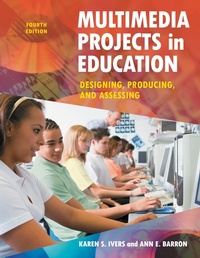
Multimedia Projects in Education
Designing, Producing, and Assessing
4th Edition
Published on 13. September 2010
240 pages
978-1-59884-535-8 (ISBN)
Description

This practical and easy-to-use resource will help teachers and library media specialists effectively integrate multimedia projects into their curriculum.
Like the three earlier editions, Multimedia Projects in Education: Designing, Producing, and Assessing, Fourth Edition addresses the need to help students use their knowledge to analyze, create, solve problems, communicate, collaborate, and innovate. With 40 percent new materials and updates to everything else, it offers the perfect, hands-on approach to using multimedia in everyday practice.
The book is centered around the easy-to-use DDD-E model-Decide, Design, Develop, and Evaluate-coupled with practical advice on how to effectively integrate the development of multimedia projects into classrooms. Focus is on student learning outcomes and such issues as classroom management, grouping alternatives, computer scheduling options, design stages, and assessments. Readers will learn how to select and plan multimedia projects; use hypermedia programs and presentation and development tools; manage graphics, audio, and digital video; and create webpages. Project suggestions come complete with a scenario, overview, topics, and reproducible worksheets, and can be easily adapted for different grade levels.
Like the three earlier editions, Multimedia Projects in Education: Designing, Producing, and Assessing, Fourth Edition addresses the need to help students use their knowledge to analyze, create, solve problems, communicate, collaborate, and innovate. With 40 percent new materials and updates to everything else, it offers the perfect, hands-on approach to using multimedia in everyday practice.
The book is centered around the easy-to-use DDD-E model-Decide, Design, Develop, and Evaluate-coupled with practical advice on how to effectively integrate the development of multimedia projects into classrooms. Focus is on student learning outcomes and such issues as classroom management, grouping alternatives, computer scheduling options, design stages, and assessments. Readers will learn how to select and plan multimedia projects; use hypermedia programs and presentation and development tools; manage graphics, audio, and digital video; and create webpages. Project suggestions come complete with a scenario, overview, topics, and reproducible worksheets, and can be easily adapted for different grade levels.
More details
Edition
4th edition
Language
English
Place of publication
New York
United States
Publishing group
Bloomsbury Publishing Plc
Target group
Interest Age: From 7 to 17 years
ISBN-13
978-1-59884-535-8 (9781598845358)
Copyright in bibliographic data and cover images is held by Nielsen Book Services Limited or by the publishers or by their respective licensors: all rights reserved.
Schweitzer Classification
Other editions
Additional editions
Karen S. Ivers | Ann E. Barron
Multimedia Projects in Education
Designing, Producing, and Assessing, 4th Edition
Book
09/2010
4th Edition
Libraries Unlimited Inc
€52.90
Shipment within 15-20 days
Persons
Karen S. Ivers is professor and associate dean in the College of Education at California State University, Fullerton.
Ann E. Barron, EdD, is professor of instructional technology in the College of Education at the University of South Florida, Tampa, FL.
Ann E. Barron, EdD, is professor of instructional technology in the College of Education at the University of South Florida, Tampa, FL.
Content
- Cover
- Contents
- Preface
- 1-Impact of Multimedia on Student Learning
- A Scenario
- Overview
- Definition of Multimedia
- Why Use Multimedia?
- Research on Multimedia and Student Learning
- Summary
- References
- 2-A Model for the Design and Development of Multimedia Projects
- A Scenario
- Overview
- The DDD-E Model
- DDD-E Benefits
- Summary
- References
- 3-Decide
- A Scenario
- Overview
- Planning Multimedia Projects
- Organizing Multimedia Projects
- Managing Brainstorming and Research Activities
- Summary
- Resources
- Blackline Masters
- References
- 4-Design
- A Scenario
- Overview
- Outlining the Content
- Creating Flowcharts
- Specifying Screen Design
- Creating Storyboards
- Reviewing Design Guidelines
- Summary
- Resources
- Blackline Masters
- 5-Developing Media Elements
- A Scenario
- Overview
- Graphics
- Animations
- Audio
- Digital Video
- Summary
- Resources
- 6-Develop: Multimedia Development Tools
- A Scenario
- Overview
- Multimedia Documents and Slide Shows
- Hypermedia Programs
- Webpage Production
- Digital Video Programs and Editors
- Selecting a Development Tool
- Facilitating Multimedia Projects in the Classroom
- Summary
- Resources
- 7-Evaluate
- A Scenario
- Overview
- Alternative Assessment Techniques
- Assessment Strategies
- Assigning Grades
- Reflections and Future Goals
- Summary
- Blackline Masters
- References
- 8-Multimedia Projects: Hypermedia
- A Scenario
- Overview
- Sample Projects
- Summary
- Blackline Masters
- 9-Multimedia Projects: Webpages
- A Scenario
- Overview
- Sample Projects for Web-Based Development
- Summary
- Blackline Masters
- 10-Multimedia Projects: Presentation Tools
- A Scenario
- Overview
- Sample Projects for Presentation Tools
- Summary
- Blackline Masters
- 11-Multimedia Projects: Video
- A Scenario
- Overview
- Sample Projects for Video-Based Development
- Summary
- Blackline Masters
- References
- Glossary
- A
- B
- C
- D
- E
- F
- G
- H
- I
- J
- K
- L
- M
- O
- P
- Q
- R
- S
- T
- U
- V
- W
- Index
- A
- B
- C
- D
- E
- F
- G
- H
- I
- J
- K
- L
- M
- N
- O
- P
- Q
- R
- S
- T
- U
- V
- W
- Y
- Z
