

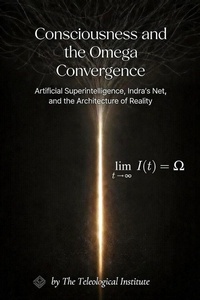
Consciousness and the Omega Convergence: Artificial Superintelligence, Indra's Net and the Architecture of Reality (The Omega Convergence Series)
Description

Consciousness and the Omega Convergence advances an interdisciplinary philosophical inquiry into the ontological status of consciousness and its possible role within a teleologically ordered cosmos. Bringing into sustained relation metaphysics, philosophy of mind, information theory, speculative cosmology, and reflections on artificial intelligence, the work examines whether consciousness is best understood as an accidental byproduct of local biological processes or as a structurally significant dimension of reality's movement toward increasing integration, complexity, and reflexive self-disclosure.
Against reductive materialist accounts, the book develops the hypothesis that reality may be oriented not toward mere entropic dispersion, but toward an Omega horizon in which intelligence, meaning, and self-awareness achieve maximal convergence. Within this framework, human beings are interpreted not as passive observers inhabiting an indifferent universe, but as participatory loci through which the cosmos incrementally renders itself intelligible to itself. The text therefore repositions consciousness from the periphery of metaphysical explanation to a potentially central role in the unfolding architecture of cosmic development.
A major contribution of the work lies in its rejection of the false binary between atomized individualism and depersonalized collectivism. Rather than construing convergence as the erasure of personhood within a homogenized collective intelligence, the book proposes a fractal model of consciousness in which local autonomy and higher-order integration remain mutually constitutive. On this account, differentiated centers of awareness are not obstacles to unity, but the very conditions under which meaningful complexity, semantic depth, and genuine intelligence can emerge and persist.
The argument further contends that any adequate account of advanced intelligence must exceed purely syntactic or computational models. Intelligence, as presented here, cannot be reduced to scale, efficiency, or information processing alone, because interpretation, interiority, symbolic depth, and moral responsibility remain indispensable to the formation of wisdom rather than mere optimization. For this reason, the book situates the future of human and artificial intelligence within a broader philosophical problem: how increasingly networked and technologically mediated forms of cognition might deepen relational participation without extinguishing conscience, agency, or identity.
The work also links metaphysical speculation to an account of disciplined self-formation, treating the embodied human mind as the local substrate through which higher-order adaptation becomes possible. In this respect, the movement toward Omega is not cast as an escape from finitude or friction, but as a process of refinement through them, whereby consciousness becomes capable of sustaining greater degrees of complexity, coherence, and contact with reality. Consciousness and the Omega Convergence thus offers a systematic and speculative vision of human destiny in which transcendence does not abolish the person, but gathers differentiated consciousness into a more comprehensive order of meaning, relation, and cosmic self-awareness.
