

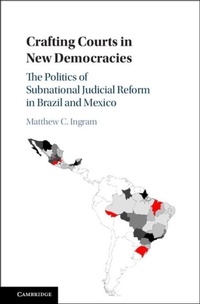
Crafting Courts in New Democracies
The Politics of Subnational Judicial Reform in Brazil and Mexico
Published on 3. December 2015
978-1-316-42696-8 (ISBN)
Description

The role of Latin American courts in facilitating democracy and economic liberalization is considerable. But while national 'high courts' have been closely studied, the form, function, and empowerment of local courts are still not well understood. In Crafting Courts in New Democracies, Matthew C. Ingram fills this gap by examining the varying strength of local judicial institutions in Brazil and Mexico since the 1980s. Combining statistical analysis and in-depth qualitative research, Ingram offers a rich account of the politics that shape subnational court reform in the region's two largest democracies. In contrast to previous studies, theoretical emphasis is given to the influence of political ideas over the traditional focus on objective, material incentives. Exhaustively researched and rigorously presented, this book will appeal to scholars and policymakers interested in the judiciary, institutional change, Latin America, the causal role of ideas, justice reform, and the rule of law.
Reviews / Votes
'Addressing critical questions about the most promising pathways to the establishment of honest and effective judicial systems in post-authoritarian Latin America, Ingram's rigorous, meticulously calibrated study shows that normative beliefs and commitments matter. In a discipline in which many assume ab initio that the only causal forces in politics are power and interest, Ingram scientifically demonstrates that the ideals and convictions of key actors concerning fairness, impartial justice, and the rule of law can have salubrious real-world effects that can potentially overcome retrograde political and material interests. This impressive contribution to the burgeoning 'court-building' literature counsels that, when it comes [to] establishing free, democratic institutions under the rule of law, we should care about the ideational commitments of their leaders, staffers, and supporters - about what they believe, how they think, and who they are.' Ken Kersch, Boston College, Massachusetts 'Matthew C. Ingram's new book is a much anticipated addition to the comparative public law literature. Ingram's project stands out not only for its theoretical innovations concerning judicial reform but also for its empirical contribution in covering two countries and their judicial systems about which we still have a lot to learn. Crafting Courts in New Democracies will prove invaluable for students of Latin American politics as much as for students of political institutions in general and judicial systems and judicial politics in particular.' Udi Sommer, Tel Aviv University 'Scholars of law and courts in the United States often take for granted the institutional integrity and independence of the judicial branch. Some focus on how to maintain judicial independence in the face of perceived or potential threats, and others fret about independent/unaccountable judges having too great a role in deciding fundamental policy issues, but the question of where strong and independent judicial institutions come from is mostly ignored or left to historians. For those who work on new (or renewed) democracies, by contrast, the question of how to construct (or reconstruct) stable, independent judiciaries is of fundamental concern, not just for scholars, but for citizens of those countries seeking to hold public and private actors accountable for legal violations. With Crafting Courts in New Democracies, Matthew C. Ingram offers an innovative and compelling contribution to this important line of research.' Lisa Hilbink, Law and Politics Book Review 'The theoretical scope of the book is ... broad, making contributions to the study of courts, comparative law, and the amplification of court strength while also addressing the literature that closed in on phenomena of uneven development across subnational units.' Jan Boesten, Latin American Research ReviewMore details
Language
English
Place of publication
Cambridge
United Kingdom
Publishing group
Cambridge University Press
Target group
Professional and scholarly
Illustrations
18 Tables, black and white; 10 Maps; 16 Halftones, unspecified; 16 Halftones, black and white; 5 Line drawings, black and white
File size
4385,60 MB
ISBN-13
978-1-316-42696-8 (9781316426968)
Copyright in bibliographic data and cover images is held by Nielsen Book Services Limited or by the publishers or by their respective licensors: all rights reserved.
Schweitzer Classification
Other editions
Additional editions
Matthew C. Ingram
Crafting Courts in New Democracies
The Politics of Subnational Judicial Reform in Brazil and Mexico
Book
11/2015
Cambridge University Press
€89.60
Shipment within 15-20 days
Person
Matthew C. Ingram (J.D., Ph.D., University of New Mexico) is Assistant Professor of Political Science at the University at Albany, State University of New York. His research has been funded by the National Science Foundation, the Social Science Research Council, and the Fulbright Program. Before entering academia, Professor Ingram worked in law enforcement in California.
Content
1. Crafting courts in new democracies; Part I. Theory and Methods: 2. Ideas, interests, and judicial institutions; 3. Methods; Part II. Empirical Analysis: 4. Large-N analysis in Mexico (1993-2007); 5. Large-N analysis in Brazil (1985-2006); 6. Small-N analysis in Mexico: Aguascalientes, Michoacan, and Hidalgo; 7. Small-N Analysis in Brazil: Acre, Rio Grande do Sul, and Maranhao; Part III. Conclusion: 8. Crafting courts in new democracies: beyond Brazil and Mexico; Appendices.
