

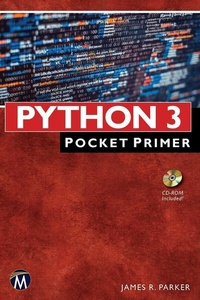
Python 3
The Comprehensive Guide
1st Edition
Published on 18. March 2024
1039 pages
978-1-68392-305-3 (ISBN)
Description

An exhaustive guide to Python 3-covering core concepts, libraries, and real-world applications, including Django, pandas, and NumPy
Key Features
- Offers an all-in-one resource spanning syntax, libraries, and frameworks
- Designed to meet real-world demands across development and data workflows
- Structured for progressive learning from foundations to deployment scenarios
Book Description
This in-depth guide to Python 3 begins by helping readers install the language and understand its core syntax through interactive exploration. Early chapters cover variables, control structures, functions, and data types like lists, tuples, dictionaries, and sets. Readers then move into file handling, error management, and object-oriented programming, building a solid foundation for real-world development. As the journey continues, the book introduces advanced concepts including decorators, generators, type hints, structural pattern matching, and context managers. It thoroughly explores the Python standard library, with practical applications in math, file systems, logging, regular expressions, parallel processing, and debugging. Readers also learn how to manage packages, virtual environments, and distributions. Later chapters shift to applied development-building GUIs with tkinter and PySide6, creating web applications with Django, and working with scientific tools like NumPy, pandas, and SciPy. The book concludes with insights on using alternative interpreters, localization, and migrating from Python 2 to 3. This resource grows with the reader, from basics to expert-level Python programming.What you will learn
- Explore Python syntax, control flow, and core structures
- Implement object-oriented and modular program designs
- Manage files, exceptions, and system-level interactions
- Navigate built-in types like lists, sets, and dictionaries
- Create web, GUI, and network apps using standard libraries
- Apply scientific tools like NumPy, pandas, and matplotlib
Who this book is for
Aimed at developers, data scientists, engineers, and computer science students, this book assumes a basic understanding of programming logic but no prior Python experience. It suits both self-learners and those in formal education or technical professions.
More details
Edition
1. Auflage
Language
English
Place of publication
United States
Target group
Professional and scholarly
US School Grade: College Graduate Student
File size
3,81 MB
ISBN-13
978-1-68392-305-3 (9781683923053)
Copyright in bibliographic data and cover images is held by Nielsen Book Services Limited or by the publishers or by their respective licensors: all rights reserved.
Schweitzer Classification
Other editions
Additional editions
E-Book
06/2025
1st Edition
Packt Publishing Limited
from
€49.19
Available for download
Book
05/2017
1st Edition
Mercury Learning & Information
€39.95
Article not available at the moment
E-Book
04/2017
1st Edition
Mercury Learning and Information
from
€39.95
Available for download
Persons
Parker James R. :
James R. Parker, PhD is a professor of Art and Digital Media at the University of Calgary. His areas of research include computer games and media art, computer simulation, and educational technology. Dr. Parker is the author of Game Development Using Python, 2/E (Mercury Learning) and The Guide to Simulations and Games (Wiley).
Content
1: Computers and Programming.
2: Repetition.
3: Sequences: Strings, Tuples, and Lists.
4: Functions.
5: Files: Input and Output.
6: Classes.
7: Graphic, Media, and Interfaces.
8: Handling Data.
9: Communication Using Python.
Index.
2: Repetition.
3: Sequences: Strings, Tuples, and Lists.
4: Functions.
5: Files: Input and Output.
6: Classes.
7: Graphic, Media, and Interfaces.
8: Handling Data.
9: Communication Using Python.
Index.
