

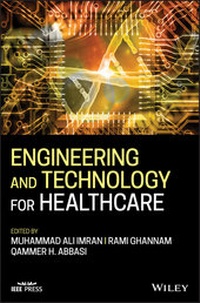
Engineering and Technology for Healthcare
Description

More details
Other editions
Additional editions
Persons
EDITED BY
MUHAMMAD ALI IMRAN, is Dean Glasgow College UESTC, Professor of Communication Systems and Head of Communications Sensing and Imaging group in the James Watt School of Engineering at the University of Glasgow, UK.
RAMI GHANNAM, is Lecturer (Assistant Professor) in Electronic Engineering and head of the Engineering Education Research Group in the James Watt School of Engineering at the University of Glasgow, UK.
QAMMER H. ABBASI, is Senior Lecturer (Associate Professor) and Deputy Head of Communications Sensing and Imaging group in the James Watt School of Engineering at the University of Glasgow, UK.
Content
List of Contributors xiii
Introduction xv
1 Maximizing the Value of Engineering and Technology Research in Healthcare: Development-Focused Health Technology Assessment 1
Janet Boutell Hawkins and Eleanor Grieve
1.1 Introduction 1
1.2 What Is HTA? 3
1.3 What Is Development-Focused HTA? 4
1.4 Illustration of Features of Development-Focused HTA 5
1.4.1 Use-Focused HTA 6
1.4.2 Development-Focused HTA 6
1.5 Activities of Development-Focused HTA 7
1.6 Analytical Methods of Development-Focused HTA 9
1.6.1 Clinical Value Assessment 11
1.6.2 Economic Value Assessment 11
1.6.3 Evidence Generation 14
1.7 What Are the Challenges in the Development and Assessment of Medical Devices? 15
1.7.1 What Are Medical Devices? 15
1.7.2 Challenges Common to All medical Devices 16
1.7.2.1 Licensing and Regulation 16
1.7.2.2 Adoption 17
1.7.2.3 Evidence 18
1.7.3 Challenges Specific to Some Categories of Device 19
1.7.3.1 Learning Curve 19
1.7.3.2 Short Lifespan and Incremental Improvement 19
1.7.3.3 Workflow 19
1.7.3.4 Indirect Health Benefit 19
1.7.3.5 Behavioral and Other Contextual Factors 20
1.7.3.6 Budgetary Challenges 20
1.8 The Contribution of DF-HTA in the Development and Translation of Medical Devices 20
1.8.1 Case Study 1 - Identifying and Confirming Needs 21
1.8.2 Case Study 2 - What Difference Could This Device Make? 21
1.8.3 Case Study 3 - Which Research Project Has the Most Potential? 21
1.8.4 Case Study 4 - What Is the Required Performance to Deliver Clinical Utility? 21
1.8.5 Case Study 5 - What Are the Key Parameters for Evidence Generation? 22
1.9 Conclusion 22
References 23
2 Contactless Radar Sensing for Health Monitoring 29
Francesco Fioranelli and Julien Le Kernec
2.1 Introduction: Healthcare Provision and Radar Technology 29
2.2 Radar and Radar Data Fundamentals 32
2.2.1 Principles of Radar Systems 32
2.2.2 Principles of Radar Signal Processing for Health Applications 35
2.2.3 Principles of Machine Learning Applied to Radar Data 38
2.2.4 Complementary Approaches: Passive Radar and Channel State Information Sensing 41
2.3 Radar Technology in Use for Health Care 42
2.3.1 Activities Recognition and Fall Detection 42
2.3.2 Gait Monitoring 46
2.3.3 Vital Signs and Sleep Monitoring 48
2.4 Conclusion and Outstanding Challenges 50
2.5 Future Trends 52
2.5.1 Paradigm Change in Radar Sensing 52
2.5.2 Multimodal Sensing 55
References 55
3 Pervasive Sensing: Macro to Nanoscale 61
Qammer H. Abbasi, Hasan T. Abbas, Muhammad Ali Imran and Akram Alomainy
3.1 Introduction 61
3.2 The Anatomy of a Human Skin 64
3.3 Characterization of Human Tissue 65
3.4 Tissue Sample Preparation 70
3.5 Measurement Apparatus 70
3.6 Simulating the Human Skin 72
3.6.1 Human Body Channel Modelling 73
3.7 Networking and Communication Mechanisms for Body-Centric Wireless Nano-Networks 76
3.8 Concluding Remarks 78
References 78
4 Biointegrated Implantable Brain Devices 81
Rupam Das and Hadi Heidari
4.1 Background 81
4.2 Neural Device Interfaces 83
4.3 Implant Tissue Biointegration 84
4.4 MRI Compatibility of the Neural Devices 87
4.5 Conclusion 90
References 90
5 Machine Learning for Decision Making in Healthcare 95
Ali Rizwan, Metin Ozturk, Najah Abu Ali, Ahmed Zoha, Qammer H. Abbasi and M. Ali Imran
5.1 Introduction 95
5.2 Data Description 98
5.3 Proposed Methodology 99
5.3.1 Collection of the Data 99
5.3.2 Selection of the Window Size 100
5.3.3 Extraction of the Features 101
5.3.4 Selection of the Features 101
5.3.5 Deployment of the Machine Learning Models 102
5.3.6 Quantitative Assessment of the Models 103
5.3.7 Parallel Processing 104
5.4 Results 105
5.5 Analysis and Discussion 108
5.5.1 Postures 108
5.5.2 Window Sizes 109
5.5.3 Feature Combinations 109
5.5.4 Machine Learning Algorithms 111
5.6 Conclusions 113
References 113
6 Information Retrieval from Electronic Health Records 117
Meshal Al-Qahtani, Stamos Katsigiannis and Naeem Ramzan
6.1 Introduction 117
6.2 Methodology 118
6.2.1 Parallel LSI (PLSI) 119
6.2.2 Distributed LSI (DLSI) 121
6.3 Results and Analysis 122
6.4 Conclusion 126
References 126
7 Energy Harvesting for Wearable and Portable Devices 129
Rami Ghannam, You Hao, Yuchi Liu and Yidi Xiao
7.1 Introduction 129
7.2 Energy Harvesting Techniques 130
7.2.1 Photovoltaics 130
7.2.2 Piezoelectric Energy Harvesting 134
7.2.3 Thermal Energy Harvesting 137
7.2.3.1 Latest Trends 139
7.2.4 RF Energy Harvesting 141
7.3 Conclusions 145
References 146
8 Wireless Control for Life-Critical Actions 153
Burak Kizilkaya, Bo Chang, Guodong Zhao and Muhammad Ali Imran
8.1 Introduction 153
8.2 Wireless Control for Healthcare 155
8.3 Technical Requirements 156
8.3.1 Ultra-Reliability 156
8.3.2 Low Latency 156
8.3.3 Security and Privacy 157
8.3.4 Edge Artificial Intelligence 157
8.4 Design Aspects 157
8.4.1 Independent Design 158
8.4.2 Co-Design 159
8.5 Co-Design System Model 159
8.5.1 Control Function 159
8.5.2 Performance Evaluation Criterion 161
8.5.2.1 Control Performance 161
8.5.2.2 Communication Performance 161
8.5.3 Effects of Different QoS 162
8.5.4 Numerical Results 163
8.6 Conclusions 165
References 165
9 Role of D2D Communications in Mobile Health Applications: Security Threats and Requirements 169
Muhammad Usman, Marwa Qaraqe, Muhammad Rizwan Asghar and Imran Shafique Ansari
9.1 Introduction 169
9.2 D2D Scenarios for Mobile Health Applications 170
9.3 D2D Security Requirements and Standardization 171
9.3.1 Security Issues on Configuration 171
9.3.1.1 Configuration of the ProSe Enabled UE 171
9.3.2 Security Issues on Device Discovery 172
9.3.2.1 Direct Request and Response Discovery 172
9.3.2.2 Open Direct Discovery 173
9.3.2.3 Restricted Direct Discovery 173
9.3.2.4 Registration in Network-Based ProSe Discovery 173
9.3.3 Security Issues on One-to-Many Communications 174
9.3.3.1 One-to-many communications between UEs 174
9.3.3.2 Key Distribution for Group Communications 174
9.3.4 Security Issues on One-to-One Communication 175
9.3.4.1 One-to-One ProSe Direct Communication 175
9.3.4.2 One-to-One ProSe Direct Communication 175
9.3.5 Security Issues on ProSe Relays 175
9.3.5.1 Maintaining 3GPP Communication Security through Relay 175
9.3.5.2 UE-Network Relay 176
9.3.5.3 UE-to-UE Relay 176
9.4 Existing Solutions 176
9.4.1 Key Management 176
9.4.2 Routing 178
9.4.3 Social Trust and Social Ties 178
9.4.4 Access Control 180
9.4.5 Physical Layer Security 180
9.4.6 Network Coding 183
9.5 Conclusion 183
References 183
10 Automated Diagnosis of Skin Cancer for Healthcare: Highlights and Procedures 187
Maram A. Wahba and Amira S. Ashour
10.1 Introduction 187
10.2 Framework of Computer-Aided Skin Cancer Classification Systems 188
10.2.1 Image Acquisition 188
10.2.2 Image Pre-Processing 189
10.2.2.1 Color Contrast Enhancement 189
10.2.2.2 Artifact Removal 190
10.2.3 Image Segmentation 191
10.2.3.1 Thresholding-Based Segmentation 192
10.2.3.2 Edge-Based Segmentation 192
10.2.3.3 Region-Based Segmentation 193
10.2.3.4 Active Contours-Based Segmentation 193
10.2.3.5 Artificial Intelligence-Based Segmentation 194
10.2.4 Feature Extraction 195
10.2.4.1 Color-based Features 196
10.2.4.2 Dimensional Features 196
10.2.4.3 Texture-Based Features 196
10.2.4.4 Dermoscopic Rules and Methods 197
10.2.5 Feature Selection 200
10.2.6 Classification 201
10.2.7 Classification Performance Evaluation 202
10.2.8 Computer-Aided Diagnosis Systems in Dermoscopic Images 203
10.3 Conclusion 205
Acknowledgment 205
References 205
Conclusions 213
Index 215
List of Contributors
Rami Ghannam,
University of Glasgow
Glasgow
UK
Muhammad A. Imran
University of Glasgow
Glasgow
UK
Qammer H. Abbasi
University of Glasgow
Glasgow
UK
You Hou
University of Glasgow
Glasgow
UK
Yuchi Liu
University of Glasgow
Glasgow
UK
Yidi Xiao
University of Glasgow
Glasgow
UK
Guodong Zhao
University of Glasgow
Glasgow
UK
Francesco Fioranelli
Technical University of Delft
Netherlands
Julien Le Kernec
University of Glasgow
Glasgow
UK
Ahmed Zoha
University of Glasgow
Glasgow
UK
Janet Bouttell
University of Glasgow
Glasgow
UK
Eleanor Grieve
University of Glasgow
Glasgow
UK
Neil Hawkins
University of Glasgow
Glasgow
UK
Naem Ramzan
University of West of Scotland
UK
Introduction
Along with Medicine and Law, Engineering is one of the oldest professions in the world. While there is debate regarding the exact definition of engineering, the word engineer derives itself from the Latin word ingenium, which means ingenuity Wall [2010]. In fact, engineering involves the application of science and technology to develop new products, tools, services or processes that can benefit society Crawley et al. [2007]. According to Theodore Von Krmn: "Scientists discover the world that exists; engineers create the world that never was" Mackay [1991]. Consequently, engineers are problem solvers and are responsible for creating the healthcare products that we see today.
During the past two hundred and fifty years, the field of engineering has witnessed several waves of innovation, which have depended on the world's techno-economic paradigm shifts Perez [2010]. Each of the these overlapping waves are approximately 50 years in duration and are also known as the Kwaves. Thanks to the use of iron, waterpower and mechanical constructions, the first of these innovation waves started with the industrial revolution in 18th Century Britain de Graaff and Kolmos [2014]. Now, as we approach the 21st century and the sixth innovation wave, engineers are shifting their interests from the fields of physics, electronics and communications to the interdisciplinary fields of biology and information technology.
Thus, during the past two decades the healthcare industry has seen a rapid transformation. In fact, medical technologies have evolved since the development of the bifocal lens in the early 18th century by Benjamin Franklin. Today, engineers are transforming these contact lenses into healthcare platforms that can monitor vital human signs Yuan et al. [2020]. Consequently, the healthcare field is continuously being reshaped through advances in sensors, robotics, microelectronics, big data and artificial intelligence.
Innovation in healthcare is now a widely researched topic. It is currently a "hot" topic, since it is desperately needed. Without doubt, innovation allows us to think differently, to take risks and to develop ideas that are far better than existing solutions. In this book, we aim to highlight the research that engineers have been engaged in for developing the next generation of healthcare technologies.
Currently, there is no book that covers all topics related to microelectronics, sensors, data, system integration and healthcare technology assessment in one reference. This book aims to critically evaluate current state-of-the-art technologies and will provide readers with insights into developing new solutions.
The book discusses how advances in sensing technology, computer science, communications systems and proteomics/genomics are influencing healthcare technology.
Our book is highly beneficial for healthcare executives, managers, technologists, data scientists, clinicians, engineers and industry professionals to help them identify realistic and cost-effective concepts uniquely tailored to support specific healthcare challenges. Moreover, researchers, professors, doctorate and postgraduate students would also benefit from this book, as it would enable them to identify open issues and classify their research based on existing literature. In fact, these academics need to ensure that their curricula are constantly being revised and updated according to the previously mentioned innovation waves Ahmad et al., Magjarevic et al. [2010], Xeni et al..
Additionally, our book aims to provide in-depth knowledge to stakeholders, regulators, institutional actors, research agencies on the latest developments in this field, which serves as an aid to making the right choices in prioritizing funding resources for the next generation of healthcare technologies. The first chapter deals with Healthcare Technology Assessment (HTA). This chapter focuses on three main topics. The first aims to provide an explanation of the principles of HTA and its familiar role in determining coverage of health care provision. The second involves outlining the challenges of health technology assessment for medical devices. An outline of the main categories of devices will be presented (large capital items, point of care devices, diagnostics, implantables and telehealth) and the difficulties associated with evaluating each of these types of devices. Challenges include licensing and regulation, incremental improvement, evidence generation, short lifespan, workflow, behavioural and other contextual factors and indirect health benefit. Finally, the authors will mention the contribution of HTA in the development and translation of medical devices. They will set out the role of HTA in identifying needs, assessing the potential of technologies in development, aiding design and tailoring evidence generation activities. The chapter will also be Illustrated with appropriate case studies.
Chapter 2 deals with contactless RF sensing, which has recently gained plenty of interest in the domain of healthcare and assisted living due to its capability to monitor several parameters related to the health and well-being of people. This ranges from respiration and heartbeat to gait and mobility, to activity patterns and behaviour. The main advantage of RF sensing is its contactless monitoring capability. Consequently, no sensors need to be worn by the person monitored and no optical images need to be taken via conventional cameras, which can raise problems of privacy especially in private homes. The aim of this chapter is to provide an overview of the most recent different RF technologies for healthcare, including active and passive radar and wireless channel information.
Chapter 3 discusses recent advances in Pervasive Sensing. Here, the vision of nanoscale networking attempts to achieve the functionality and performance of the Internet with the exceptions that node size is measured in cubic nanometres and channels are physically separated by up to hundreds or thousands of nanometres. In addition, these nano-nodes are assumed to be self-powered, mobile and rapidly deployable in and around a specific target. Nevertheless, downscaling the principles of traditional electromagnetic networks to the nanoscale introduces several challenges, both in terms of device technologies and communication solutions. This chapter will shed light on the basic principles of nano-electromagnetic communication in the Terahertz frequency region in the nanoscale dimension.
Moreover, chapter 4 is concerned with providing recent advances in Microelectronics for Brain Implants. This Chapter discusses advances in diagnosis, monitoring, management and treatment of neurological disorders. It will be two parts: first we will discuss our approaches for in vitro diagnostics include lab-on-chip progresses for neurodegenerative diseases such as Alzheimers and Parkinsons diseases. Secondly, we will review our in-vivo implantable medical devices for different applications include treatments of epilepsy and spinal cord. We will conclude this chapter from different perspective including sensing, communications and energy harvesting.
Chapter 5 describes the rationale for using machine learning (ML) techniques for decision making in the healthcare industry. In human physiology, hydration is essential for the proper functioning of multiple systems. Hydration is responsible for controlling various biological reactions by acting as a solvent, a reaction medium, a reactant and a reaction product. Water is the major component of the human body, making it critical for thermoregulation, cell volumes and even for joint lubrication. This chapter will deal with applying machine learning techniques on data collected from a controlled environment for detection of skin hydration levels.
In chapter 6, the authors describe how machine learning techniques can revolutionize medical diagnosis. Single Nucleotide Polymorphisms (SNPs) are one of the most important sources of human genome variability and ML has the potential to predict SNPs, which can enable the diagnosis and prognosis of several...
