

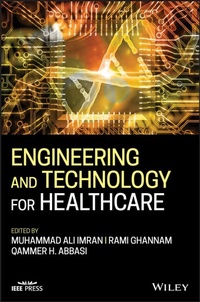
Engineering and Technology for Healthcare
1st Edition
Published on 24. December 2020
Book
Hardback
240 pages
978-1-119-64424-8 (ISBN)
Description
Innovation in healthcare is currently a "hot" topic. Innovation allows us to think differently, to take risks and to develop ideas that are far better than existing solutions. Currently, there is no single book that covers all topics related to microelectronics, sensors, data, system integration and healthcare technology assessment in one reference. This book aims to critically evaluate current state-of-the-art technologies and provide readers with insights into developing new solutions. With contributions from a fully international team of experts across electrical engineering and biomedical fields, the book discusses how advances in sensing technology, computer science, communications systems and proteomics/genomics are influencing healthcare technology today.
More details
Other editions
Additional editions
Muhammad Ali Imran | Rami Ghannam | Qammer H. Abbasi
Engineering and Technology for Healthcare
E-Book
11/2020
1st Edition
Wiley-ISTE
€115.99
Available for download
Muhammad Ali Imran | Rami Ghannam | Qammer H. Abbasi
Engineering and Technology for Healthcare
E-Book
11/2020
1st Edition
Wiley-ISTE
€115.99
Available for download
Persons
EDITED BY
MUHAMMAD ALI IMRAN, is Dean Glasgow College UESTC, Professor of Communication Systems and Head of Communications Sensing and Imaging group in the James Watt School of Engineering at the University of Glasgow, UK.
RAMI GHANNAM, is Lecturer (Assistant Professor) in Electronic Engineering and head of the Engineering Education Research Group in the James Watt School of Engineering at the University of Glasgow, UK.
QAMMER H. ABBASI, is Senior Lecturer (Associate Professor) and Deputy Head of Communications Sensing and Imaging group in the James Watt School of Engineering at the University of Glasgow, UK.
Content
Contributors
1.1. Introduction ix
1.2. Bibliography xv
2. Maximising the value of engineering and technology research in healthcare: development-focused health technology assessment
2.1. Introduction
2.2. What is HTA?
2.3. What is development-focused HTA?
2.4. Illustration of features of development-focused HTA?
2.4.1. Use-focused HTA?
2.4.2. Development-focused HTA?
2.5. Activities of development-focused HTA?
2.6. Analytical methods of development-focused HTA
2.6.1. Clinical value assessment
2.6.2. Economic value assessment
2.6.3. Evidence generation
2.7. What are the challenges in the development and assessment of medical devices?
2.7.1. What are the medical devices?
2.7.2. Challenges common to all medical devices
2.7.2.1. Licencing and regulation
2.7.2.2. Adoption
2.7.2.3. Evidence
2.7.3. Challenges specific to some categories of device
2.7.3.1. Learning curve
2.7.3.2. Short lifespan and incremental improvement
2.7.3.3. Workflow
2.7.3.4. Indirect health benefit
2.7.3.5. Behavioural and other contextual factors
2.7.3.6. Budgetary challenge
2.8. The contribution of DF-HTA in the development and translation of medical devices
2.8.1. Case study 1 - Identifying and confirming needs
2.8.2. Case study 2 - What difference could this device make?
2.8.3. Case study 3 - Which research project has the most potential?
2.8.4. Case study 4 - What is the required performance to deliver clinical utility?
2.8.5. Case study 5 - What are the key param-eters for evidence generation?
2.9. Conclusion
3. Contactless Radar Sensing for health monitoring
3.3.1. Introduction: healthcare provision and radar technology
3.3.2. Radar and Radar Data Fundamentals
3.3.2.1. Principles of radar systems
3.3.2.2. Principles of radar signal processing for health applications
3.3.3. Principles of machine learning applied to radar data
3.3.4. Complementary approaches: passive radar and channel state information sensing
3.4. Radar technology in use for healthcare
3.4.1. Activities recognition and fall detection
3.4.2.Gait monitoring
3.4.3. Vital signs and sleep monitoring
3.5. Conclusion and outstanding challenges
3.6. Future Trends
4. Pervasive Sensing: Macro to Nanoscale
4.1 Introduction
4.2. The anatomy of a human skin
4.3. Chracteristic of human tissue
4.4 Tissue Sample Preparation
4.5. Measurement Apparatus
4.6. Simulating the human skin
4.6.1. Human body channel modelling
4.7. Networking and Communication Mech-anisms for Body-Centric WirelessNano-Networks
4.8. Concluding Remarks
5. Bio integrated Implantable Brain Devices
5.1. Background
5.2 Neural Device Interfaces
5.3. Implant Tissue Biointegration
5.4. MRI Compatibility of the NeuralDevices
5.5. Conclusion
6. Machine Learning for Decision Making in Healthcare
6.1. Introduction
6.2. Data Description
6.3. Proposed Methodology
6.3.1. Data collection
6.3.2. Window size selection
6.3.3. Feature Extraction
6.3.4. Feature Selection
6.3.5. Implementation of Machine learning Models
6.3.6. Model Evaluation
6.4. Results
6.5. Analysis and Discussion
6.5.1. Impact of Postures
6.5.2. Impact of Windows Size
6.5.2. Impact of Feature combination
6.5.3. Impact of Machine Learning algorithms
6.6. Conclusion
7. Information Retrieval from Electronic Health Records
7.1. Introduction
7.2. Methodology
7.2.1. Parallel LSI (PLSI)
7.2.2. Distributed LSI (DLSI)
7.3. Results and Analysis
7.4 Conclusion
8. Energy Harvesting for Wearable and Portable Devices
8.1. Introduction
8.2. Energy Harvesting Techniques
8.2.1. Photovoltaics
8.2.2. Piezoelectric Energy Harvesting
8.2.3. Thermal Energy Harvesting
8.2.3.1. Last Trends
8.2.4. RF Energy Harvesting
8.3. Conclusion
9. Wireless control for life-critical actions
9.1. Introduction
9.2. Wireless Control for Healthcare
9.3. Technical Requirements
9.3.1. Ultra-Reliability
9.3.2. Low Latency
9.3.3. Security and Privacy
9.3.4. Edge Artificial Intelligence
9.4. Design Aspects
9.4.1. Independent Design
9.4.2. Co-Design
9.5. Co-Design System Model
9.5.1. Control Fusion
9.5.2. Performance Evaluation Criterion
9.5.2.1. Control Performance
9.5.2.2. Communication Performance
9.5.3. Effects of Different QoS
9.5.4. Simulation Results
9.6. Conclusion
10. ROLE OF D2D COMMUNICATIONS INMOBILE HEALTH APPLICATIONS: SECURITY THREATS AND REQUIREMENTS
10.1. Introduction
10.2. D2D Scenarios for Mobile Health Applications
10.3. D2D Security Requirements and Standardisation
10.3.1. Security Issues on Configuration
10.3.1.1. Configuration of the ProSe enabled UE
10.3.1.2. Security Issues on Device Discovery
10.3.1.2.1. Direct Request and Response Discovery
10.3.1.2.2. Open Direct Discovery
10.3.1.2.3. Restricted Directory
10.3.1.2.4. Registration in network-based ProSe Discovery
10.3.2. Security Issues on One-to-Many Communications
10.3.2.1. One-to-many communications between UEs
10.3.2.2. Key distribution for group communications
10.3.3. Security Issues on One-to-One Communication
10.3.3.1. One-to-one ProSe direct communication
10.3.3.2. One-to-one ProSe direct communication
10.3.4. Security Issues on ProSe Relays
10.3.4.1. Maintaining 3GPP communication security through relay
10.3.4.2. UE-Network relay
10.3.4.3. UE-to-UE relay
10.4. Existing Solutions
10.4.1. Key Management
10.4.2. Routing
10.4.3. Social Trust and social ties
10.4.4. Access Control
10.4.5. Physical Layer Security
10.4.6. Network Coding
10.5. Conclusion
11. Automated diagnosis of skin cancer for healthcare: Highlights and Procedures
11.1. Introduction
11.2. Framework of Computer-aided Skin Cancer Classification Systems
11.2.1. Image Acquisition
11.2.2. Image Pre-processing
11.2.2.1. Color Contrast Enhancement
11.2.2.2. Artificial Removal
11.2.3. Image Segmentation
11.2.3.1. Thresholding-based Segmentation
11.2.3.2. Edge-based Segmentation
11.2.3.3. Region-based Segmentation
11.2.3.4. Active contours-based Segmentation
11.2.3.5. Artificial Intelligence-based Segmentation
11.2.4. Feature Extraction
11.2.4.1. Color-based Features
11.2.4.2. Dimensional Features
11.2.4.3. Textual-based Features
11.2.4.4. Dermoscopic Rules and Methods
11.2.4.4.1. ABCD Rule
11.2.4.4.2 Menzies Method
11.2.4.4.3 7-Point Checklist
11.2.5. Feature Selection
11.2.6. Classification
11.2.7. Classification Performance Evaluation
11.3. Conclusion
12. Conclusion